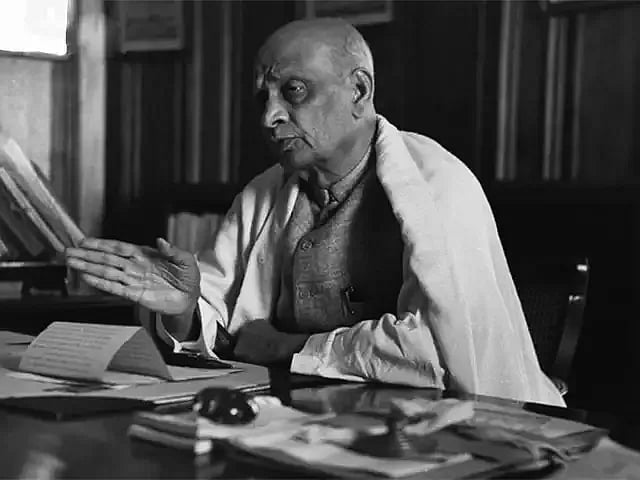
Vallabhbhai Jhaverbhai Patel, popularly known as Sardar Patel, played a key role in the Indian freedom movement and persuaded the princely states to accede to the newly independent India. For this role and commitment towards national integration, Sardar Patel earned the sobriquet 'Iron Man of India'.
Said to have been born on October 32, 1875 in Nadiad, Bombay Presidency, Vallabhbhai Patel went on to become the first deputy Prime Minister of the free republic of India.
In 2014, the government declared his birthday, October 31, as Rashtriya Ekta Diwas (National Unity Day). On his 143rd birth anniversary, the government of India built a 182-metre statue of the “iron man”.
Here are 5 interesting facts about the iron man of India:
Coming from poor family background, Patel was still very much keen on studying. He used to borrow books from senior lawyers to study for his bar examination.
Patel was never interested in joining the freedom struggle during its initial days, nor was he fond of the principles propagated by Mahatma Gandhi. But, after meeting Gandhi in 1917 in Godhra, Gujarat, he was taken with Gandhi’s vision and wisdom and went on to become one of his earliest political lieutenants and close confidants.
Besides being dubbed the Iron man of India, he is also recognized as the “patron saint of India’s civil servants” for having established the modern All India Service system.
He organised relief efforts in the wake of plague and famine in Gujarat's Kheda and after personal contemplation left his ambition as a lawyer and devoted himself completely to the freedom struggle. He was the force behind the 'Gujarat Satyagraha'.
To mark his significance during the independence struggle and his contributions to independent India, Prime Minister Narendra Modi inaugurated the Statue of Unity, a colossal statue of Sardar Vallabhbhai Patel on October 31, 2018. It is 182m high, making it the tallest in the world. The statue was built at a cost of Rs 2,989 crore.
In 1920, Sardar Patel became the President of Gujarat Pradesh Congress Committee and he worked extensively in the following years against alcoholism, untouchability, caste discrimination and empowerment of women in the state.
He rose to the leadership of the Indian National Congress and organised the party for elections in 1934 and 1937 even as he continued to promote the Quit India Movement.
Sardar Patel died on December 15, 1950, at Birla House in Bombay after a massive heart attack. He was awarded the Bharat Ratna.
(with inputs from sources)

