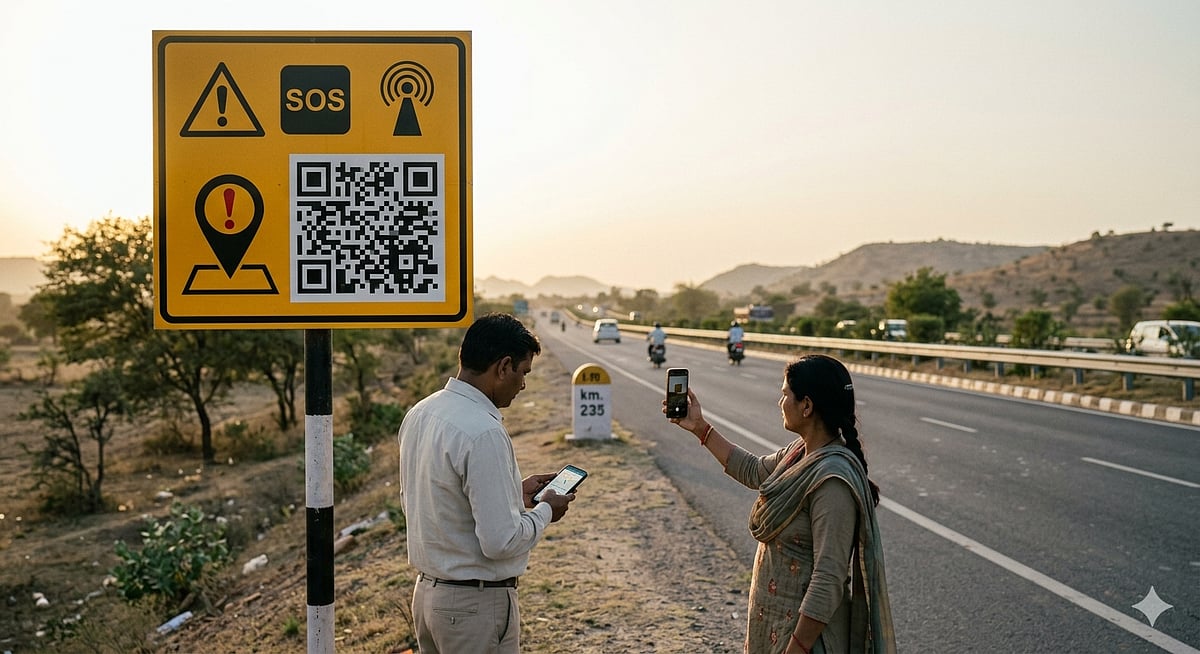
Jaipur: In a bid to make governance easy and accessible, Rajasthan is using QR codes. One can get the information of accident-prone points on highways by just scanning a QR code launched by the Jaipur police. At the same time, the education department of the state has issued a QR code for its employees to lodge complaints and grievances.
As part of the “Mission Safer Road” initiative, the Jaipur police has issued a QR code that will facilitate people getting information about accident-prone points (black spots) on highways passing through Jaipur to Delhi, Agra, Ajmer, or Sikar.
Upon scanning it, all the black spots located across the Jaipur Range national highways will appear directly on the mobile phone screen. Within this QR code system, these accident-prone points have been categorized into three distinct zones. Locations where 10 accidents have occurred over the past three years have been classified as Yellow zones, while 10-20 and above 20 accident locations have been denoted as Orange and Red high zones, respectively.
Police Range IG Rahul Prakash said, "With the objective of reducing road accidents, the ‘Mission Safer Road’ campaign has been launched." Under this initiative, a survey was first conducted at the police station level to identify and categorize ‘black spots’ (accident-prone areas). Prioritizing public safety, Google has also extended its support to this initiative.”
The survey identified 121 distinct “black spots” where, over the last three years, a staggering 1,108 people have lost their lives. Among these, the 6 spots designated as “Red Zones” account for 162 fatalities, while the 37 spots in the “Orange Zone” have witnessed 475 deaths. Similarly, the 78 spots classified as “Yellow Zones” have resulted in the deaths of 471 people.

Also Watch:
Similarly, the Education Department of the state has issued a QR code to enable teachers and staff members to directly convey their grievances to the Additional Chief Secretary (ACS) of the department. By scanning these codes, teachers, staff members, or other concerned individuals can register their grievances online. This will help a workforce of over 500,000 teachers and staff members. There are options for filing 12 different types of complaints ranging from transfers & postings to court cases and other service and school infrastructure issues.
“We will conduct a weekly review of complaints received online. This will reveal which districts are generating the highest volume of complaints and which types of issues are most prevalent,” said Rajesh Yadav, ACS, Department of Education.
