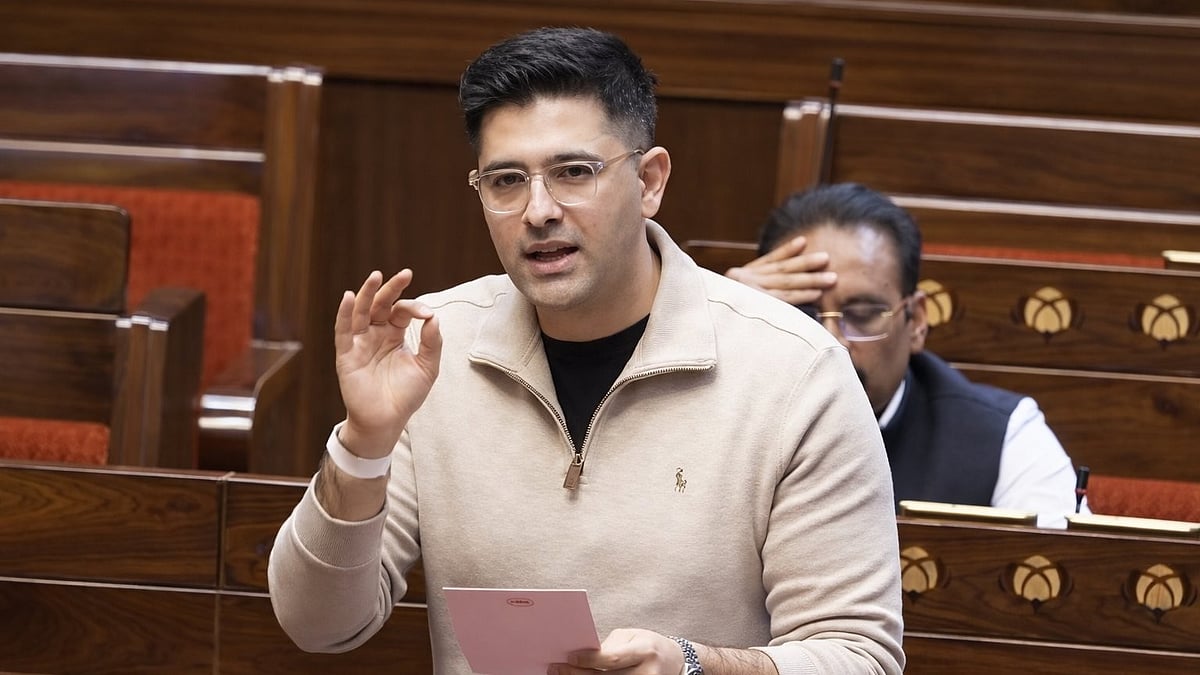
Perhaps in its more than decade-long existence, the Aam Aadmi Party has learnt a hard lesson. The sense of invincibility it enjoyed initially is ephemeral and can quickly transform into a tsunami of shocks. Since its inception, the party’s history has been marked by a series of high-profile departures that have reshaped its political identity.
The most seismic shift occurred in on Friday, when Raghav Chadha, arguably the most recognisable national face of the party after Arvind Kejriwal, led a mass exodus of seven Rajya Sabha MPs to join the Bharatiya Janata Party.
This departure was not merely a resignation but a public indictment of the party's current trajectory, with Chadha lamenting that the organisation he nurtured for 15 years had fundamentally deviated from its founding values to prioritise personal benefit over national interest.
His exit, closely following his removal as AAP's Deputy Leader in the Rajya Sabha along with his fellow MPs, signalled a near-total collapse of the party’s parliamentary strength in the Upper House.
Following is a timeline of high-profile exits from AAP from its inception to the present day:
2026: The Rajya Sabha collapse
The mass resignation of Chadha and six fellow MPs—Sandeep Pathak, Swati Maliwal, Harbhajan Singh, Vikram Sahney, Ashok Mittal and Rajinder Gupta—represents the most significant institutional loss for the party to date.
Chadha’s public statement that he felt like the "right man in the wrong party" highlighted a deep ideological rift that had been brewing for years. This collective move to the BJP effectively stripped the party of its veteran legislative voices and key organisational strategists.
2024 – 2025: Pre-election turmoil and ministerial exits
In early 2025, the party faced a wave of internal dissent when sitting MLAs such as Naresh Yadav, Bhavna Gaur and Rajesh Rishi resigned after being denied tickets for the Delhi Assembly elections.
This followed the high-profile departure of Kailash Gahlot in November 2024, a senior cabinet minister who oversaw the critical transport and home portfolios. Gahlot’s exit was particularly damaging as he pointed to "grave challenges" regarding the party's integrity.
Earlier that same year, Raaj Kumar Anand, the social welfare minister, also quit both the cabinet and the party, citing concerns over corruption and a lack of adequate representation for Dalit communities.
2018 – 2020: Departure of spokespersons and strategists
During this period, the party lost several of its most articulate public faces and strategists. Kumar Vishwas, a founding member and magnetic orator, finalised his long-standing public break from the leadership after years of internal friction.
In late 2019, Alka Lamba resigned from the primary membership to return to the Congress following a public spat over a party resolution. These exits followed a string of resignations in 2018 and early 2019, including senior advocate HS Phoolka, who quit to focus on social work, and former journalists Ashutosh and Ashish Khetan, both of whom had been instrumental in the party’s early communication and policy-making efforts.
2014 – 2015: Initial ideological schism
The first major crisis for the party occurred shortly after its 2015 victory in Delhi when founding members Yogendra Yadav and Prashant Bhushan were expelled. Their departure marked the end of the party’s initial internal "intellectual" collective and prompted the formation of Swaraj India.
This period also saw the exit of Shazia Ilmi, one of the most prominent women leaders from the Anna Hazare era, who cited a lack of internal democracy as her reason for leaving, eventually joining the BJP.

