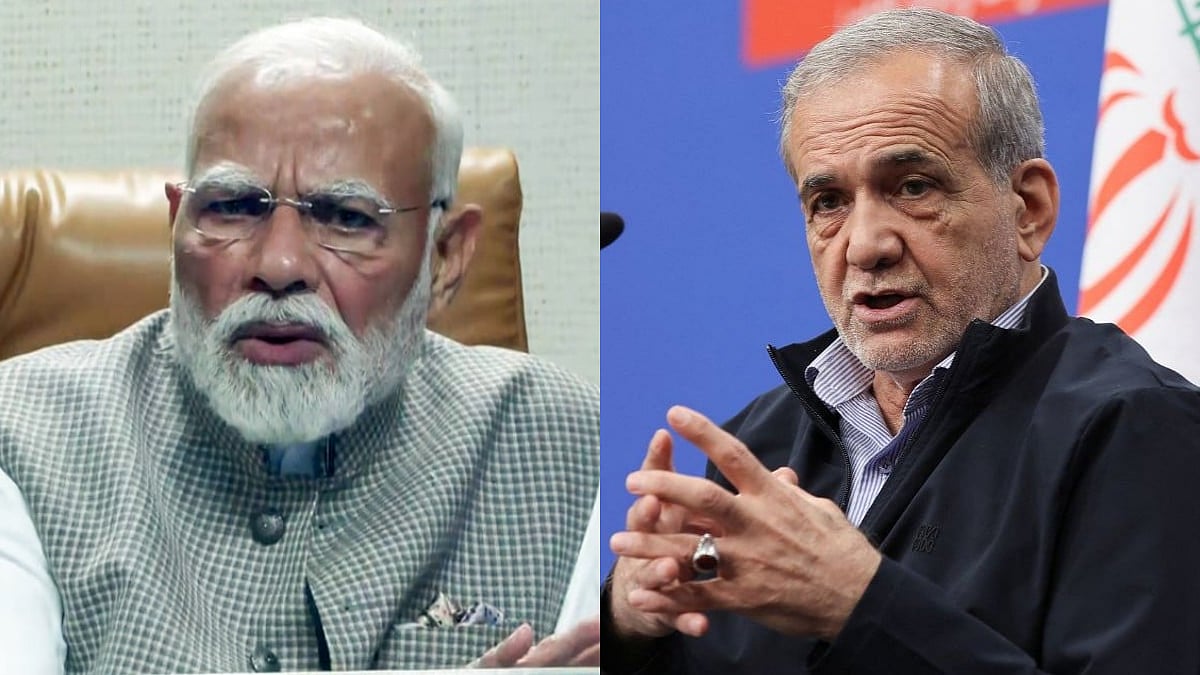
Prime Minister Modi’s conversation with Iranian President Dr. Masoud Pezeshkian highlighted the energy concerns that India was facing due to the ongoing US-Iran war. The call, which was the second time that the two leaders had spoken since the onset of the war, saw him urge the Iranian president to keep shipping lanes open and secure.
“We expressed hope that this festive season brings peace, stability, and prosperity to West Asia. Condemned attacks on critical infrastructure in the region, which threaten regional stability and disrupt global supply chains. Reiterated the importance of safeguarding freedom of navigation and ensuring that shipping lanes remain open and secure. Appreciated Iran’s continued support for the safety and security of Indian nationals in Iran,” the prime minister said in his tweet.
Iran has effectively shut down the Strait of Hormuz, ensuring that New Delhi which is one of the largest importers of oil and natural gas, could be facing a potential energy crisis. Figures shared by the U.S. Energy Information Administration (EIA) showed that about 20.9 million barrels of oil per day, or 27% of the world’s oil was transported through the Strait. The figures also showed that 84-89% of the world’s oil was headed to Asia, with India, China, and South Korea being the main buyers. Coming to India, the country is currently the world’s third largest oil importer, and as for LPG, the country relies on 40% of its gas needs from Qatar.
With these figures, it is not surprising to understand that not just India but the world faces an energy crisis. US Treasury Secretary Scott Bessent said in a post on X that to “enable oil to keep flowing into the global market, the Treasury Department is issuing a temporary 30‑day waiver to allow Indian refiners to purchase Russian oil.” Showing the US’s growing concern over the price of oil, which has surged to $114 a barrel from $63-70 prior to the war, the US Treasury Secretary also went as far as to say in an interview that India could buy Iranian crude which was already at sea.
Energy experts debunk Bessent’s statement. Global energy expert Narendra Taneja states that “over time Indian companies had invested 18 billion dollars in oil and gas assets in Russia. So, the Americans cannot say that we can’t get oil from there because that’s our own oil. These statements are probably made to reassure their own political constituencies back home. For us, our government has made it very clear that we will buy oil from wherever it is available.”
Figures show the difference. According to ship tracking firm Kpler, in December last year, Russian oil imports to India had fallen to below 1 million bpd with Iraq and Saudi Arabia becoming the main suppliers to India. In March this year India has bought an estimated 2.2 million bpd per day. The surge in Russian oil imports is important, but it also raised the questions about how much strategic oil reserves does the country have. “For oil, we have strategic reserves for about 25 days. And we have additional reserves for about roughly say 25 days in tank farms. All refineries have their own tank farms which is roughly 50 days of reserves. But given that we do not want to empty everything, we would be looking at around 40 days of reserves,” says Taneja.
India is currently scrambling to find alternate buyers to make up for the shortfall in oil from the Middle East. The country has increased imports from Russia but has also sharply increased imports from the United States in a bid to diversify imports from the Middle East. Figures show that India imported 6.31 million tonnes of US crude in January-April up from 1.69 million tonnes in the same period in 2024. With this, US oil exports to India went up from 2% to 7%, and it might rise further should the war continue.
While India has strategic reserves for oil, the biggest concern for the country is in cooking gas or LPG. Qatar has regularly provided 40% of India’s LPG needs, and with the war showing no sign of ending, there are few good alternatives for New Delhi. That is because Qatar and Iran have the South Pars/North Dome gas field that accounts for over 20% of the world’s gas reserves. What makes the problem worse for India is that it does not have strategic reserves of LPG for a number of factors: it evaporates, is highly expensive to maintain, and it is also highly flammable.
The problem is exacerbated by India’s growing reliance on LPG. Crisil Ratings stated in a report that LPG consumption in India grew over 44% to 31.3 million metric tons (MMT) in 2025 from 21.6 MMT in fiscal 2017 and estimated it would be 34 MMT in 2026. 60% of this demand is met through imports. India requires an estimated 80,000 tonnes a day which is the equivalent of two Very Large Gas Carriers (VLGC) a day. To put that in perspective, the arrival of the VLGCs Shivalik and Nanda Devi last week - each carrying 46,000 tonnes - would fill India’s LPG needs for little over a day.
Taneja does not forsee a long-term problem. “As far as Qatar’s gas export infrastructure is concerned, only 15% has been impacted (in the Iranian attack) which means that 85% of the export infrastructure of gas and the gas production is intact. Second, let’s note that Qatar has not enforced a force majeure on India (a force majeure is when a supplier suspends contractual deliveries due to extraordinary events). This suggests that it remains ready to export to India.”

While such news is heartening, New Delhi is more than aware that it will need to move away from the Middle East in the long term if it is to secure its oil and gas needs. A first step has been made towards the US. Union Minister for Petroleum and Natural Gas Hardeep Puri stated on November 17 last year that India had achieved a “historic first.”
“In a significant development, Indian PSU oil companies have successfully concluded a 1 year deal for imports of around 2.2 MTPA LPG, close to 10% of our annual imports - for the contract year 2026, to be sourced from the US Gulf Coast - the first structured contract of US LPG for the Indian market,” he tweeted on X. The minister also added in a statement later that the government was also looking at deals with “Norway, Canada, Algeria, and Russia, in addition to available Gulf sources.”
The increased import from the US will not be without pain. The longer shipping distances will add to increased costs for the government and could add to increased costs for the consumer. What is also unclear is how Indian business could weather this. Mumbai’s hospitality industry has been hard hit, with some forecasting that 60% of the city’s restaurants could shut soon. Other impacts are also being seen with migrant workers in Surat leaving their jobs in textile factories to go home as cooking gas costs soar. India has managed the crisis well so far, but it may not be able to shield its citizens from the long-term impact.

