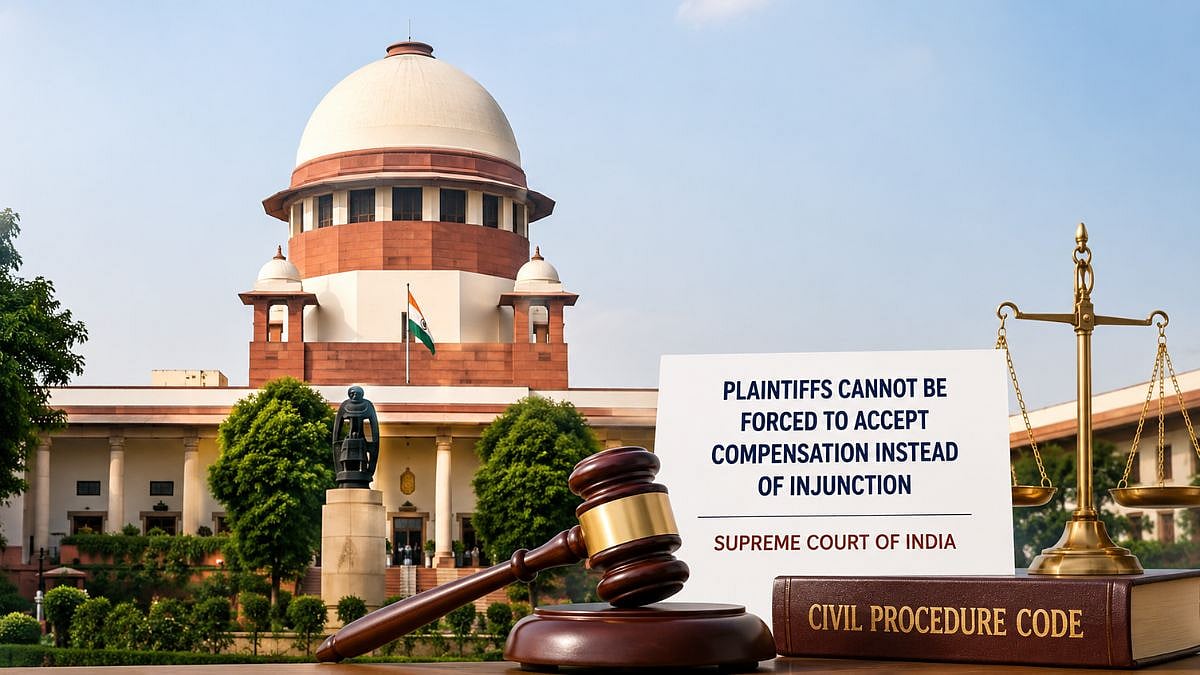
New Delhi, June 22: The Supreme Court has held that courts cannot compel a plaintiff to accept monetary compensation in place of an injunction when no such relief has been sought in the pleadings.
The ruling came as the court set aside a Punjab and Haryana High Court judgment that had replaced decrees directing the removal of alleged encroachments with an award of compensation.
A Bench of Justice S.V.N. Bhatti and Justice Atul S. Chandurkar said it was legally impermissible for an appellate court to grant a relief that was never prayed for by a party.
The court also held that once a decree is set aside, an executing court cannot be asked to decide issues that do not arise from any surviving decree, Live Law reported.
Relief Cannot Be Imposed
The dispute stemmed from two civil suits filed by a plaintiff against certain respondents, seeking the removal of an allegedly encroaching wall and a lintel erected on the wall of his house.
The Trial Court had decreed both suits, directing the removal of the structures and restraining further construction. The first Appellate Court upheld those decrees.
However, in second appeals, the Punjab and Haryana High Court modified the decrees. It directed the defendants to pay compensation and treated the disputed wall as a common wall.
The matter reached the Supreme Court in 2013, which set aside the High Court's decision after finding that no substantial question of law had been framed as required under Section 100 of the Code of Civil Procedure (CPC). The cases were then remanded to the High Court.
Upon reconsideration, the High Court again set aside the decrees and directed the Executing Court to assess the value of the constructions and award compensation to the plaintiffs. Aggrieved by this decision, the legal heirs of the original plaintiff approached the Supreme Court once again.
Executing Court Cannot Fill Legal Gaps
Allowing the appeals, Justice Chandurkar, who authored the judgment, found fault with the High Court's approach on two counts. First, it compelled the plaintiff's legal heirs to accept compensation even though the original plaintiff had never sought damages or compensation in the suits. Second, it directed the Executing Court to determine compensation after setting aside the decrees that had been passed in favour of the plaintiff.
The Supreme Court observed that there was no prayer whatsoever for damages or compensation in the original suits. In such circumstances, the High Court could not substitute the relief granted by the Trial Court and compel the legal heirs to accept compensation, particularly when they had not consented to such a course.
The court further noted that once the decrees passed by the Trial Court had been set aside, no executable decree remained in force. Therefore, there was no basis for the Executing Court to assess the value of the wall or undertake any exercise related to compensation. According to the court, such a direction was not supported by Order XXI of the Code of Civil Procedure, 1908.
Court Reiterates Civil Law Principles
The judgment underscores an important principle of civil law: courts must decide disputes within the framework of the reliefs sought by parties and cannot create entirely new remedies that were never requested.
It also reinforces the limited role of executing courts, which can only act on existing decrees and cannot independently determine rights once a decree has ceased to exist.
Also Watch:

Since the High Court's earlier decision in the second appeals was not based on the merits of the dispute and no substantial question of law had been framed, the Supreme Court directed the Punjab and Haryana High Court to reconsider both appeals in accordance with Section 100 of the CPC. The court also requested that the matters be decided expeditiously, noting that the second appeals have been pending since 2008.
To get details on exclusive and budget-friendly property deals in Mumbai & surrounding regions, do visit: https://budgetproperties.in/
