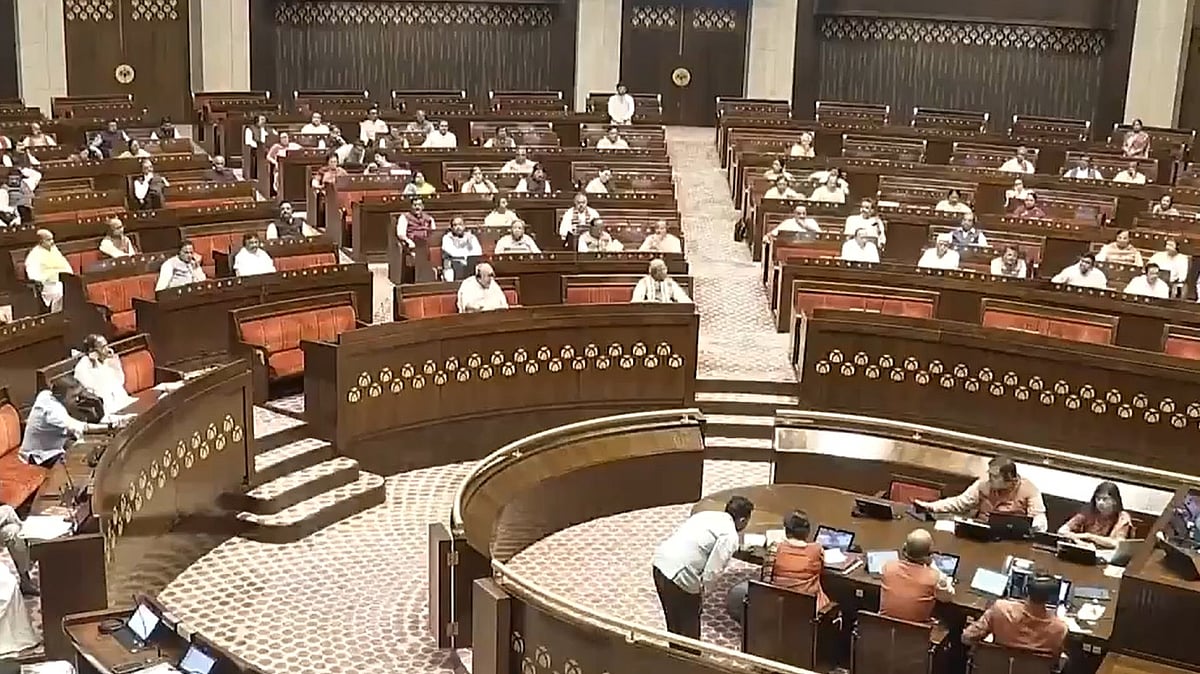
Opposition parties on Thursday criticised the government's proposed amendments to the Public Examinations (Prevention of Unfair Means) Act, 2024, arguing that merely increasing punishments will not stop examination paper leaks unless systemic flaws are addressed.
Participating in the discussion on the Public Examinations (Prevention of Unfair Means) Amendment Bill, 2026, in the Rajya Sabha, several Opposition MPs said the proposed legislation focuses on harsher penalties while failing to spell out measures to prevent leaks in the first place. The Bill proposes stricter punishment of up to 10 years' imprisonment and a fine of ₹50 lakh for those involved in paper leaks.
Tougher penalties or stronger systems?
Chowdry Mohammad Ramzan of the Jammu and Kashmir National Conference said the amendment has been presented as a reform, but in reality, it only enhances punishments and fines. He questioned whether stricter penalties alone could solve the problem, arguing that if harsher punishment were the answer, serious crimes such as murder would have disappeared long ago. He also accused the government of lacking sincerity in tackling paper leaks.
Jharkhand Mukti Morcha MP Mahua Maji echoed similar concerns, saying increasing punishments and penalties has never been enough to eliminate crime. She pointed out that many countries have chosen to strengthen their systems instead of relying solely on harsher punishments.
Shiv Sena (UBT) MP Sanjay Raut described the proposed amendment as the "same old Bill", saying that apart from increasing punishment, nothing substantial has changed. He maintained that the legislation, in its present form, would not produce meaningful results.
Congress MP Mukul Wasnik also questioned the government's approach, saying the Bill talks only about punishment without explaining how paper leaks can actually be prevented. Referring to the large number of pending cases in fast-track courts across the country, he expressed doubt that the proposed amendments would significantly help tackle examination paper leaks, PTI reports.

Government defends tougher law
Defending the amendment, Shiv Sena MP Milind Murli Deora said stricter punishment, higher fines and time-bound adjudication of cases in fast-track courts would help deliver justice to students and act as a deterrent.
Bharatiya Janata Party MP Sudhanshu Trivedi accused the Opposition of politicising students' protests and asserted that the government has framed a stringent law that would discourage criminal elements from engaging in paper leaks. He said the government was adopting "a sensitive approach, secure process and a stringent law" to address the issue.
The debate highlighted the sharp divide between the government and the Opposition, with the former banking on stronger legal deterrence and the latter insisting that lasting solutions will require deeper institutional reforms alongside stricter punishment.

