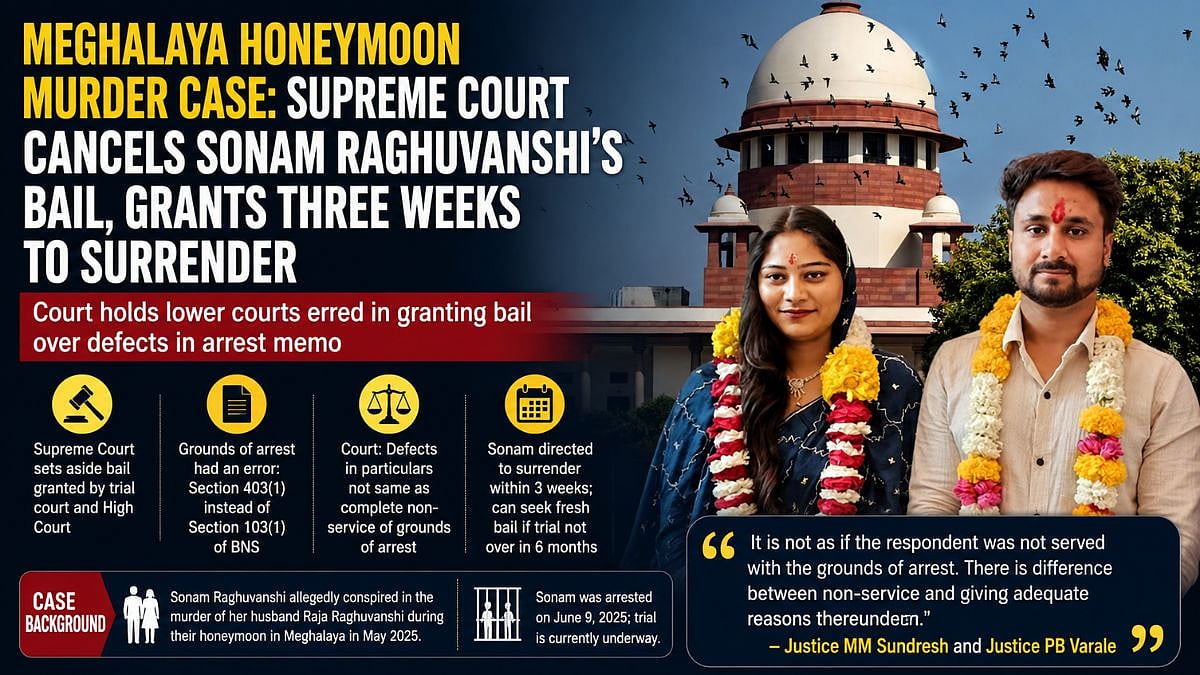
New Delhi, July 23: The Supreme Court on Thursday set aside the bail granted to Sonam Raghuvanshi, the prime suspect in the alleged murder of her husband, Raja Raghuvanshi, during their honeymoon in Meghalaya.
The Court held that both the trial court and the Meghalaya High Court had erred in granting her bail on the ground of alleged defects in communicating the grounds of her arrest.
A Bench of Justice M.M. Sundresh and Justice P.B. Varale, however, granted Sonam three weeks to surrender. The Court also said that if the trial is not concluded within six months, she will be free to file a fresh bail application.
Allowing an appeal filed by the State of Meghalaya, the Bench observed that while serving the grounds of arrest is mandatory under Article 22(1) of the Constitution, the present case did not involve complete non-service of the grounds of arrest, Live Law and Bar & Bench reported.
Arrest Grounds Under Scrutiny
The case centred on an error in the arrest memo. The grounds of arrest referred to Section 403(1) of the Bharatiya Nyaya Sanhita (BNS) instead of Section 103(1).
Relying on an earlier Supreme Court judgment in the Mihir Rajesh Shah case, Sonam had argued that she had not been properly informed of the grounds of her arrest and was therefore entitled to bail. The trial court accepted her argument, and the High Court upheld that decision.
The Supreme Court disagreed with that reasoning, drawing a distinction between complete non-service of the grounds of arrest and defects in the particulars mentioned in the document.
"It is not as if the respondent was not served with the grounds of arrest. There is a difference between non-service and giving adequate reasons thereunder. While the first category might vitiate the arrest, in the second one has to see the prejudice," the Bench observed.
The Court noted that Sonam had acknowledged receiving the grounds of arrest and related documents before the Magistrate, who had also recorded her satisfaction regarding compliance.
It, therefore, declined to examine the validity of the arrest and held that both the trial court and the High Court had wrongly relied on the earlier Supreme Court ruling while granting bail.
The Bench also clarified that even if an arrest is found defective because the grounds of arrest were not properly served, the investigating agency is not prevented from carrying out a fresh arrest during the investigation.
Trial To Continue
While cancelling Sonam's bail, the Supreme Court noted that her earlier bail applications had already been rejected on merits and those orders had attained finality.
"We are also conscious of the fact that bail is the rule and jail is the exception. However, we are dealing with a case where the earlier bail orders rejecting enlargement on merit have attained finality. The trial has already begun. We are inclined to observe that continued enlargement at this stage might hinder the ongoing trial," the Bench said.
The Court directed Sonam to surrender within three weeks while leaving open the option of seeking fresh bail if the trial is not completed within six months.
The Bench also observed that changing social realities were reflected in such cases. It remarked that while the younger generation may have greater access to information, they appear more vulnerable when dealing with pressure.
During the hearing, Solicitor General Tushar Mehta said that young people today have more information but less knowledge. Justice Varale added, "Whatever is being shared on WhatsApp is being treated as knowledge."
Arguments Before The Court
Appearing for Sonam, Senior Advocate Ardhendumauli Prasad argued that only four of the 94 prosecution witnesses had been examined so far. He maintained that the grounds of arrest supplied to his client were incomplete, with none of the relevant boxes in the arrest document being marked and the wrong legal provision mentioned.
Prasad also disputed the State's claim that Sonam had surrendered before the police. Referring to the arrest memo, he argued that it recorded her arrest from a one-stop centre in Ghazipur, Uttar Pradesh, and questioned how she could be treated as having voluntarily surrendered in a Meghalaya case while she was allegedly in another state.
Solicitor General Tushar Mehta, appearing for the State of Meghalaya, argued that Sonam had surrendered before the police and said this fact had been mentioned in the charge sheet from the beginning. He also submitted that earlier Supreme Court rulings on the supply of grounds of arrest did not deal with situations where an accused had surrendered.
The Bench questioned whether Sonam could raise the issue of defects in the arrest after three bail applications had already been rejected on merits. It ultimately found no merit in her arguments and proceeded to cancel the bail granted by the lower courts.
Background Of The Case
According to the prosecution, Sonam Raghuvanshi and her husband, Raja Raghuvanshi, travelled to Meghalaya after their marriage in May 2025 for their honeymoon. Raja was allegedly murdered in East Khasi Hills, and investigators claim his body was thrown into a gorge with the help of three accomplices allegedly hired by Sonam.
Sonam allegedly remained untraceable after the incident and was arrested on June 9, 2025. She was later charge-sheeted for offences including murder, and the trial is currently underway.
In April 2026, the District and Sessions Court in East Khasi Hills granted Sonam bail after holding that the investigating agency had failed to properly communicate the grounds of her arrest.
The Meghalaya government challenged that order before the High Court, which upheld the bail on June 29, observing that the grounds of arrest had been prepared mechanically and contained irrelevant entries.
The State then moved the Supreme Court seeking cancellation of the bail. During an earlier hearing, the apex court had suggested that Sonam surrender while key prosecution witnesses were examined and indicated that her bail could later be reconsidered on merits.
With Thursday's ruling, the Court has now cancelled her bail but left the door open for a fresh application if the trial is not concluded within six months.
Also Watch:

The judgment also reinforces the Supreme Court's view that procedural defects in arrest documents must be examined carefully and cannot automatically result in bail if the accused has otherwise been informed of the grounds of arrest.
At the same time, the Court balanced that position by preserving Sonam's right to seek bail again if the trial is delayed, signalling that speedy justice remains an important consideration.
To get details on exclusive and budget-friendly property deals in Mumbai & surrounding regions, do visit: https://budgetproperties.in/

