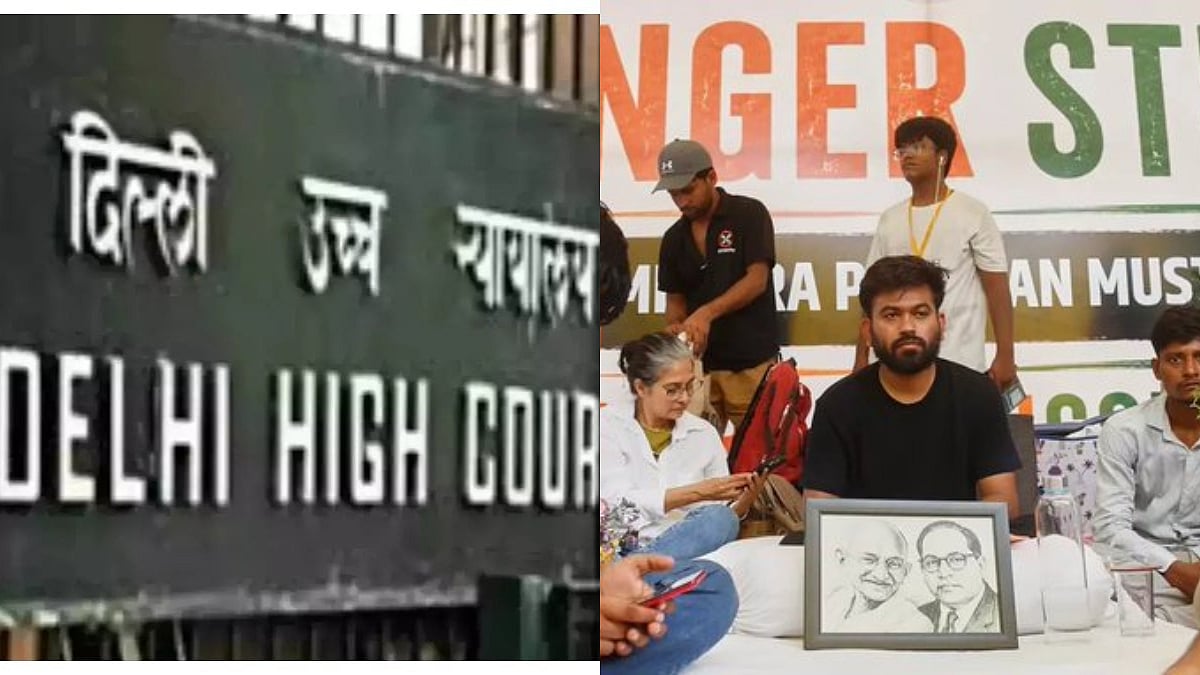
The Delhi High Court on Friday refused to entertain a public interest litigation (PIL) seeking criminal action against those allegedly involved in violence, assault on police personnel and damage to public property during the July 20 student protest at Jantar Mantar.
A Division Bench of Chief Justice Devendra Kumar Upadhyaya and Justice Tejas Karia said the petitioner, NGO Save India Foundation, was free to approach the concerned authorities, who would take appropriate action under the law. The Court observed that the Supreme Court has already laid down the legal mechanism for dealing with cases involving damage to public and private property, Live Law and Bar & Bench report.
Court Relies on Existing Legal Framework
At the outset, the Bench told the petitioner's counsel that the legal position in such matters is well settled. It noted that the mechanism mandated by the Supreme Court is already in place and advised the NGO to submit its grievance before the competent authorities instead of seeking directions through the PIL.
Disposing of the petition, the Court said that if the petitioner submits a representation, it must be considered by the authorities, who should take an appropriate decision in accordance with the law and communicate the outcome to the petitioner.
Plea Sought Police Action Against Protesters
The petition had sought directions to the Delhi Police to identify those allegedly responsible for violence during the protest, prosecute them under applicable criminal laws and recover the cost of damage caused to public property.
According to the plea, the protesters assaulted police personnel, vandalised public property and disrupted normal life in central Delhi, including areas around Parliament and India Gate. It further alleged that the protest was organised by a group identified as the "Cockroach Janta Party" (CJP) and claimed that social media campaigns linked to the group encouraged unlawful acts and mobilisation. The petition also alleged that videos and online material incited participants to defy law enforcement and engage in disruptive activities.
Claims of Wider Conspiracy Raised in Petition
The NGO further alleged that the protesters were following a pattern of civil unrest seen in neighbouring countries such as Sri Lanka, Bangladesh and Nepal by using social media to mobilise people against the government. It also claimed that certain lawyers were offering free legal aid to protesters, encouraging them to violate the law without fear of consequences.
The petition alleged that the campaign had escalated into hate speech, calls to topple the democratically elected government and ultimatums demanding the resignation of the Union Education Minister and the Prime Minister. It urged the Court to direct criminal action against the protesters and issue directions to ensure the safety and security of Delhi residents from violent protests.
Also Watch:
NGO's Litigation History Comes Into Focus
The case also brought attention to Save India Foundation's history of filing PILs before the Delhi High Court. Earlier this year, the Court noted that the NGO had filed 37 PILs and 11 writ petitions between 2024 and 2026, observing that several of them appeared to unnecessarily revisit past issues without serving any larger public interest.
The High Court had also expressed displeasure on earlier occasions over the NGO filing repeated petitions concerning alleged encroachments by mosques, dargahs and waqf properties while commenting on pending matters on social media. During hearings held in January and February this year, the Court had criticised the organisation's approach in such cases.
Court Signals Procedure Over Judicial Intervention
By declining to entertain the PIL, the High Court underscored that existing legal mechanisms should be followed before seeking judicial intervention. Rather than issuing fresh directions, the Bench reaffirmed that allegations of violence and damage to public property should first be examined by the authorities empowered to act under the law.
The order reflects the Court's preference for established legal procedures in matters involving law and order, while leaving the door open for the petitioner to pursue the issue through the appropriate administrative channels.

