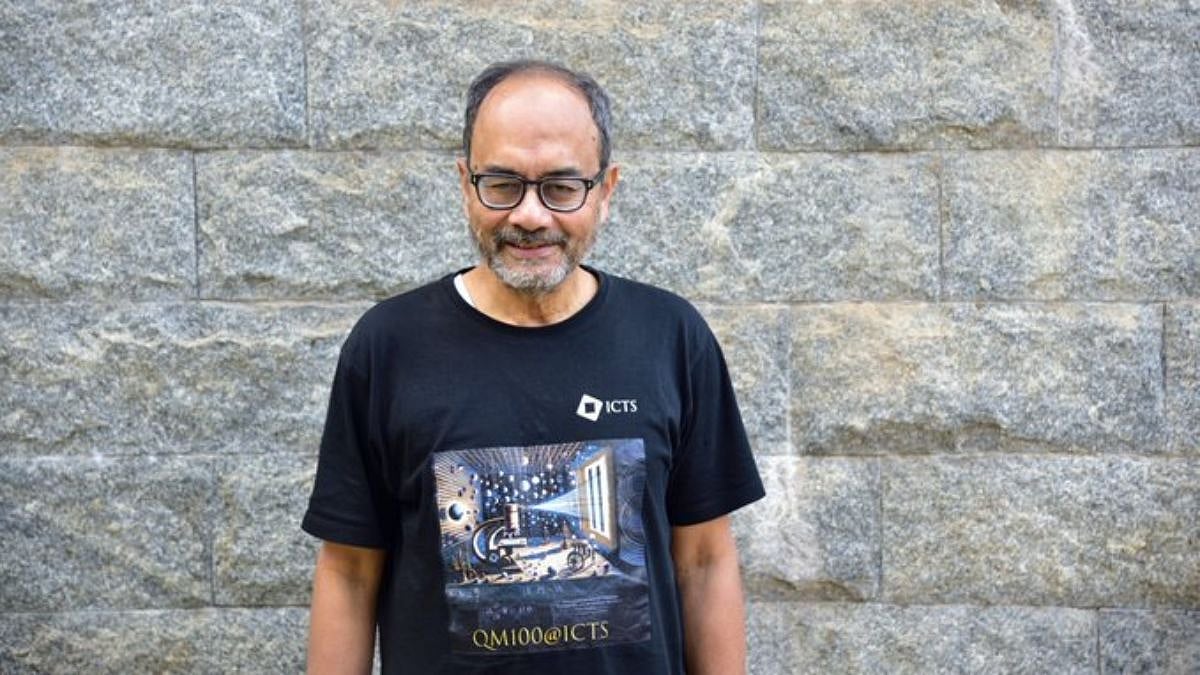
Sen, a renowned physicist and professor at the Bengaluru-based International Centre for Theoretical Sciences (ICTS), has earned global recognition for his contributions to string theory and research on black holes. His latest achievement marks a significant moment for Indian science and highlights the country's contribution to advanced research in physics.
Pioneering Work In String Theory
Sen, who holds the ICTS-Infosys Madhava Chair Professorship, is known for his pioneering research on S-duality, the precise counting of black-hole entropy and string field theory. His work has played an important role in shaping modern string theory.
As part of the recognition, Sen delivered the 2026 Oskar Klein Memorial Lecture, titled Gravity from Strings and Strings from Gravity, at Stockholm University's AlbaNova Centre on October 22, 2026.
A Career Marked By Major Honours
The Oskar Klein Medal adds to Sen's impressive list of national and international achievements. In 2012, he received the Breakthrough Prize in Fundamental Physics for his contributions towards establishing a unifying framework for string theory. He was also awarded the Dirac Medal in 2014.
His other honours include the ICTP Prize in 1989, the Shanti Swarup Bhatnagar Prize in 1994, the Infosys Prize in Mathematical Sciences in 2009, the Padma Shri in 2001 and the Padma Bhushan in 2013. He was also elected a Fellow of the Royal Society in 1998.
ICTS Director Praises Sen's Contribution
Congratulating Sen on the achievement, ICTS Director Rajesh Gopakumar praised his contribution to the institution and its academic environment.
“It has been no less than wonderful having Ashoke with us and setting the tone for excellence here at ICTS,” Gopakumar said.
The recognition reflects Sen's longstanding contribution to theoretical physics and the important role his research has played in advancing the understanding of fundamental scientific concepts.
What Makes The Oskar Klein Medal Special?
Named after Swedish theoretical physicist Oskar Klein, the medal is awarded annually by Stockholm University and the Nobel Committee for Physics of the Royal Swedish Academy of Sciences.
Established in 1988, the award recognises distinguished contributions to physics. Its first three recipients were Nobel laureates Chen-Ning Yang, Steven Weinberg and Hans Bethe, respectively, PTI reports.
Sen's inclusion among such distinguished physicists is a notable achievement for Indian science and underlines the international recognition of his decades of research.

