India has called on United Nations human rights mechanisms to avoid politicisation and selectivity while respecting cultural and historical contexts. New Delhi reiterated its commitment to protecting human rights for all without double standards.
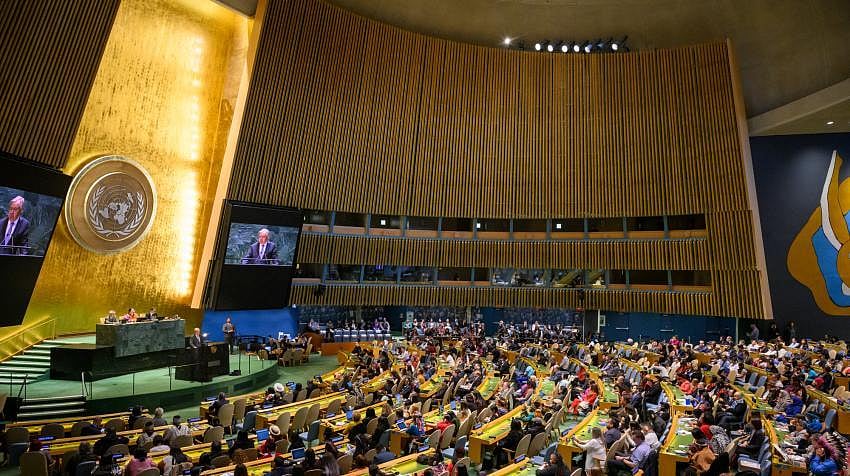
Anuj Swarup, First Secretary at the Permanent Mission of India, made the remarks on Monday during the 81st Session of the United Nations General Assembly (UNGA) Third Committee, while addressing the agenda item ‘Report of the Human Rights Council’.
India Calls For Impartiality In UN Human Rights Mechanisms
Swarup said India would continue working with the UN High Commissioner for Human Rights and the Office of the United Nations High Commissioner for Human Rights (OHCHR) in a “spirit of trust and partnership, as we remain committed to advancing human rights for all without selectivity and double standards”.
“We hope that the UN human rights mechanisms will rise above politicisation and selectivity, respecting cultural and historical context, so that these bodies remain an impartial moral compass for the world,” he said.
His remarks followed India's criticism of the OHCHR over its comments on protests in Delhi. New Delhi had described the observations as “unwarranted” and “unacceptable interference” in its internal affairs.
Last week, the UN human rights office expressed concern over “reports of mass detentions of demonstrators, protest leaders, members of civil society organisations, lawyers and journalists, before and during today’s large-scale demonstrations in Delhi.”
India Highlights Human Rights Record And Welfare Initiatives
Swarup said India's approach to human rights draws on its civilisational values of pluralism and peaceful coexistence.
“As a member of the Human Rights Council, India has engaged constructively in a spirit of dialogue and cooperation,” he said, emphasising the country's commitment to ensuring dignity for every citizen as the world's largest democracy.
Highlighting India's development achievements, Swarup said more than 250 million people had emerged from multidimensional poverty over the past decade, while the country's social protection system covered over one billion people.
He pointed to free food grains for 800 million citizens, free health coverage for 600 million people and 320 million bank accounts for women as examples of India's people-centric development approach.
“India remains committed to promotion and protection of human rights for all, and working with all members to make the Council an effective, objective, and credible body,” he said.
Meanwhile, the UN General Assembly on Tuesday elected 15 countries to the Human Rights Council for the 2027-2029 term. They are Brazil, Burundi, Dominican Republic, Germany, Ghana, Ireland, Japan, Jordan, Kuwait, Nepal, Nigeria, Republic of Moldova, Ukraine, Uruguay and Zambia.

India Rejects UN Report's Claims On Forest Rights
In a separate intervention at the UNGA Third Committee under the agenda item ‘Rights of Indigenous Peoples’, India strongly objected to references concerning unresolved claims under the Forest Rights Act in a UN report.
The report, prepared by Special Rapporteur on the rights of Indigenous Peoples Albert Barume, examined the demarcation, registration and titling of indigenous peoples’ lands, territories and resources.
It stated that “in India, although millions of claims have been submitted under the Forest Rights Act, a substantial number remain unresolved, particularly community claims.”
Rejecting the observation, Swarup questioned the evidence used to support the report's conclusions.
“While the report acknowledges that the Forest Rights Act recognises individual and collective rights, my delegation takes strong exception to the unsubstantiated reference to India in paragraph 42 of the report. The assertion that a substantial number of claims under the Forest Rights Act remain unresolved rests on a single submission by an individual. It is not supported by any official data. Such selective reliance on unverified input calls into question the rigour and objectivity of the report,” he said.
Also Watch:
India Cites Official Data, Offers To Share Updated Figures
Citing official figures, Swarup said more than 5.4 million claims had been submitted under the Forest Rights Act, with over 80% already decided and more than 2.5 million titles distributed.
India also offered to share updated data with the Special Rapporteur “so that such anomalies based on unverified submissions can be rectified.”
Swarup reaffirmed India's commitment to sustainable and holistic development that leaves no community behind, while underscoring its consistent support for protecting and promoting the rights of indigenous peoples.

