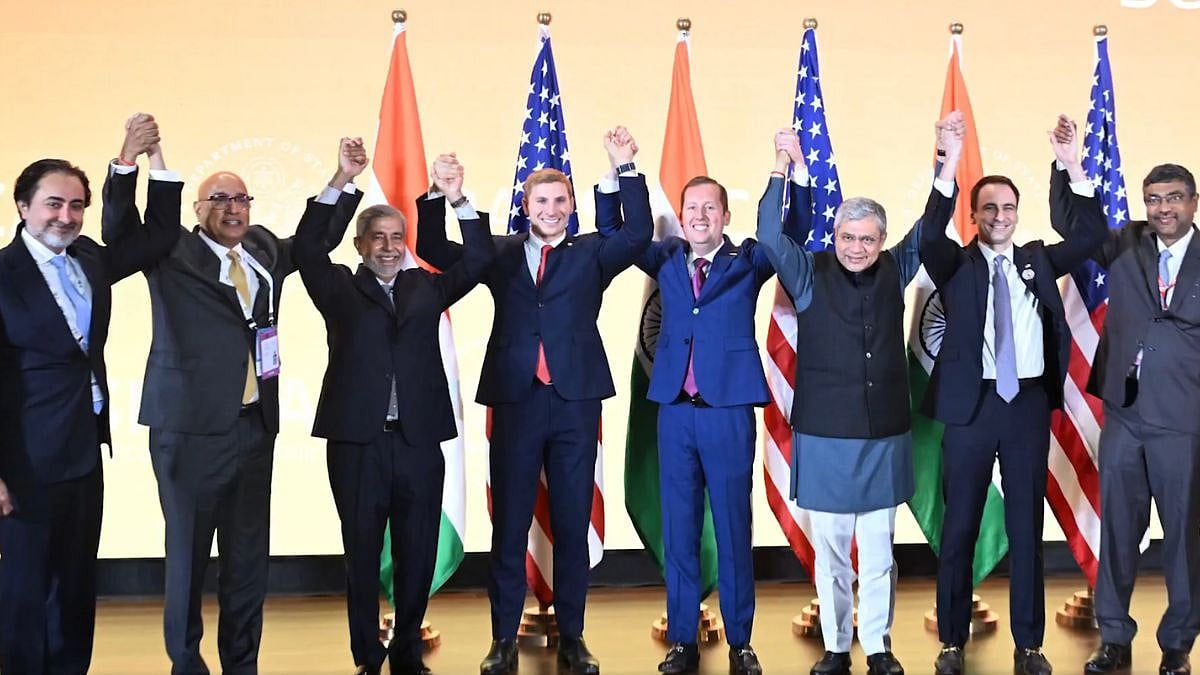
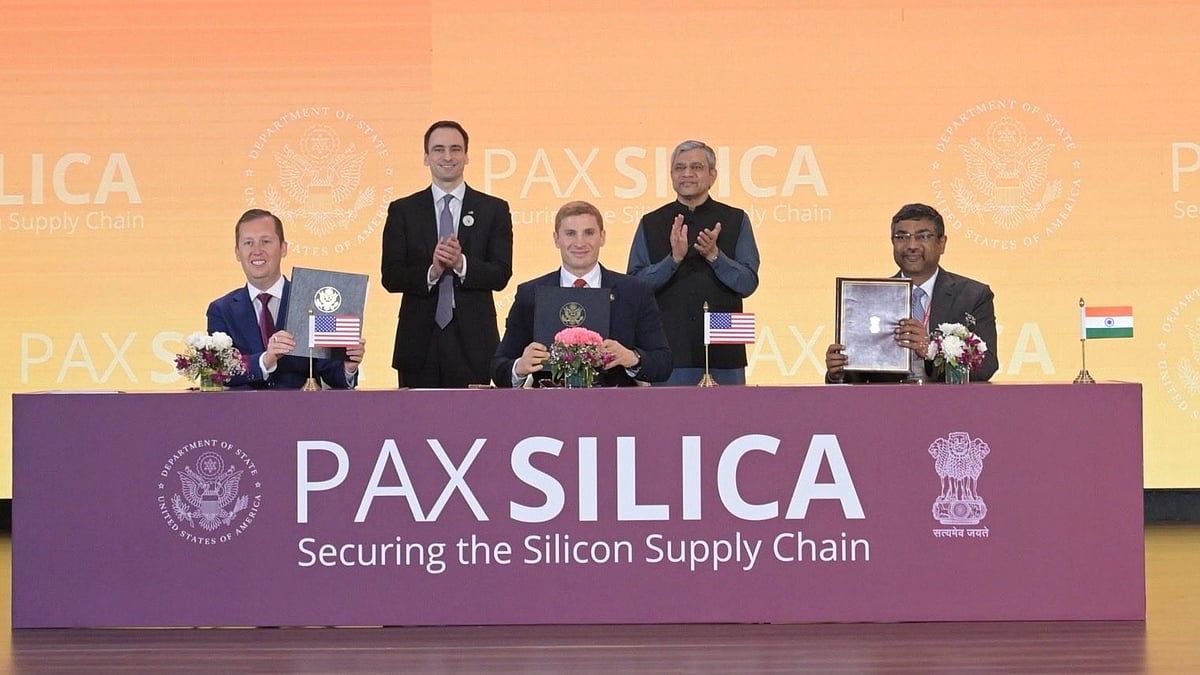
New Delhi: India formally announced its entry into the Pax Silica coalition on Friday. Pax Silica is a US-led strategic initiative formed in December 2025 focused on building secure, resilient supply chains for semiconductors, critical minerals, and artificial intelligence technologies. Currently the group has nine signatories, which include Australia, the UK, Israel and the UAE among others, before India has signed on, and non-signatory participants include the European Union, the Netherlands, and Taiwan. China is not among the signatories.
Speaking just after India had formally signed the declaration in New Delhi, US UnderSecretary Jacob Helberg stated. Pax Silica is our declaration that the future belongs to those who build and when free people join forces, we do not wait for the future to be given to us. We build it ourselves.” Helberg was there at the signing along with the US Ambassador to India, Sergio Gor, while India was represented by S. Krishnan, Secretary, Electronics and Information Technology.
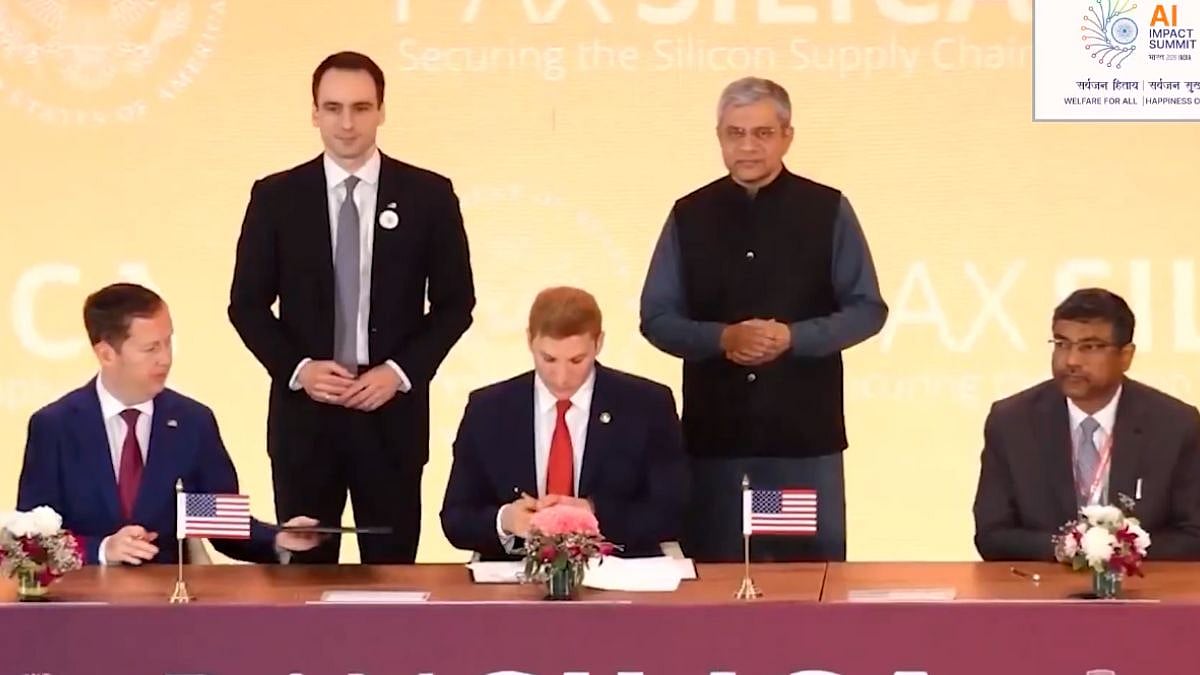
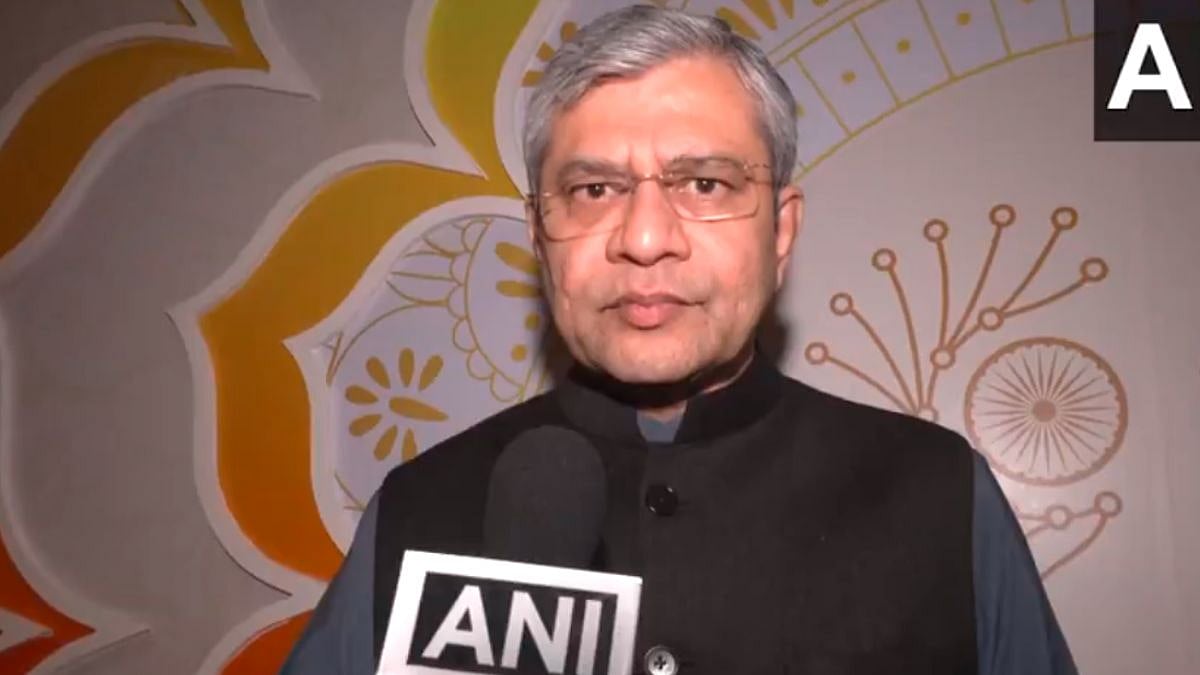
Union Minister of Electronics and Information Technology Ashwini Vaishnaw and Google CEO Sundar Pichai were also present on the occasion. Speaking after the signing, Vaishnaw said in an interview to ANI,“The semiconductor supply chain is very important for the entire world. There is a need for a resilient supply chain. We have seen the kind of disruptions which happened during COVID, and it can also be weaponised. So that's why today the entire world is looking at India as a trusted country.
Our Prime Minister Narendra Modi has positioned India as a trusted country that believes in freedom and democracy...Its a very important historical event for us because our semiconductor industry has evolved very well in the last decade.” A joint statement released by both sides stated that India and the US today acknowledge a “shared vision for innovation ecosystems, highlighting the relevance of the Pax Silica Declaration’s principles to the India-US Comprehensive Global Strategic Partnership and India-US Compact (Catalyzing Opportunities for Military Partnership and Accelerated Commerce and Technology) for the 21st century.”
While Pax Silica has been viewed positively by many nations, China has declared its opposition to the coalition. A report in the Global Times stated that the collaboration was “intended to address deficits in critical mineral access and counter China’s massive investment in its critical minerals and the tech sector.”
The report added that the “move is essentially aimed at decoupling with China in the semiconductor supply chain, a scenario that disrupts the global supply chain” and raises the costs of global chips worldwide. In India’s case the government has made it clear that it was essential for the country to join the coalition. Speaking in an interview to a newspaper, Krishnan said. “I think the important thing is access to the technology and being part of that value chain.”
He added. It's important that the way this technology is built—it's not as if any one country will dominate every part of that value chain. So we need to have a significantly important part in that value chain to make sure that we cannot be ignored.” Not everyone agrees entirely with the government’s view. Syed Akbaruddin, Permanent Representative of India to the UN wrote in an article that it was critical that India was not “outside the semiconductor ecosystem” it was also important to be aware of risks.
“Supply-chain coalitions can become tools of power. Access becomes conditional unless you are in the trusted circle. In a crisis, insiders get protected first, and everyone else discovers that markets do not override politics.” It was imperative, he insisted, that India belong to the first and not the second bloc of nations.”India should exercise caution, especially as President Trump has not shown much regard for its interests to date. As former foreign secretary Kanwal Sibal pointed out, the US president continued to equate India and Pakistan, a point that was made clear when he launched the Board of Peace (BoP).
“Trump wanted the Indian and Pakistani leaders to stand up at the Board of Peace meeting in Washington DC in recognition of the role he played in forcing a ceasefire,” Sibal wrote on X. “Equating India and Pakistan. Distorting the mandate of the Board limited to Gaza. Patronising foreign leaders, treating them with little respect. If we had joined the Board, imagine this kind of exposure to indignity.” One hopes that does not prove to be the case with Pax Silica.

