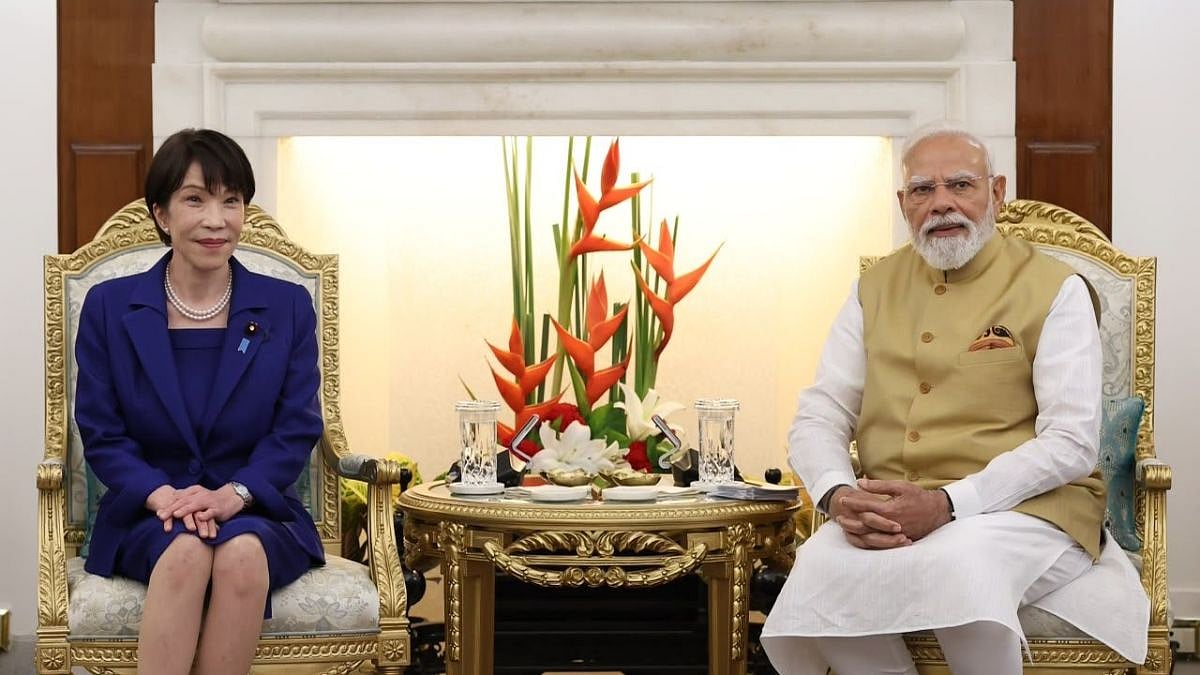
New Delhi: PM Narendra Modi welcomed his Japanese counterpart Sanae Takaichi as she landed in New Delhi on Thursday night. The Japanese leader, making her first trip to India, has come with a 150- strong business delegation for the India-Japan 16th annual summit. Talks were held between the two leaders, post which a number of initiatives were signed in the fields of AI, economic security, and clean energy, among other areas. MEA officials said that the two leaders also exchanged views on regional and global issues.
Speaking at a joint press conference, Modi referred to the Japanese PM as his “younger sister” and lauded the fact that she came from Nara Prefecture, which he stated was “a very important centre of the shared Buddhist heritage of India and Japan.”
He stated that both sides had issued a joint statement on AI saying, “several key institutions within the Indian AI ecosystem have also signed agreements with their Japanese partners.” On the defence front, he added that India and Japan had signed their first-ever co-development defence technology project called the Unicorn Project which he said would open up a new chapter in our defence technology partnership. “Going forward, we will jointly develop defence technologies that strengthen regional peace, maritime security, and the rules-based order.”
Trade was another key area for both sides, with Prime Minister Modi making clear that the India-Japan Investment Partnership continued to grow from strength to strength, with over 100 new business agreements having been concluded over the past year. He stated that India’s goal remained clear: “to attract ten trillion yen of Japanese investment into India over the next ten years and to double the number of Japanese companies operating in India.” Currently, an estimated 1,400 Japanese companies operate in India.
Japan is among the largest investors in India and has many infrastructure projects in the country, the most notable of which is the Mumbai-Ahmedabad high-speed rail project. The country has also financed several phases of the Delhi, Mumbai, and Chennai metros in the country. In the banking sector, Japan’s Sumitomo Mitsui Banking Corporation has acquired a 20% stake in Yes Bank for `13,483 crore ($1.6 billion) This is the largest foreign investment in India’s banking sector.
Speaking at a special briefing post the meeting between the two leaders, Foreign Secretary Vikram Misri described the India-Japan relationship as one of “exceptional trust” adding that trust was the “new currency of global relationships” today. Speaking about the discussions, Misri said that the talks between the two leaders were focused on “economic security, energy resilience, and technology and innovation.”
Misri stated that both sides had issued a joint statement on energy resilience where they agreed to cooperate on “strategic stockpiling and reserve mechanisms for crude oil and petroleum products.” In this regard, he said that both countries had announced today “the Japan-India Cooperative Biogas for Growth Initiative. Under this, Japan will partner with India in setting up 1,000 biogas plants all across India by leveraging the vast network of dairy cooperatives that already exist in India.”
Misri said India welcomed the evolution of the Japanese defence posture as far as defence exports were concerned. He said that the prime minister had suggested that this cooperation could span the entire spectrum of the defence sector from designing to production to manufacturing. “Insofar as specific platforms are concerned, you would have noticed the leaders marking the progress on the major project that is underway right now between the two countries, which is the Unicorn project, which is a naval radio antenna-related project.”
Asked if discussions had taken place between the two leaders about the Quad, Misri said that questions about the Indo-Pacific and the Quad were not the central point of this bilateral summit. However, he added that both leaders had reaffirmed the importance of the Quad and cooperation in the Indo-Pacific. “Insofar as specific engagements are concerned, I would say you should stay tuned because there will be more activities and events related to Quad that will happen in the coming months.”

