How is India's actual power of diplomacy measured when the country which often champions "right" to navigate through international waters ends up requesting for "permission" to do the same.
On March 11, 2026, following a high-stakes phone call between External Affairs Minister S Jaishankar and Iranian Foreign Minister Abbas Araghchi, India secured a specific "transit waiver" for its vessels to pass through the Strait of Hormuz.
This move comes as the Strait—the world’s most critical energy artery—has effectively been "licensed" by Iran following the outbreak of the US-Israel-Iran war on February 28.
Why did India have to ask for permission?
Under international law (UNCLOS 1994), the Strait of Hormuz is an international waterway where all ships enjoy "transit passage." However, since March 4, the Islamic Revolutionary Guard Corps (IRGC) has declared the Strait "closed" to hostile nations.
According to strategic analyst Shanaka Anslem Perera, while China transits freely (as it funds the Iranian war machine) and the West is blocked entirely, India was placed in a vulnerable middle tier. Without this explicit "green light" from Tehran, Indian tankers risked being targeted by Iranian drones or missiles.
What are the specific details of the agreement?
The Jaishankar-Araghchi talks established a protocol that fundamentally alters how India interacts with the region:
~ The notification system: Indian-flagged tankers, such as the Pushpak and Parimal, must now notify Iranian authorities before entering the 33km-wide chokepoint.
~ Targeting immunity: In exchange for this transparency, Iran has guaranteed that these vessels will not be targeted by its "autonomous commands."
~ Limited scope: The waiver is diplomatic. There is no guarantee that the 31 independent IRGC provincial commands—who operate on a decentralised "Mosaic Doctrine"—will always honour a deal made by the foreign ministry in Tehran.
Why China, not Iran, is the actual guardian
While India negotiated its waiver with Tehran, the 2026 crisis has revealed a startling geopolitical shift. Iran holds the weapons, but China manages the traffic. Iran is acting as a "gatekeeper" creating a selective blockade, but China has emerged as the de facto custodian of safe passage.
How China exercises this 'guardianship':
~ Targeted exemptions: As tensions peaked in early March, the IRGC explicitly signalled that Chinese vessels—and those with verifiable Chinese links—enjoyed "Tier One" status. Since February 28, nearly 11.7 million barrels have transited under IRGC protection because Beijing effectively funds the Iranian war machine.
~ China-owner signalling: In a desperate bid for safety, non-Chinese ships have been caught on AIS (Automatic Identification System) data spoofing their identities to read "Chinese owner" or "All-Chinese crew" to avoid being targeted by Iranian autonomous drone swarms.
~ Economic leverage: China’s role as the buyer of 90 per cent of Iran’s oil exports gives it the unique leverage to compel Tehran to keep the gates open. In this crisis, a Chinese "stamp of approval" is more protective than any international treaty.
~ Informational presence: While the US Navy has offered kinetic escorts, China has deployed surveillance vessels like the Liaowang-1. This creates an alternative intelligence apparatus that monitors the Strait, allowing Beijing to broker limited safe passage where Western powers cannot.
Diplomatic paradox for India
This reality reframes the Jaishankar-Araghchi call. India is not merely navigating Iranian sovereignty, but also handling the Sino-Iranian partnership parallelly.
While India’s "multi-alignment" doctrine allows it to reject American conditions on Russian crude, it has forced New Delhi into a position where it must accept a 'licensed' reality managed by its primary regional rival, China. Iran holds the weapon (the blockade), but China exercises the influence to manage the flow.
For India, "taking permission" from Tehran is, in effect, acknowledging China’s role as the new, selective guardian of the world’s most important oil artery.
Where is the "chokepoint" and why is it vital for India?
The Strait of Hormuz lies between Oman and Iran. It is the only sea exit for the Persian Gulf.
~ Energy dependence: Roughly 40 per cent to 50 per cent of India's crude oil and two-thirds of its LNG (Liquified Natural Gas) pass through this narrow gap.
~ The fertiliser crisis: India’s March fertiliser tenders recently went unawarded because cargo ships were afraid to transit, threatening India’s upcoming sowing season.
~ Human stakes: Over 10 million Indian citizens work in the Gulf. Their safety and the remittances they send home are tied to regional stability.
How does this change India’s global diplomatic image?
This event highlights a sharp turn in India’s multi-alignment doctrine. It portrays India as a pragmatic realist rather than a rule-follower of Western international order:
~ Dual dependencies: Last week, India defied the US by buying Russian oil, claiming it "doesn't take orders," when the former insisted on giving permission to New Delhi to buy Russian oil. This week, it accepted Iranian conditions to move that oil, proving it "takes permissions" when the threat is existential.
~ Tiered diplomacy: India has successfully treaded its way into "Tier Two" of the new world order—avoiding the total blockade faced by the West, but lacking the 'protected' status of China.
~ Russian connect: To secure this deal, Jaishankar also consulted with Russia's Sergey Lavrov, suggesting that India is leveraging its ties with Iran’s allies to bypass Western-led maritime security.
What happened to countries that didn't ask?
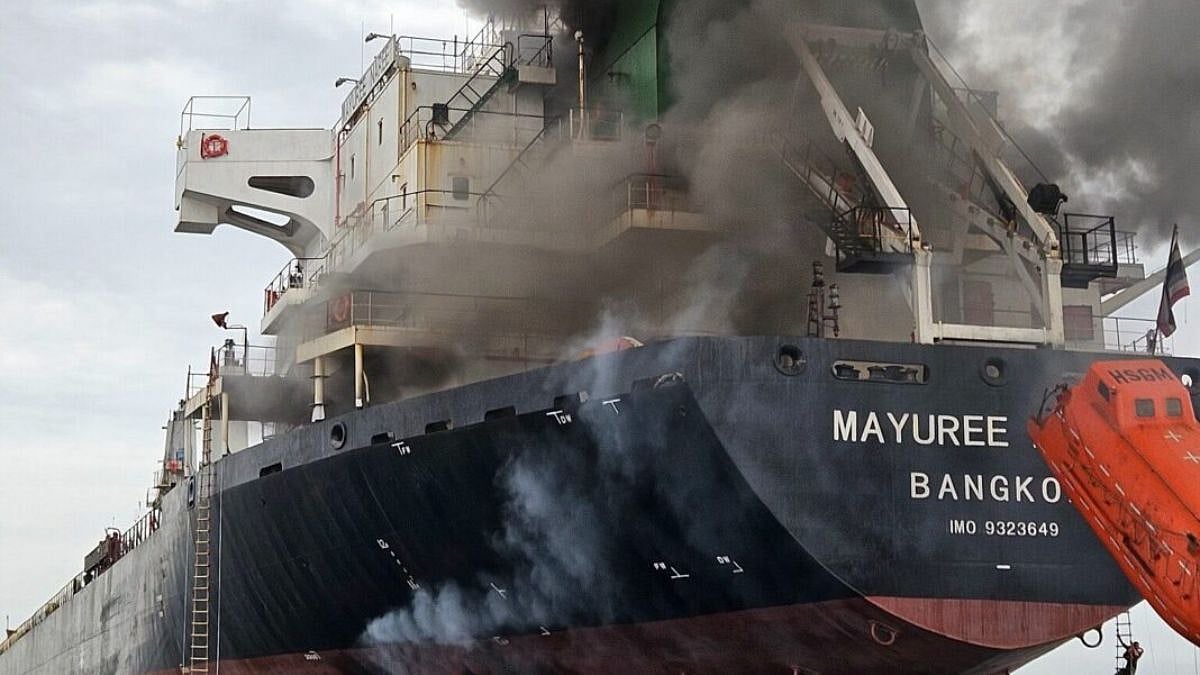
The risk of ignoring this new "licensing" reality was made clear on the same day as the talks. The Mayuree Naree, a Thai-flagged vessel bound for the Kandla Port in Gujarat, was struck by projectiles. Three sailors are missing. Unlike India, Thailand had not negotiated a waiver, leading to its vessel being categorised under "Tier Four"—ships that transit at their own peril.
How is the US responding?
To prevent a total collapse of the Indian economy, the US Treasury (OFAC) issued a 30-day emergency waiver allowing India to receive Russian oil that was "stranded" at sea. This creates a bizarre diplomatic triangle where India is using American legal waivers to buy oil and Iranian military waivers to transport it.
