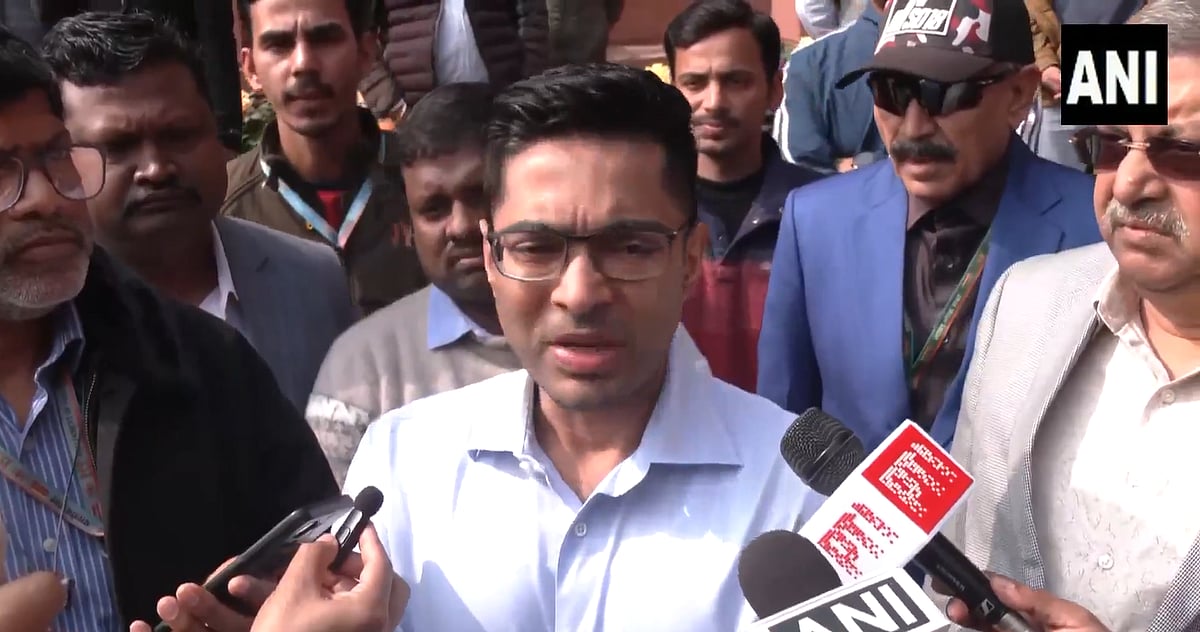
Trinamool Congress (TMC) MP Abhishek Banerjee on Sunday strongly criticised the Union Budget 2026–27, alleging that it ignored West Bengal, farmers, and the country’s youth.
Reacting after Finance Minister Nirmala Sitharaman presented the Budget in Parliament, Banerjee accused the Centre of deliberately sidelining Bengal.
‘Bengal’s Name Not Taken Even Once’
Speaking to reporters, Banerjee said the Budget speech lasted 1 hour and 25 minutes, which he broke down to emphasise his point.
“The Union Finance Minister spoke for 85 minutes, which is 5,100 seconds. In these 5,100 seconds, Bengal’s name was not taken even once,” he said.
He further alleged that the Centre views Bengal unfairly, adding, “Otherwise, why was Bengal not mentioned even once?”
‘No Concrete Plan for Jobs, Farmers’
Targeting the government’s emphasis on technology and innovation, Banerjee said the Budget lacked clarity on employment generation.
“The government keeps talking about AI, Skill India and technological advancement, but there was no concrete discussion on how jobs will be provided to the youth or how employment will be generated,” he said.
He also claimed that farmers were ignored, stating, “There is no financial security for farmers in this Budget.”
‘No Expectations From This Budget’
Banerjee alleged that political considerations influenced the Centre’s spending priorities.
“We had no expectations from this Budget. They knew that even if they spent money in Bengal, they wouldn’t win. So, from their perspective, they have preferred not to spend any money on Bengal,” he said.
‘Centre Sees Bengal as Bangladesh’: Abhishek Banerjee
Escalating his attack, the TMC leader termed the Budget as “faceless, baseless and visionless” and accused the Centre of treating Bengal unfairly.
“The Centre views Bengal as Bangladesh. That is why Bengal has been completely ignored,” he claimed.
The 2026–27 budget presented by Nirmala Sitharaman despite being short speech, Sitharaman outlined a clear fiscal and reform roadmap, with an emphasis on fiscal consolidation, infrastructure-led growth, and strategic manufacturing.
She pegged the fiscal deficit at 4.3% of GDP for FY27, reaffirming the government’s commitment to debt consolidation, while projecting GDP growth of 6.8–7.2% amid global uncertainty.
Capex Push, Self-Reliance at the Core
The Budget continued the government’s strong infrastructure push, with capital expenditure raised to Rs 12.2 lakh crore, alongside new initiatives in high-speed rail corridors, inland waterways, and private infrastructure financing.
Key sectoral announcements included India Semiconductor Mission 2.0, Rs 10,000 crore Bio Pharma Shakti, MSME support funds and incentives for rare earths, container manufacturing and chemical parks reinforcing the Atmanirbhar Bharat agenda.
Sitharaman avoided major populist tax announcements, keeping income tax slabs unchanged, while announcing compliance simplification through the new Income Tax Act, 2025, set to take effect from April 2026.

