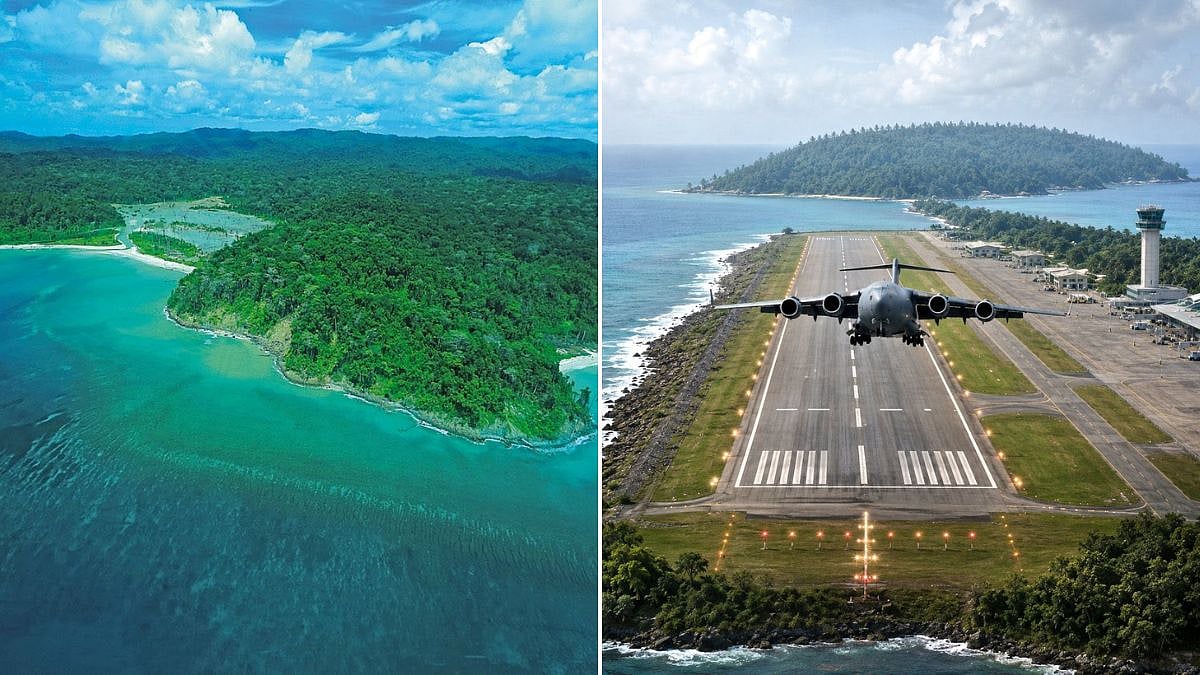
New Delhi: The Centre has approved the construction of a ₹13,000-crore greenfield airport at Chingen near Galathea Bay in Great Nicobar Island, marking a significant strategic shift in India's plans for the Andaman and Nicobar archipelago. The proposed airport, which will serve both military and civilian aviation requirements, will replace an earlier proposal to expand the existing Indian Navy air station, INS Baaz, at Campbell Bay.
The decision forms a critical component of the ambitious ₹81,000-crore Great Nicobar Project, one of the largest infrastructure initiatives currently underway in the country. Conceived as a strategic maritime, logistics and economic hub, the project seeks to leverage Great Nicobar's proximity to one of the world's busiest sea lanes while simultaneously strengthening India's defence posture in the eastern Indian Ocean.
Government and defence sources said extensive studies had concluded that extending the existing 4,500-foot runway at INS Baaz to approximately 10,000 feet was neither operationally nor environmentally feasible. The proposed expansion faced significant challenges arising from terrain limitations, navigational constraints and the need for substantial supporting infrastructure.
Officials also found that runway expansion at Campbell Bay could have a greater impact on tribal settlements, forests and wildlife habitats than constructing an entirely new airport at Chingen near Galathea Bay.
As a result, the government has chosen to pursue a greenfield airport capable of accommodating both civilian and military aircraft, while providing greater flexibility for future expansion.
According to Ministry of Defence sources, the airport will remain under the operational control of the Indian Navy. Airside operations and air traffic control will be managed by the Navy, while the Airports Authority of India (AAI) will oversee civilian passenger terminals and commercial aviation operations.
The project is expected to be completed within five years.
The strategic significance of the decision extends far beyond aviation infrastructure. Great Nicobar occupies a unique position in the eastern Indian Ocean, lying close to the western approaches of the Malacca Strait, one of the world's most critical maritime chokepoints connecting the Indian Ocean with the South China Sea.
A substantial share of global container traffic, international trade and energy shipments traverses these waters. Security planners have long viewed Great Nicobar as a crucial vantage point for monitoring maritime activity and enhancing India's surveillance capabilities in a region increasingly witnessing geopolitical competition.
Officials believe the new airport will significantly improve India's maritime domain awareness, military logistics capability and rapid deployment potential. It will also strengthen India's ability to monitor shipping movements along the East-West international shipping route located roughly 40 nautical miles from the island.

Government officials argue that the project will help reduce India's dependence on foreign transshipment ports while simultaneously strengthening national security infrastructure in a strategically sensitive region.
The latest decision also comes amid a renewed political controversy surrounding the Great Nicobar Project.
Congress leader and Leader of Opposition in the Lok Sabha Rahul Gandhi recently criticised the project during a visit to the Andaman and Nicobar Islands and through a post on social media platform X. Gandhi questioned the government's assertion that the project was driven primarily by defence considerations.
Government and defence sources, however, reject the suggestion that the project is primarily commercial in nature. They maintain that strategic imperatives have been central to planning from the outset. Officials point to growing geopolitical competition in the Indo-Pacific and the need for India to enhance its military reach, surveillance network and logistical capabilities in the region.
Sources further emphasise that environmental clearances were granted after detailed assessments and that only a small proportion of the island's total area would be utilised for the project. They also argue that the decision to abandon the INS Baaz expansion itself demonstrates that environmental and ecological considerations were taken into account during the planning process.
For the government, the new airport represents far more than an aviation facility. It is envisioned as a strategic asset that will anchor India's maritime ambitions in the eastern Indian Ocean, support military operations near one of the world's busiest shipping corridors and provide the critical infrastructure necessary for transforming Great Nicobar into a major economic and security hub.

