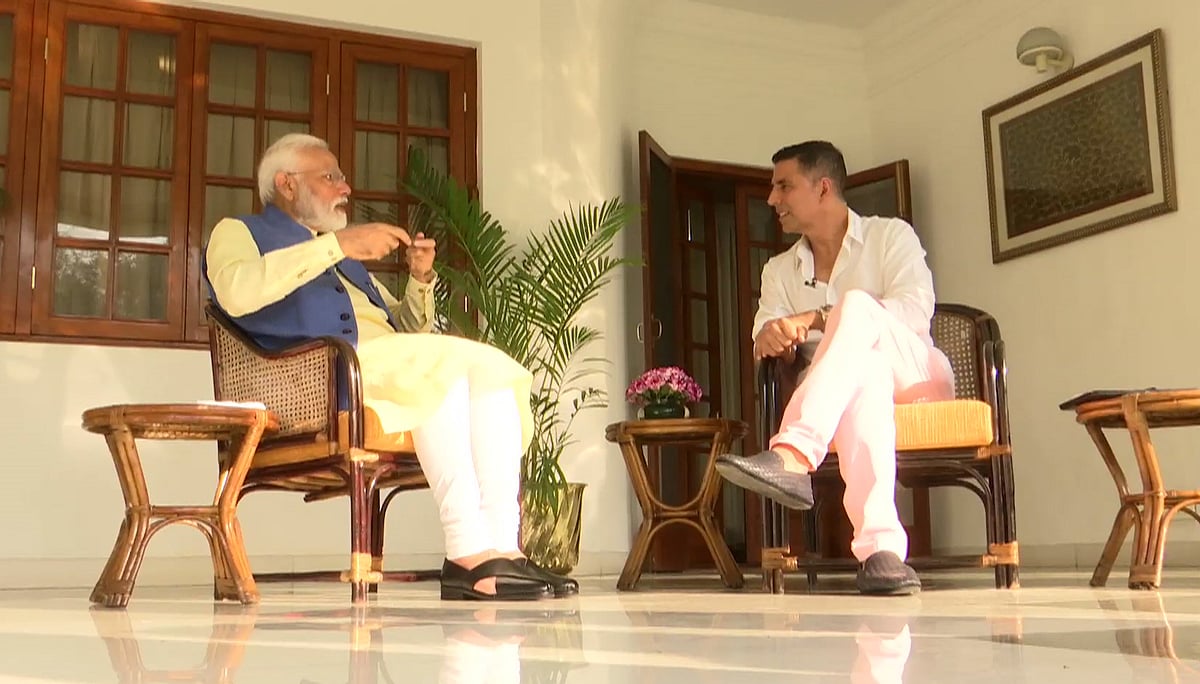
Indian politics is witnessing a shift from traditional rallies to celebrity-led interviews. From Bollywood to Marathi cinema, actors are now hosting politicians in casual, scripted conversations that focus more on image than accountability. While these interviews create emotional appeal and massive digital reach, they often sideline tough questions, blurring the line between entertainment, PR, and serious political discourse.
Is the trend of celebrities interviewing politicians a genuine emotional connection with voters, or a calculated move to divert political discourse?
Indian politics has witnessed numerous shifts over the decades. There was a time when fiery speeches at massive rallies and the roar of party workers were the primary tools of campaigning. Today, however, politics has entered the era of 'Content Creation' and 'Image Consultancy.' Amidst the hustle of the Maharashtra civic elections, we are seeing a new 'pattern' adopted by everyone from Chief Minister Devendra Fadnavis to other top leaders: the celebrity-hosted interview. From Bollywood's Akshay Kumar to Marathi cinema's Tejashri Pradhan, Girija Oak, and Mahesh Manjrekar, the trend of actors interviewing politicians has become firmly established. Moving away from the dust of political rallies, these 'non- political' chats conducted over cups of tea in air-conditioned halls are being used to cast a spell on the minds of voters.
Psychological warfare: ‘How do you eat mangoes?’
When an actor asks a leader, “How do you eat mangoes?”, “What do you do to de-stress?” or “Why are the roads delayed?”, the question isn’t born out of mere curiosity. Behind it lies a subtle form of Psychological warfare.
The ‘halo effect’ and psychology
When a popular actor or actress interviews a leader with visible respect, the leader’s image is automatically polished in the minds of the audience. This is not just entertainment; it can be a sophisticated form of ‘soft propaganda.’
Journalism vs celebrity dialogue: The accountability gap
Journalism is considered the fourth pillar of democracy, and its primary job is to hold those in power accountable. However, in celebrity interviews, this accountability is often missing.
The scripted narrative:
Journalists ask follow-up questions and can quickly spot inconsistencies in a leader’s response. In contrast, celebrity interviews are often scripted. Everything from camera angles to the final edit is designed to present the leader as 'larger than life.’
Sidelining burning issues:
Issues like inflation, unemployment, lack of infrastructure, or stalled projects are rarely raised by celebrities. Even if they are, they remain superficial, allowing the leader to easily manage the narrative.
In a democracy, the question "Why are the roads delayed?" should carry more weight than "How do you eat mangoes?" When artists take the place of journalists, the vital element of cross-examination disappears.
The new equation of Marathi cinema and politics
Previously, artists maintained a distance from politics. However, examples like Amol Kolhe, Aadesh Bandekar, Subodh Bhave, and Riteish Deshmukh show that the line between entertainment and politics has blurred. For artists, this is an opportunity to build a distinct social identity; for leaders, it is a ‘shortcut’ to leverage the actor’s massive popularity. Regardless of the party or leader, these are not just casual chats but well-designed PR campaigns. Using professional lighting, cinematic camera angles, and background music, the leader is presented like a cinematic hero.
The digital impact
The response to these ‘non-political’ interviews on social media is staggering. Views on platforms like YouTube and Facebook reach into the millions.

Also Watch:
Emotional manipulation of voters?
Should politics be based on logic or emotion? Celebrity interviews pull at the heartstrings of the electorate. When an actress narrates the story of a Chief Minister’s personal struggle, voters may begin to overlook administrative failures in favor of personal sympathy. This is a clever political tactic. The younger generation, which values social media reels and glamour over traditional political news, is particularly susceptible to being influenced by such content.
The verdict
There is nothing wrong with wanting to know about a leader’s private life. However, when this personal information is used as ‘branding’ during election season, voters must be cautious. While it is welcome for leaders to engage with the public, a major star interviewing a politician often serves as a conduit for the leader’s scripted answers rather than a voice for the people’s questions. If you want to understand the leader as a human being, a celebrity interview is excellent; but if you want to judge them as a public representative, a journalistic interview remains the only effective tool.

