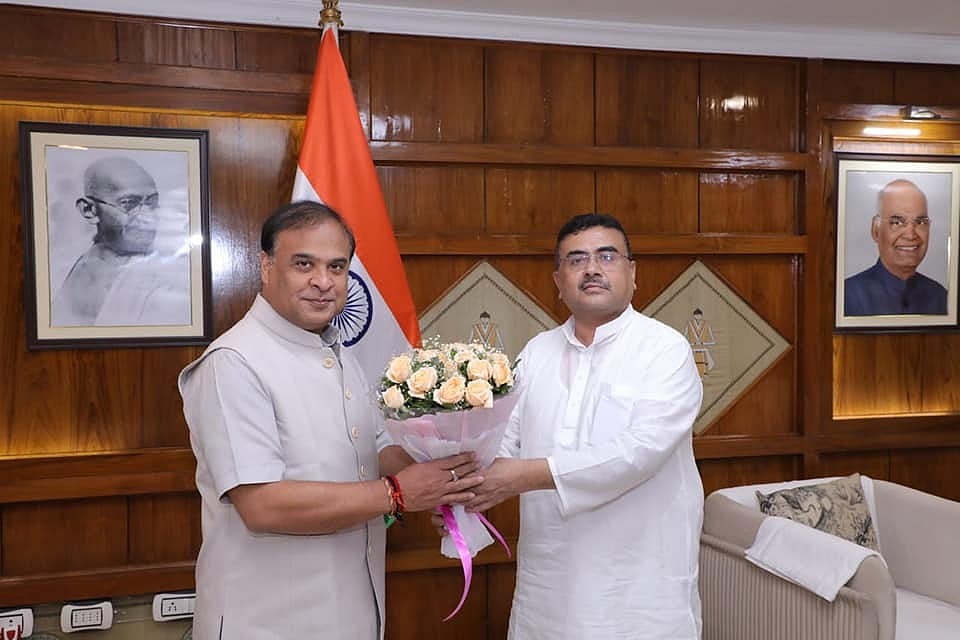
Conclusion of the 2026 Assembly elections has codified a new political reality in eastern India, marking the zenith of a decade-long strategic project by the BJP. While Himanta Biswa Sarma has secured a historic third consecutive term in Assam with a commanding 102-seat mandate for the NDA, Suvendu Adhikari has achieved a paradigm shift in West Bengal, steering the saffron party to its first-ever majority with 206 seats.
The striking parallels between their journeys—from indispensable regional lieutenants to the primary architects of the BJP’s eastern arc—offer a compelling study in modern Indian power dynamics.
Anatomy of 'Number Two'
Both Adhikari and Sarma emerged from the same political crucible. They were the quintessential "troubleshooters" and organisational engines for formidable regional leaders.
In Assam, Sarma was the vital force behind Tarun Gogoi’s Congress government, holding critical portfolios like health, education and finance maintaining the party’s pulse. In West Bengal, Adhikari was the grassroots general for Mamata Banerjee, the man who practically delivered the Nandigram movement that ended 34 years of Left rule and birthed the Trinamool Congress era.
Their rise within their original parties created a specific structural tension. Both leaders possessed a "pan-state" reach that eventually rivalled their mentors. This positioned them as natural successors, yet both hit a glass ceiling created by the rise of dynastic heirs—Abhishek Banerjee in the TMC and Gaurav Gogoi in the Congress.
Their eventual defections to the BJP (Sarma in 2015, Adhikari in 2020) were not merely changes in party colour but the migration of entire regional political ecosystems.
Strategy of giant-killer
The BJP’s reliance on these leaders stems from their unique ability to bridge the gap between national ideology and local identity. Sarma and Adhikari did not just join the BJP. They brought the "manual" on how to defeat their former mentors. Sarma’s masterstroke was the creation of the North East Democratic Alliance (NEDA), which systematically dismantled the Congress' safe zone in the Northeast.
Adhikari’s impact, however, has been more visceral, characterised by the systematic dismantling of a chief minister’s personal geography. The 2026 results highlight a symbolic collapse of the Banerjee legacy. Mamata often referred to her constituencies as family, calling Bhabanipur her 'elder sister' and Nandigram her 'middle sister'.
Five years ago, she ventured into Adhikari’s turf in Nandigram and was defeated by the 'middle sister'. In 2026, the tables turned completely. Adhikari entered the fray in Bhabanipur—and the "daughter of the house" lost in her own home. While his 2021 victory in Nandigram was by a narrow margin of 1,956 votes, his 2026 victory in Bhabanipu was a landslide of over 15,000 votes. By defeating her on her own home turf, Adhikari did not just win a seat, he shattered an aura of invincibility.
Convergence in governance and rhetoric
As the 2026 mandates take effect, a shared governance model is emerging. Sarma has perfected a blend of aggressive cultural assertion—often centring on identity and indigenous anxieties—paired with a hyper-efficient "Direct Benefit Transfer" (DBT) welfare machinery. This 'Sarma Model' proved that the BJP could win without relying solely on a 'Modi Wave' by building a robust, localised executive image.
Adhikari is following this blueprint with sharp ideological clarity. Upon accepting his victory certificate for Bhabanipur, he dedicated the win to those who "gave their lives for Hindutva," declaring that Banerjee’s "political retirement is complete."
This mirrors Sarma’s trajectory in Assam, where he combined administrative ruthlessness with a clear ideological mandate to consolidate the party’s core base while delivering governance. Both leaders have shown an ability to attract transfer votes from the opposition—Adhikari notably acknowledged that thousands of traditional CPM voters backed him in Bhabanipur to ensure the TMC's defeat.
Future challenges
The consolidation of power under Sarma and Adhikari marks the completion of the BJP’s long-term 'Look East' political project. From the Brahmaputra to the Hooghly, the party now controls the strategic border states that define India’s eastern security and economy.
However, the challenges ahead are distinct.
For Sarma, a second term as chief minister is a test of managing the complexities of tribal identities and the fallout of delimitation, all while maintaining the engine of development. For Adhikari, the task is more foundational transitioning a party built on anti-TMC sentiment into a cohesive governing body in a state with a deeply entrenched, often volatile, political culture.
Redefining BJP’s internal DNA
The rise of Suvendu Adhikari and Himanta Biswa Sarma represents a shift in the BJP’s internal DNA. The party has moved toward empowering 'converted' regional heavyweights who command their own loyalists and possess a deep understanding of local sensitivities.
While their methods—often polarising and intensely combative—draw criticism from opponents, their results in 2026 are indisputable. They have successfully synthesised the BJP’s nationalistic core with a localised, results-oriented 'strongman' leadership that has fundamentally redefined the politics of eastern India. For the first time since Independence, the eastern arc is not just a strategic goal for the BJP, but a political reality.

