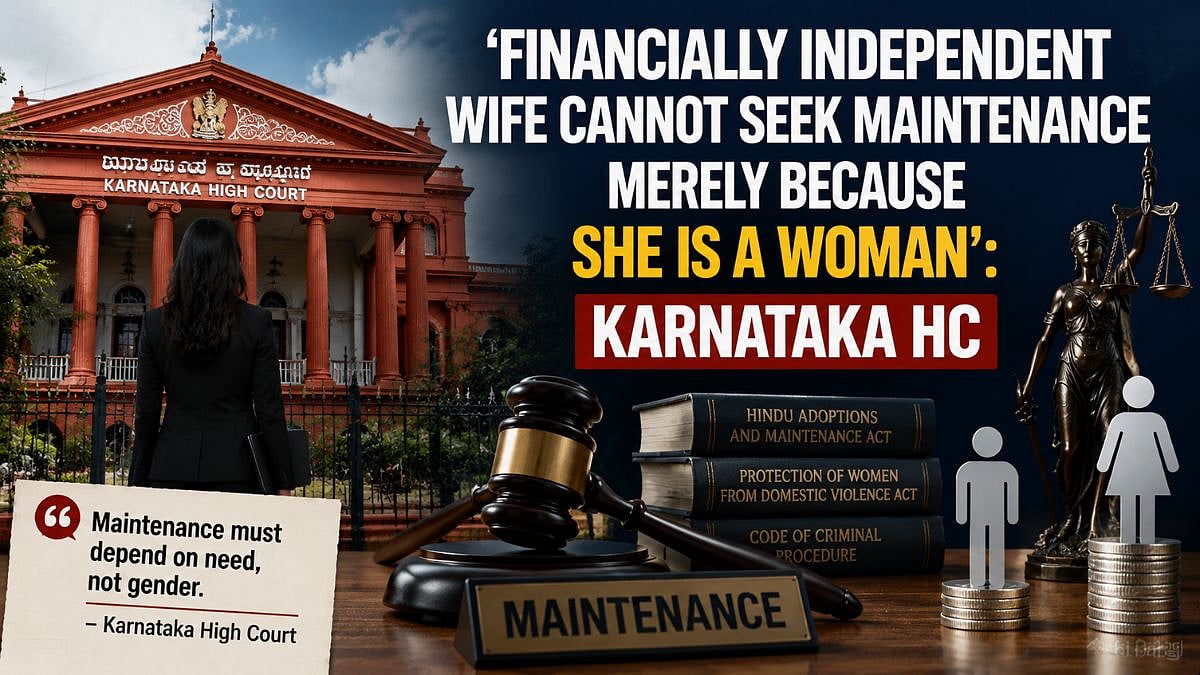
Bengaluru, June 29: The Karnataka High Court has held that courts should not grant maintenance to a wife merely on the assumption that women must always be financially supported by their husbands.
It observed that if a wife is financially independent, earns more than her husband and has no significant financial responsibilities, there is no justification for directing the husband to pay maintenance.
Justice Chillakur Sumalatha made the observations while setting aside a trial court order that had directed a husband to pay his estranged wife Rs 20,000 per month as interim maintenance. The High Court stressed that maintenance orders must be based on the financial circumstances of both parties and not on gender-based assumptions.
Maintenance Based On Need
The Court said that family courts should carefully examine whether a wife is genuinely unable to maintain herself before awarding maintenance. It observed that only when it is shown that the wife has no financial means to maintain herself in accordance with the standard of living enjoyed by her husband should interim or final maintenance be granted.
The judge further said that courts should not automatically award maintenance simply because a woman invokes provisions under the Protection of Women from Domestic Violence Act, 2005, the Hindu Adoptions and Maintenance Act or the provisions of the Code of Criminal Procedure that recognise the right to claim maintenance.
According to the Court, every case must be decided on its own facts instead of relying on the belief that a husband is always required to maintain his wife.
Court Notes Higher Income
The case arose after the husband challenged the trial court's order dated December 19, 2025, before the High Court. He argued that while he earned about Rs 60,646 per month, his wife had an admitted monthly income of Rs 1 lakh. The wife had sought interim maintenance of Rs 1,13,515 per month after filing proceedings under the Protection of Women from Domestic Violence Act, 2005.
The wife contended that she had incurred debts for her marriage and, being the only child of her parents, was responsible for repaying them. However, the High Court noted that she did not produce any material to support her claims regarding pending loans or EMIs. The affidavit filed by her, instead, showed that her salary was substantially higher than that of her husband.
Interim Order Set Aside
Finding merit in the husband's arguments, the High Court ruled that there was no need to direct him to pay Rs 20,000 per month as interim maintenance when the wife was earning considerably more and was capable of maintaining herself.
The Court held that the trial court had failed to consider the wife's earnings while passing its order and declared the interim maintenance order legally unsustainable.
Also Watch:

At the same time, the High Court clarified that its observations were confined to the interim maintenance order under challenge. It said the ruling would not influence the final decision in the pending proceedings before the trial court or affect any future interim applications for maintenance that the wife may file if there is a change in her circumstances.

