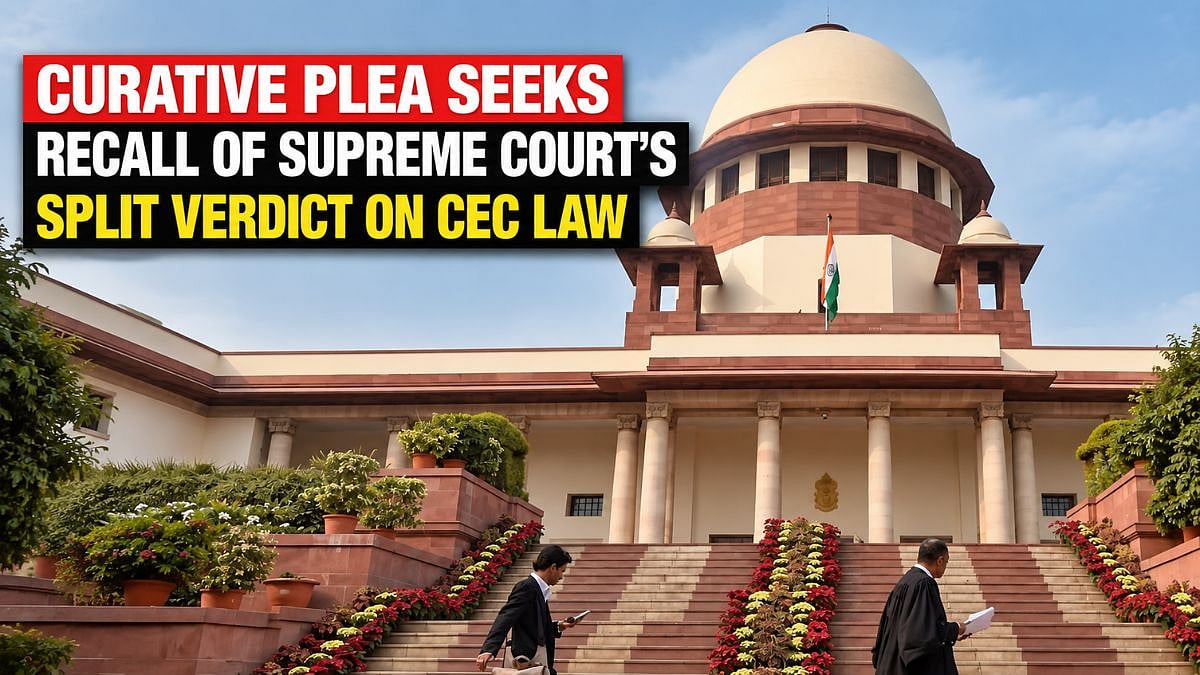
New Delhi, September 30, 2026: A curative petition has been filed in the Supreme Court seeking recall of its September 23 split verdict on the validity of the law governing the appointment of the Chief Election Commissioner (CEC) and Election Commissioners (ECs).
The petition, filed by Jaya Thakur, raises what it describes as a “reasonable apprehension of bias and propriety” over reports that the son of Justice Satish Chandra Sharma, one of the two judges who delivered the split verdict, is standing counsel for the Election Commission of India (ECI) before the Madhya Pradesh High Court. The plea has brought the question of judicial propriety to the centre of an already significant constitutional dispute.
Conflict Of Interest Claim
Filed through advocate Varun Thakur, the plea states that the petitioner learnt about Justice Sharma’s son Siddharth Sharma’s association with the ECI only after the split verdict was pronounced. Jaya Thakur said she subsequently verified the claims reported in the media through the Madhya Pradesh High Court website and found that Siddharth Sharma had been empanelled with the ECI since July 10, 2024.
“In the respectful submission of the petitioner, there is a direct conflict of interest in the professional duty of Siddharth Sharma on behalf of the Election Commission of India and adjudication of lis challenging the appointment of Election Commissioners by Justice Satish Chandra Sharma... Because justice should not only be done, but manifestly and undoubtedly be seen to be done,” the petition said.
Plea Questions Judicial Propriety
The petition contends that a judge cannot decide a case involving a party represented by a family member, even if that representation is before a different forum. It argues that propriety required Justice Sharma to disclose his son’s association with the ECI before proceedings began.
The plea further argues that the circumstances are covered by the “reasonable likelihood of bias” and “real danger test” laid down by the Supreme Court, and claims Justice Sharma’s presence on the bench vitiated the September 23 decision, PTI reports.
Review Route Sought To Be Bypassed
The petition has been filed invoking the Supreme Court’s inherent jurisdiction under Article 32 read with Article 142 of the Constitution and Order 48 Rule 1 of the Supreme Court Rules, 2013. It relies on the guidelines laid down in the Rupa Ashok Hurra v. Ashok Hurra case governing curative petitions.
Jaya Thakur has sought exemption from first filing a review petition, arguing that a review would ordinarily go before the same bench and, therefore, “no useful purpose would be served”.
Under Supreme Court rules, an aggrieved party can seek review of a judgment after disposal of a case by pointing to an “error apparent on face of the record”. Such petitions are normally considered in chambers by the judges who delivered the original decision, except in exceptional circumstances when an open-court hearing is permitted.
A curative petition is ordinarily considered by a bench comprising three senior judges of the Supreme Court along with the judges who delivered the original judgment, if they are available.
What The Split Verdict Was About
On September 23, a bench of Justices Dipankar Datta and Satish Chandra Sharma delivered differing opinions on whether petitions challenging the Chief Election Commissioner and Other Election Commissioners (Appointment, Conditions of Service and Term of Office) Act, 2023, should be referred to a larger Constitution bench. The Supreme Court’s website records the September 23 judgment in Jaya Thakur’s case.
The bench, which heard the matter for five days, directed that it be placed before Chief Justice of India Surya Kant on the administrative side for the constitution of a bench of appropriate strength for an effective and authoritative adjudication.
The judges also requested the Chief Justice of India to explore the possibility of constituting a permanent five-judge Constitution bench to decide seminal issues.
CJI’s Exclusion At Heart Of Challenge
The petitions challenge the constitutional validity of the 2023 law, which excludes the Chief Justice of India from the selection panel responsible for appointing the CEC and Election Commissioners.
The Centre, however, submitted that the petitions raise seminal questions of constitutional importance and should be referred to a five-judge Constitution bench.
Also Watch:
The curative petition now adds a separate issue to the litigation by questioning the circumstances in which the September 23 split decision was delivered. The claims concerning conflict of interest and bias are allegations raised by the petitioner and have not been presented here as findings of the Supreme Court.
To get details on exclusive and budget-friendly property deals in Mumbai & surrounding regions, do visit: https://budgetproperties.in/

