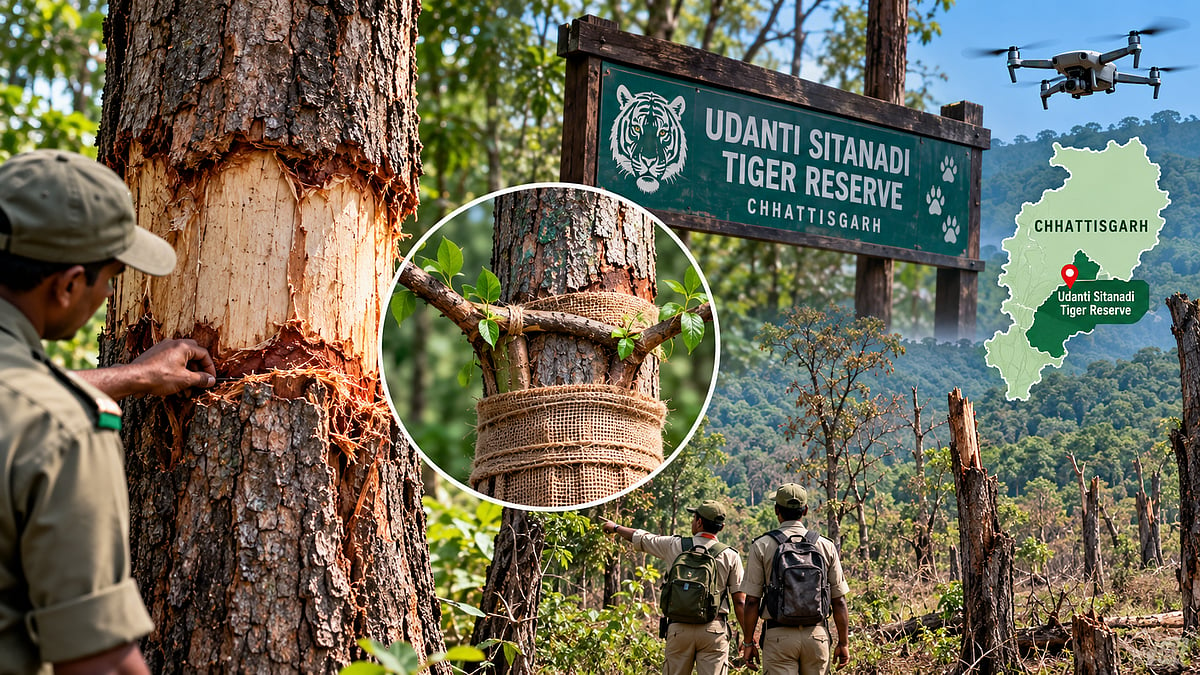
The Chhattisgarh Forest Department is seeking expert help to save more than 500 trees that were allegedly damaged by encroachers in Karka village, located deep inside the Udanti Sitanadi Tiger Reserve (USTR). The department plans to use a technique called ‘bridge grafting’, which could help the damaged trees recover and survive.
The trees were damaged through a process known as girdling, in which portions of the bark are removed to disrupt the supply of nutrients. This can eventually kill the tree. While thousands of trees have suffered damage in the reserve, officials believe that more than 500 were girdled recently and have a better chance of survival if treated in time.
Survey Reveals Extensive Forest Damage
An inspection conducted by the Forest Department between September 22 and October 10 found around 2,500 girdled trees, mainly Sal, Bija and Tendu. The reserve stretches across Chhattisgarh’s Dhamtari and Gariaband districts.
The inspection also involved a Differential Global Positioning System (DGPS)-enabled drone survey and satellite images from the Indian Space Research Organisation (ISRO) dating back to 2010 and 2016. These images showed dense forest cover in the area at the time, leading officials to conclude that thousands of trees may have been cleared over the past decade.
Fresh Damage Raises Encroachment Concerns
USTR Deputy Director Varun Jain said the findings showed the scale of forest loss and highlighted the urgent need for restoration, stronger protection measures and legal action against those responsible.
“These findings underscore the magnitude of forest loss and the urgent need for restoration and stronger protection measures besides prosecution of the accused persons from Karka. While several trees have suffered damage over the years, some (over 500) have been freshly girdled, raising concerns that deliberate damage is being done to facilitate further expansion of encroachment. Protecting the forests of USTR is particularly important given their significance for biodiversity and the Mahanadi River’s origin landscape,” Jain said.
The findings raise serious concerns about the protection of the reserve, particularly as fresh damage could lead to further forest loss. Saving the recently affected trees is important, but preventing further destruction will be equally necessary.
‘Tree Doctor’ to Help Save Damaged Trees
As part of the restoration effort, Vijay Nishanth, popularly known as the ‘Tree Doctor’ for his conservation work through Project Vruksha Foundation, is expected to visit the reserve soon, Indian Express reports.
Nishanth will assess the damaged trees, identify those that can still be saved and recommend suitable treatment methods. These may include bridge grafting and other techniques aimed at restoring damaged trees.
How Will the ‘Tree Surgery’ Work?
Bridge grafting involves placing a healthy branch across the damaged section of a tree to reconnect tissues and help restore the movement of nutrients. The technique offers a possible way to save trees that might otherwise die because of girdling.
Jain said the department currently applies a mixture of cow dung and soil to the damaged portion of a tree before wrapping it with gunny bags. The treatment is more effective before the monsoon, when tissue growth is higher.
“Bridge grafting involves grafting a healthy branch across the girdled portion of a tree to reconnect the damaged tissues. We currently apply a mixture of cow dung and soil over the wound and wrap it with gunny bags. The procedure is more effective pre-monsoon when tissue growth is higher. However, our success rate was less as we have not had enough time to research the technique. Hence, to try and save more trees, we are taking expert help,” Jain said.
Earlier Treatment Had Just 10% Success Rate
The reserve authorities had previously attempted bridge grafting on damaged trees in the Tourenga Range in 2022. However, the treatment achieved a success rate of only around 10%, showing the challenges involved in restoring girdled trees.

The earlier results highlight why expert assistance is important this time. Apart from treating the trees, Nishanth’s visit is expected to help forest personnel learn specialised restoration techniques and develop procedures for future care and monitoring.
Tribal Knowledge to Support Conservation
The reserve authorities are also consulting tribal communities and forest dwellers living in and around the protected area. The department hopes to use their traditional ecological knowledge and indigenous tree-care practices as part of the restoration initiative.
The effort to save more than 500 trees is an important conservation step, but the damage already recorded in the reserve shows that treatment alone will not be enough. Stronger forest protection, action against encroachment and regular monitoring will be essential to prevent further losses.

