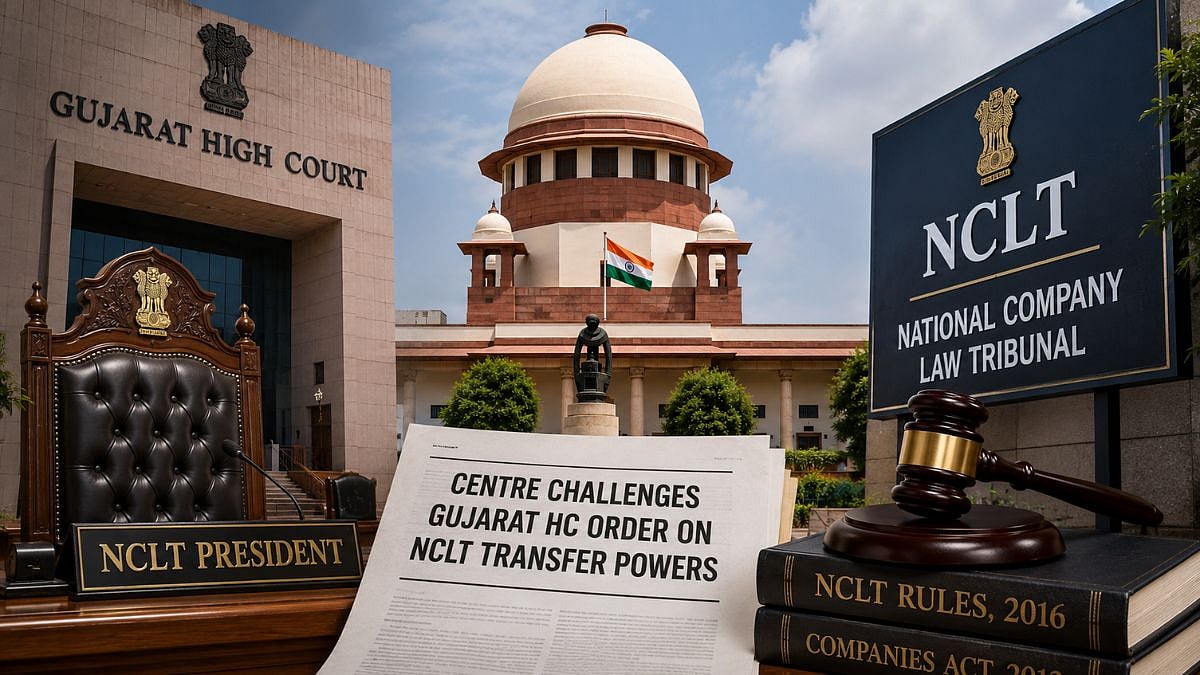
Mumbai, June 15: The Central government has approached the Supreme Court challenging a Gujarat High Court ruling that restricted the powers of the President of the National Company Law Tribunal (NCLT) to transfer cases between Benches beyond their territorial jurisdiction.
The appeal arises from a dispute involving ArcelorMittal Nippon Steel India Private Limited, formerly Essar Steel India Limited. The Centre has argued that the High Court wrongly interpreted Rule 16(d) of the NCLT Rules, 2016, which authorises the NCLT President to transfer cases from one Bench to another when circumstances warrant such action, Bar & Bench reports.
A Bench comprising Chief Justice of India Surya Kant and Justice V Mohana issued notice on the Centre's plea and sought a response from ArcelorMittal Nippon Steel India.
Transfer Powers Under Scrutiny
At the heart of the dispute is the scope of Rule 16(d). The Gujarat High Court had ruled that the provision does not allow the NCLT President to transfer matters beyond the territorial jurisdiction of a particular Bench.
Based on this interpretation, the High Court set aside administrative orders transferring cases involving ArcelorMittal from the NCLT's Ahmedabad Bench to its Mumbai Bench.
The Centre has contended before the Supreme Court that the High Court effectively introduced a territorial restriction that does not exist in the rule. According to the government, the NCLT functions as a single tribunal for the entire country and operates under a unified administrative structure.
It argued that individual Benches are created primarily for administrative convenience and accessibility rather than as separate geographical jurisdictions.
The government further submitted that Rule 16(d) permits transfers between Benches across India whenever circumstances require such intervention.
Recusals Triggered Administrative Intervention
The Centre has also highlighted the circumstances that led to the transfer orders. According to the plea, an NCLT Ahmedabad Bench recused itself from hearing the matter on January 9, 2024. Subsequently, another Bench, NCLT Ahmedabad Court II, also recused itself in April 2024.
Following these recusals, the NCLT President transferred the cases to the Mumbai Bench through administrative orders dated June 6, 2024, and February 10, 2025.
The government argued that administrative intervention became necessary to ensure the tribunal's functioning and prevent a judicial vacuum. It warned that if the Gujarat High Court's interpretation is upheld, situations involving simultaneous recusals or vacancies at a Bench could halt adjudication altogether.
ArcelorMittal challenged both the recusal orders and the transfer orders before the Gujarat High Court. Justice Niral R Mehta subsequently quashed the recusal orders as well as the transfer orders, holding that the NCLT President lacked administrative authority to alter or extend the territorial jurisdiction of any Bench.
In February 2026, a Division Bench of the Gujarat High Court directed the Centre to approach the Supreme Court because a similar issue was already pending before the apex court.
Notably, the Supreme Court had agreed in January 2026 to examine the same legal question in a petition filed by Anita Rayapatti against the same order.
Also Watch:
The case is likely to have wider implications for the functioning of the NCLT. While the Centre maintains that a flexible transfer mechanism is necessary to keep the tribunal operational in exceptional situations, the legal challenge raises important questions about the limits of administrative powers within specialised judicial bodies.
To get details on exclusive and budget-friendly property deals in Mumbai & surrounding regions, do visit: https://budgetproperties.in/

