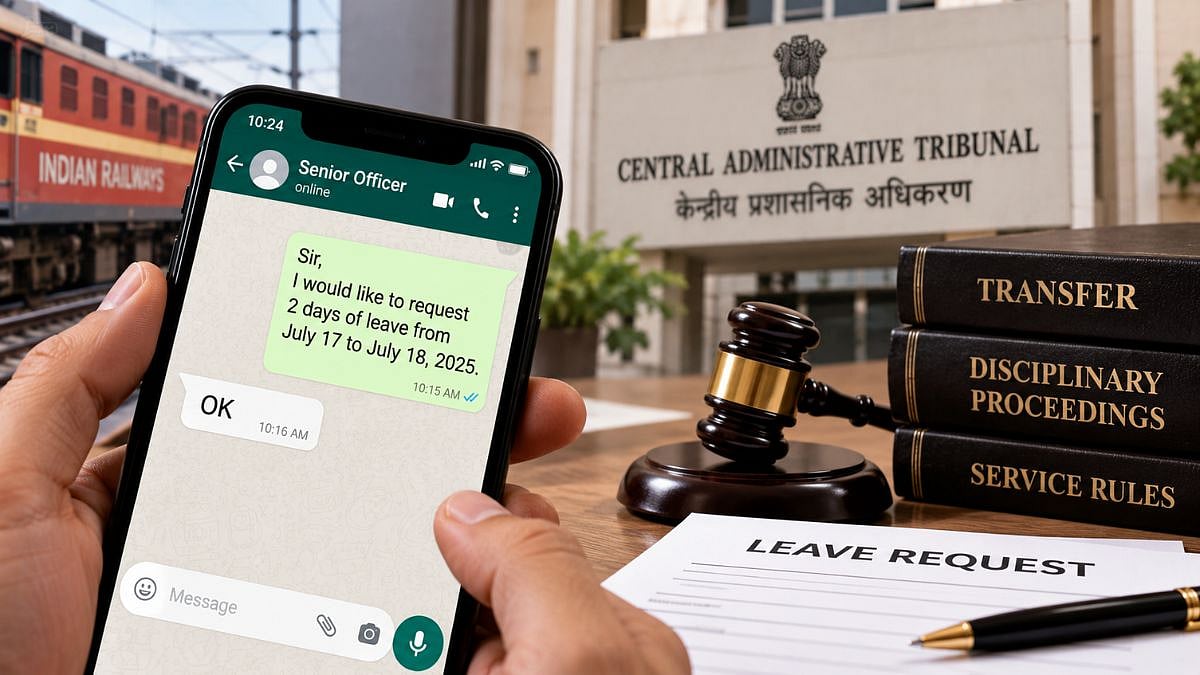
Allahabad, October 22, 2026: The Central Administrative Tribunal (CAT), Allahabad Bench, has ruled that a senior officer’s ‘OK’ response to a leave request on WhatsApp does not automatically mean the leave has been officially approved. The Tribunal said such a message alone cannot prove that the competent authority sanctioned the leave.
Judicial Member Rajnish Kumar Rai made the observation while dismissing a petition filed by North Central Railway employee Priya Ranjan Kumar, who challenged his transfer from Prayagraj to Fatehpur. In its October 7 order, the Tribunal also held that a transfer cannot be considered punishment merely because disciplinary proceedings were initiated against an employee, Bar & Bench reported.
What Led To The Dispute?
The case began after Kumar took three days of leave from July 14 to July 16, 2025, to visit his native village. He later requested an additional two days of leave through WhatsApp and claimed that Senior Divisional Commercial Manager Himanshu Shukla had approved his request by replying ‘OK’.
However, when Kumar returned to duty on July 21, 2025, he was suspended. On July 25, he was transferred to Fatehpur, and a disciplinary charge-sheet was issued against him on July 31. Kumar challenged the transfer, arguing that it was not a routine administrative decision but a punitive action linked to the disagreement over his leave.
Why Did The Railways Transfer Him?
The Railways rejected Kumar’s allegations and maintained that the transfer was made for administrative reasons. It informed the Tribunal that a new entry and booking office was being developed at Fatehpur Railway Station, which necessitated the transfer.
The Tribunal accepted this explanation and found that the Railways had provided an independent administrative reason for the decision. It also observed that the WhatsApp reply relied upon by Kumar was insufficient to establish that his leave had been formally sanctioned.
Tribunal Clarifies Status Of WhatsApp Reply
The Tribunal made it clear that an informal response on a messaging platform cannot, by itself, establish official approval of a leave request.
“The applicant’s reliance upon the WhatsApp response ‘OK’, therefore, cannot by itself be treated as conclusive proof of sanction of leave by the competent authority,” Judicial Member Rai observed.
The ruling highlights the distinction between an informal acknowledgement and an officially sanctioned leave request. While a brief WhatsApp reply may appear to indicate approval, the Tribunal found that it was not enough to establish that the competent authority had granted leave.
Transfer Cannot Automatically Be Punishment
The Tribunal also examined Kumar’s argument that his transfer was intended to punish him. Referring to the Supreme Court’s ruling in Somesh Tiwari v. Union of India, it reiterated that a transfer made as a substitute for punishment cannot be legally sustained.
However, in Kumar’s case, the Tribunal found no sufficient basis to conclude that the transfer was motivated by mala fides or intended as punishment. Since the Railways had established an administrative justification, the Tribunal dismissed his application.
Also Watch:

The decision underlines the importance of distinguishing between administrative transfers and punitive action, particularly when disciplinary proceedings are also involved.
Advocate Rakesh Kumar Dixit represented Kumar, while Advocate Anil Kumar appeared for the Railways.
To get details on exclusive and budget-friendly property deals in Mumbai & surrounding regions, do visit: https://budgetproperties.in/

