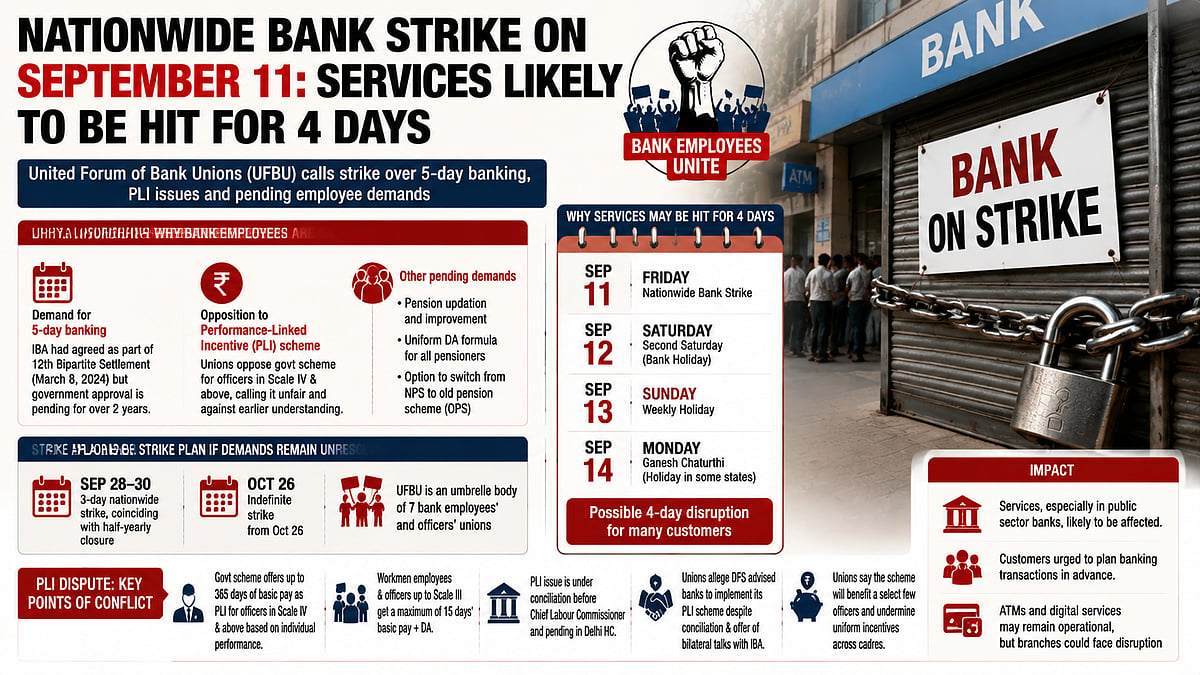
Banking services across the country could face disruption as the United Forum of Bank Unions (UFBU) has announced a nationwide strike on September 11, demanding action on five-day banking, performance-linked incentive (PLI) issues and several pending employee demands.
The strike, if it goes ahead, is expected to impact services, particularly in public sector banks. Since September 11 falls on a Friday and is followed by two bank holidays, customers in many parts of the country could face a four-day disruption. September 14 is a holiday in some states due to Ganesh Chaturthi.
Banking reforms stuck, unions lose patience
The UFBU, an umbrella body of seven bank employees' and officers' unions, has also warned of a three-day nationwide strike from September 28, coinciding with the half-yearly closure. If their demands remain unresolved, the unions have threatened an indefinite strike from October 26.
The key demand is the implementation of five-day banking. The Indian Banks' Association (IBA) had agreed to the proposal as part of the 12th Bipartite Settlement and 9th Joint Note signed on March 8, 2024. Under the proposal, working hours from Monday to Friday would increase by 40 minutes, PTI reports.
However, the proposal, which was later sent to the government for approval, has remained pending for more than two years, said All India Bank Officers' Confederation (AIBOC) general secretary Rupam Roy while addressing the media in New Delhi.
PLI dispute adds fuel to the conflict
The unions have also opposed the government's performance-linked incentive scheme for bank officers in Scale IV and above. They said the scheme differs from the understanding reached with the IBA, under which incentives were to be linked to the overall performance of individual banks and remain uniform for employees and officers up to Scale VII.
Under the government's scheme, officers in Scale IV and above could receive a PLI of up to 365 days of basic pay based on individual performance. In comparison, workmen employees and officers up to Scale III would receive a maximum of 15 days' basic pay plus dearness allowance.
The PLI issue is currently under conciliation before the Chief Labour Commissioner (CLC) following the strike call by the UFBU and is also pending before the Delhi High Court, said All India Bank Employees' Association (AIBEA) general secretary C H Venkatachalam.
Venkatachalam alleged that despite the ongoing conciliation process and an offer to hold bilateral discussions with the IBA, the Department of Financial Services (DFS) advised banks to implement the government's PLI scheme.

Pension demands remain unresolved
He further claimed that crediting of performance-linked incentives under the DFS scheme has already started in banks, alleging that it violated the requirement to maintain the status quo during conciliation proceedings.
Venkatachalam said the DFS-backed PLI scheme would disproportionately benefit a small section of officers and weaken the principle of uniform incentives across cadres.
Apart from the PLI dispute, the unions have raised other unresolved issues, including pension updation and improvement, a uniform dearness allowance formula for all pensioners, and an option for employees covered under the National Pension System (NPS) to switch to the old pension scheme (OPS).
With multiple issues piling up and negotiations failing to deliver a resolution, the planned strike highlights the growing friction between bank unions and authorities over long-pending demands. The coming weeks will determine whether discussions can prevent a disruption to banking services.

