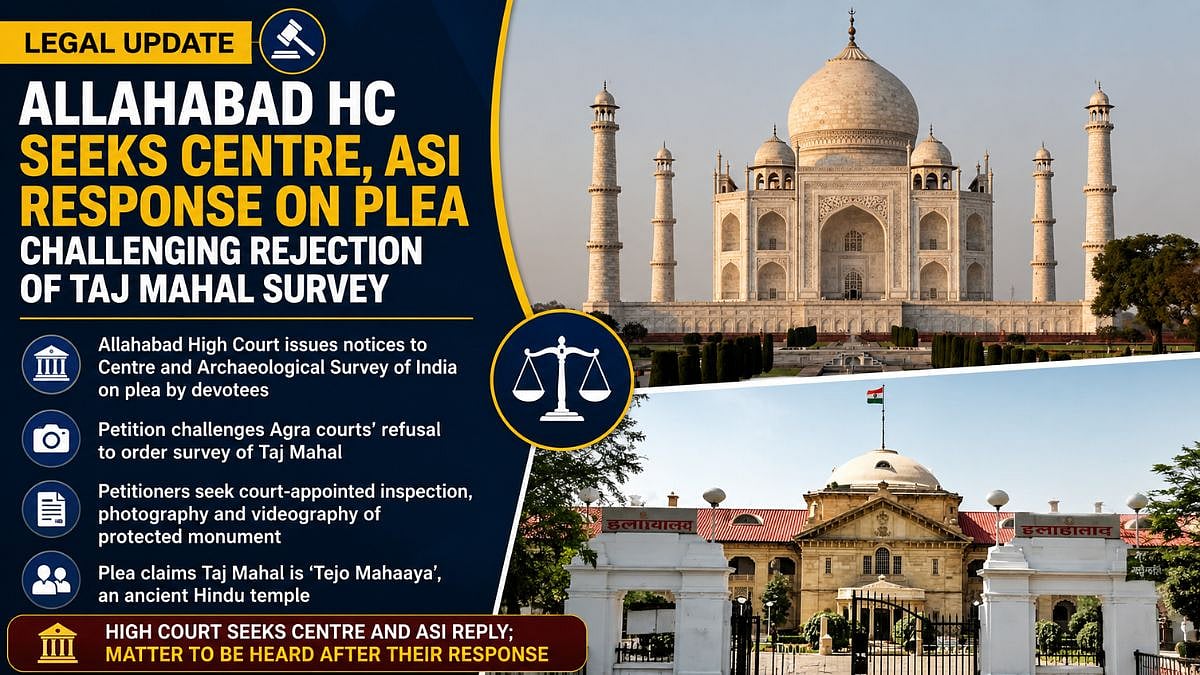
New Delhi, July 6: The Allahabad High Court has issued notices to the Centre and the Archaeological Survey of India (ASI) on a plea challenging an Agra court's refusal to order a survey of the Taj Mahal. The petition has been filed by devotees who claim the monument is an ancient Hindu temple known as "Tejo Mahalaya" and have sought a court-appointed inspection of the protected monument.
A Bench of Justice Rohit Ranjan Agarwal passed the order after hearing Advocate Hari Shankar Jain, who appeared for the petitioners. The plea has been filed on behalf of the deity, Lord Sri Agreshwar Mahadev Nagnatheswar Virajman, through next friend Hari Shankar Jain, along with several devotees.
The petition challenges orders passed by two Agra courts that declined to appoint an advocate commissioner to inspect, photograph, and videograph the Taj Mahal.
Survey Row Reaches High Court
The dispute dates back to 2019, when the plaintiffs sought the appointment of an advocate commissioner to survey the Taj Mahal. However, the Additional Civil Judge (Senior Division), Agra, rejected the application, saying the plaintiffs had failed to produce revenue records such as Khasra or Khatauni to establish the exact Gata number. The court also noted that the property's described boundaries and area of 77 bighas did not match the defendants' records.
A revision petition against the order was later held to be non-maintainable by the Additional District Judge, Agra, in April this year.
Before the High Court, the petitioners argued that the lower courts' reasoning suffers from "patent illegality, material irregularity and failure to exercise jurisdiction". They contended that the application was rejected on "considerations that are wholly irrelevant to the purpose of appointment of Commissioner". According to the plea, there is no dispute over the identity of the property, as it is a well-known protected monument.
The petitioners also argued that the monument's physical features, structural characteristics, and locked portions "cannot be effectively proved through oral evidence alone".
"...in the suit it is clear that plaintiffs have described regarding different description existing in the monument in question showing the existence of a Temple and a building having Hindu Religious Character and such signs and symbols available in the building itself cannot be proved without there being the authoritative photograph to be filed before the court. It is worth to mention that subject building is a protected monument and the plaintiffs have no right to take photographs within or outside the premises of the monument," the petition states.
The petitioners submitted that they do not have unrestricted access to the ASI-controlled monument, making a court-appointed photographer and videographer essential for effective adjudication.
Historical And Architectural Claims
In the original suit, the plaintiffs sought a declaration that the Taj Mahal is a Hindu temple and requested that Hindus be allowed to perform darshan and pooja within its premises, claiming such worship is protected under Article 25 of the Constitution.
The petition refers to several historical and architectural claims made in the original suit. It alleges that the Tejo Mahalaya temple was built by Raja Paramardi Dev in 1155-56 AD, later came under Raja Maan Singh and Raja Jai Singh of Jaipur, and was subsequently taken over by Mughal ruler Shahjahan, who allegedly altered parts of the structure by adding Islamic features, Live Law reports.
The petition also claims there are at least 109 archaeological and historical features supporting the temple claim, including a kalash and lotus petals on the marble dome and an ASI-recorded "Gaushala" on the south-east corner of the complex.
It further alleges that the ASI has "unlawfully" allowed Muslims to offer namaz on Fridays while restricting visitors and keeping several floors of the monument locked. The plaintiffs also contend that the use of the property for any purpose other than Hindu pooja is unlawful.
Also Watch:
Relief Sought
Seeking relief, the petitioners have asked the High Court to set aside the Agra court orders and direct the trial court to decide the application for the appointment of an advocate commissioner on its merits.
Through an interim application, they have also requested the High Court to direct the ASI Director to take photographs of the monument from the inside and outside, in the presence of the petitioners, and place them before the court.
To get details on exclusive and budget-friendly property deals in Mumbai & surrounding regions, do visit: https://budgetproperties.in/

