
Official findings and insider accounts have highlighted that Air India’s Phuket-Delhi flight’s pilot-in-command (PIC), Sudeep Vashistha, who was under the influence of marijuana, suffered from severe impairment and behaved erratically in the cockpit. The post-flight maintenance report revealed that the aircraft suffered various technical issues during the cruise and displayed multiple mechanical system warnings.
The flight AI-2379, operated by Airbus A320neo registered as VT-EXO carrying 137 passengers and eight crew members, suffered a sudden 300-feet altitude plunge over Odisha on August 4 during its cruise phase. This caused a momentary "negative G" state that hurled unbuckled passengers and items toward the ceiling, leaving at least 20 passengers and four cabin crew members injured. While the multiple hydraulic failures raised concerns about the aircraft’s technical issues, the pilot’s psychoactive substance tests – which resulted positive in confirmatory testing – have raised severe flight safety concerns.
Also Watch:
Details from internal airline reports, cabin crew complaints and investigative disclosures paint an alarming picture of what unfolded inside the flight deck. According to cabin crew filings, Vashishtha, under the influence of marijuana, allegedly acted erratically. The crew members have reportedly alleged that he sat on the flight deck floor, stood leaning behind the co-pilot's seat during the critical altitude drop and at one point attempted to smoke inside the cockpit. Cabin crew members had to physically assist him back to his seat while the young co-pilot was forced to single-handedly stabilise the aircraft and navigate a safe landing in Delhi.
The PIC’s colleagues on the flight also alleged that the pilot was noticeably unsteady and unable to walk properly. An official from the Aircraft Accident Investigation Bureau (AAIB) claimed that he had to physically assist the captain to sit down and produce a urine sample for drug screening even after informing him that he was under CCTV surveillance.
According to reports, Vashistha allegedly took the crew to a party in Phuket during the layover, which was less than 24hr. After the altitude drop, the pilot allegedly went into the cabin to check on the passengers and asked them not to record his photos or videos. In the airline’s internal flight safety report, Vashistha denied consuming illegal substances but claimed that he was on sleep medication prescribed by his doctor and had not found enough rest time due to a tightly scheduled layover.
13 Warnings and 3 Failure Messages Recorded
Adding a critical technical layer to the probe, the aircraft’s post-flight maintenance report logged 13 system warnings and three failure messages during the Phuket-Delhi route. The messages highlighted various issues like multi-system hydraulics pressure drop, autopilot trip, triggering of door sensors and others. The AAIB and DGCA are currently evaluating recorded flight telemetry and system logs to determine whether the 300-foot plunge was triggered by rare technical snags or brought on by accidental or intentional input on the flight controls while the captain was incapacitated.
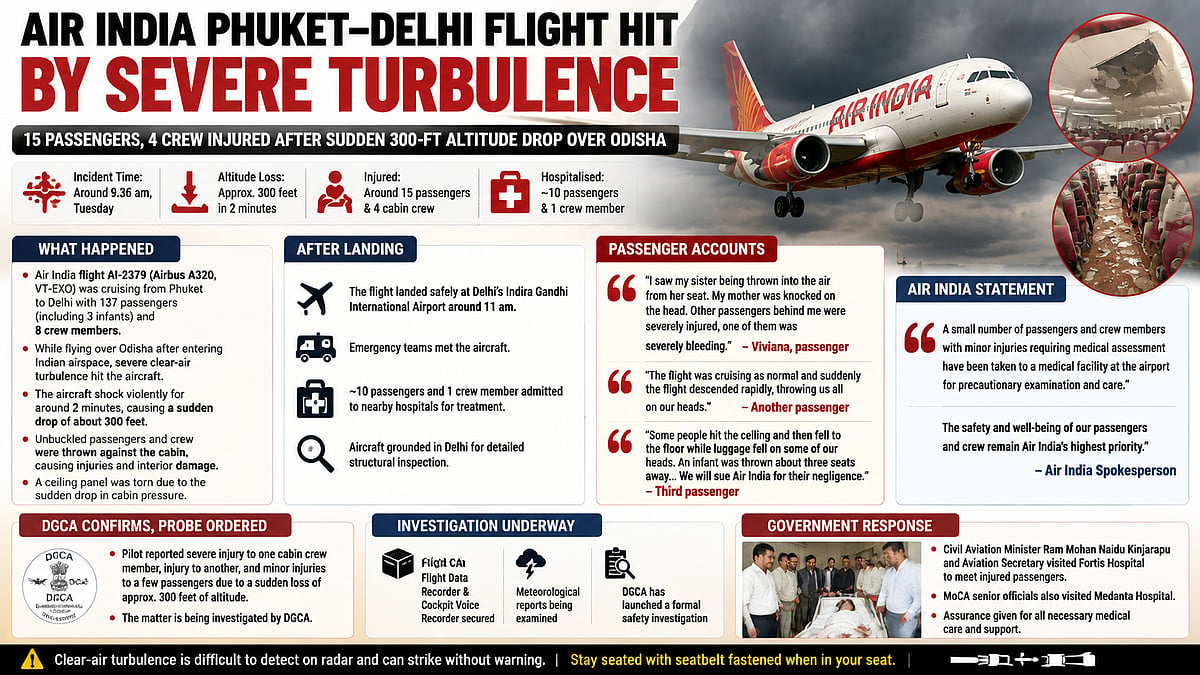
Did Air India Lie About Turbulence?
On the day of the incident, Air India said in an official statement that AI-2379 “experienced a brief in-flight turbulence-related event.” However, the latest details about the post-flight maintenance report, published two hours before the statement was issued, had already revealed a long list of technical failures faced by the aircraft. Notably, in the later statements, the airline removed the word turbulence in its statements. The airline also seems to have attempted to downplay the issue in its first statement by saying that the event resulted in a “momentary change in altitude,” whereas the plunge was around 300 feet within a span of two seconds. Aviation experts have highlighted that Air India did not transparently disclose the technical issues and tried to pass them off as minor.

