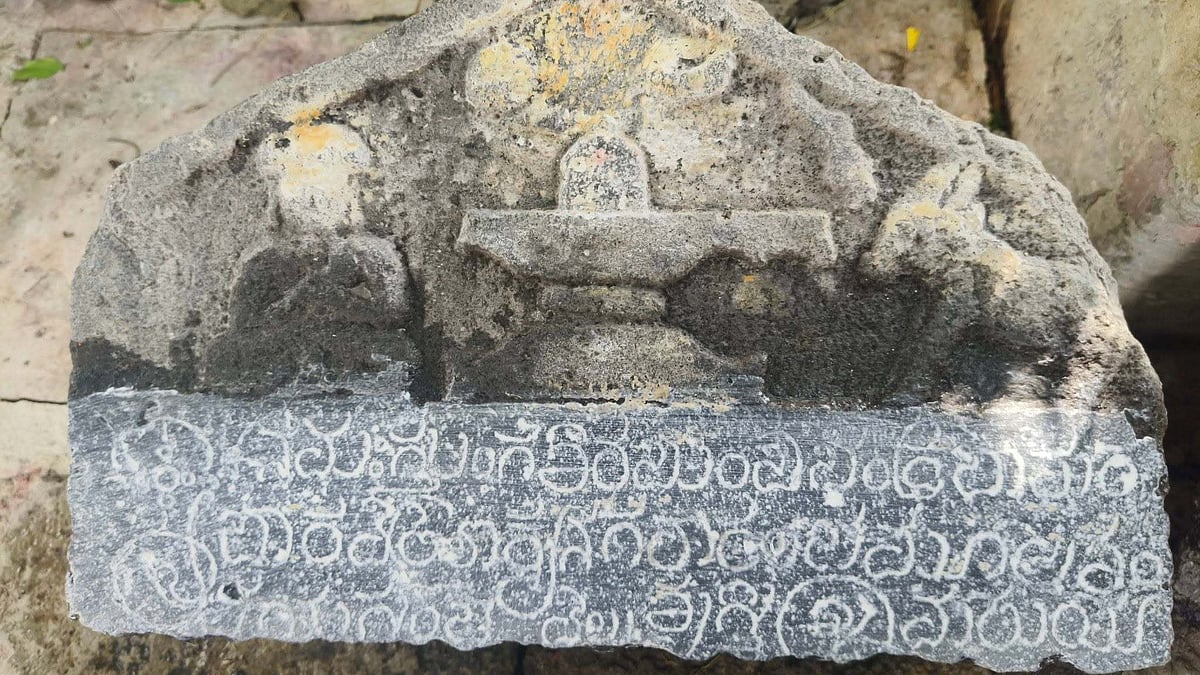
Latur, August 6: A partially damaged Kannada stone inscription discovered at the Kashiling (Mahadev) Temple premises in Jeur village of Akkalkot tehsil is believed to date back to the 13th century, said researcher Krushna Gudade.
The inscription, carved on a broken stone slab placed on a platform beneath a peepal tree inside the temple complex, survives only in part. The upper portion bears engravings of a Shiva Linga, a cow, the Sun and Moon, and a sword, while the surviving lower section contains three lines of Kannada script. The remaining portion of the inscription has been lost due to damage over time.
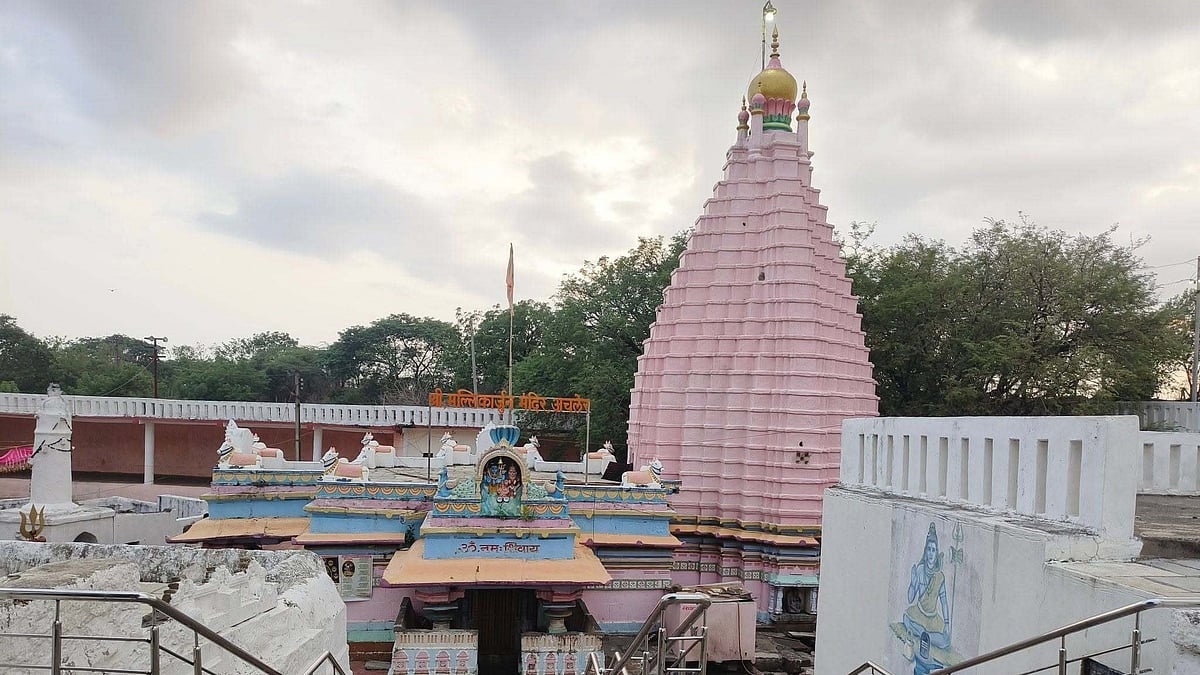
The extant slab measures 28 cm in length and 16.5 cm in height, with the inscribed text occupying nearly 9 to 16 cm of the available surface.
According to the reading prepared by Karnataka History Academy President Dr Devarakonda Reddy, the inscription begins with a Sanskrit invocation to Lord Shiva written in Kannada script. The opening verse "Namahstunga Shirachumbi Chandra Chamara Charave Trailokya Nagararambha Moola Stambaya Sambhave" is identified as a celebrated verse from Banabhatta's Harshacharita. It salutes Lord Shambhu (Shiva) as the primordial pillar supporting the three worlds, with the moon adorning His head like a ceremonial fly-whisk.
Also Watch:
The surviving text thereafter reads "Shvasti Srimatu Ya...", after which the inscription is broken. Researchers believe the incomplete word beginning with "Ya" may have referred to the Yadava dynasty, leading them to tentatively date the inscription to the 13th century. However, they emphasised that the dating remains provisional due to the missing portion of the stone.
The inscription is also believed to be associated with the historic Kashiling Mahadev Temple, a conclusion supported by the opening invocation dedicated to Lord Shiva.
To get details on exclusive and budget-friendly property deals in Mumbai & surrounding regions, do visit: https://budgetproperties.in/

