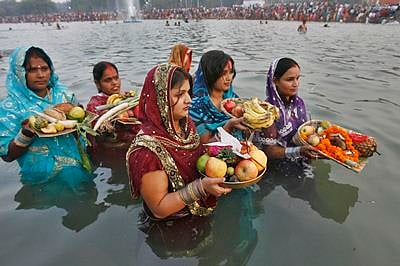
Rohtas (Bihar): Endowed with natural beauty, an old bank of River Sone in the historic Rohtas district in south Bihar will come alive with folk songs and performances this Chhath, as part of an overnight programme coinciding with the festival, which seeks to revive the forgotten and fading cultural legacy of the region.
Chhath Puja, a three-day festival during which devotees worship the Sun God starts tomorrow. During this age-old traditional celebration, mostly observed in Bihar and eastern Uttar Pradesh region, people pay obeisance to the setting and the rising sun in succession on the last two days. The programme, ‘Uga Ho Suruj Deva’ is a civil society
initiative taken up in Dehri-in-Sone, a small but historic town in Rohtas, the district otherwise famous as the land of ‘Sher Shah Suri’, the Afghan king who built the Grand Trunk Road, and lies interred here in Sasaram in his famed but neglected mausoleum, said to have partly inspired the Taj Mahal design.
“Chhath last two days entail offering (‘argyas’) to the setting sun and the rising sun, and so we are doing this
programme on the intervening night. We will begin on November 17 evening when devotees will assemble at the Anicut Ghat for the evening ‘arghya’ and the event will go on till next morning when they again offer the morning ‘arghya’,” said Manish Singh, the chief organiser. Singh, an engineer in the public sector, hails from Dehri-on-Sone, and also part-time runs an NGO ‘Incredible Rohtas’ that explores the hidden, forgotten cultural landmarks, and promotes the region’s tangible and intangible heritage.
“Today, cheap and vulgar Bhojpuri songs have invaded our cultural spaces and we have forgotten how rich Shahabad region’s linguistic and architectural legacy have been. And, so through this programme, we seek to celebrate our folk music, dance and theatre and revive our forgotten cultural legacy,” Singh said. Shahabad region refers to a part of south Bihar which includes Ara, Rohtas and parts of Gaya districts. The term finds reference in historical texts but is no more in vogue,though residents of the region continue to use the term. Bhojpuri is the primary dialect spoken in this region, besides some tribal tongues.
“The songs and dances on the Chhath day will showcase our culture and implore people to return to their original heritage rather than be swayed by meaningless cheap and commercial cinema that degrades our culture,” he said. From Ganga to Sone to Gandak and Ghagra, riverbanks in all districts are flooded with devotees jostling for a space there, and the colourful paraphernalia of the festival becomes a visual treat for visitors and locals alike.
Singh, whose ‘Incredible Rohtas’ founded in 2011, draws members from all walks of life – doctors, engineers, managers, designers, media professionals, etc, says, their aim is to “harness the depth and richness of Rohtas’ cultural and natural heritage to the fullest, for the enrichment of all people, including especially the rural multitudes that still practice and cherish their living.”
“Most of us don’t live in our hometowns, and working elsewhere, but are united by a common cause, to promote and conserve our history and heritage and project it to the outside world.” A few years ago, the NGO had hosted a group of experts from England on a tour of the heritage areas of the district, including works of the British on the Anicut Dam, the sundial, and the octagonal-shaped temple of Mundeshwari Devi, among other places.
The civil society group has also been endeavouring to get archaeological and historic sites preserved by seeking intervention of the Archaelogical Survey of India. Incidentally, the venue – Anicut Ghat – is endowed with pristine sands and clear waters of River Sone and lies in the vicinity of the historic Anicut Dam, said to be country’s first such project for irrigation, built by the British in the 1870s.
“The region and the town of Dehri-on-Sone has such rich history, but the place has never been on the tourism map. The purpose of this event also is to let the local people themselves know the importance of such places,” Singh added. Celebrated for over centuries, on day one of Chhath puja, devotees, mostly women, take a dip in a river and cook ‘kheer’ as a ‘prasad’.
On the second evening lakhs of people across the state converge on the banks of rivers in their area and offer the first ‘arghya’ to sun god. On the next day, they pay obeisance to the rising sun, followed by a family feast at home. The tomb of ‘Sher Shah Suri’, with its majestic stone-built architecture, sits at the centre of a pond in Sasaram (over 150 km from Patna), the district headquarters of Rohtas. But, the water in the pond has now gone bad due to discharge of the town’s waste into it.
“We have been urging ASI authorities to help restore Sher Shah’s Tomb… Here is the man, who gave us the iconic Grand Trunk Road, introduced the currency of ‘rupaiya’ and we have allowed his last resting place to become neglected,” Singh said. This Chhath programme is one of our series of programmes that we will conduct over a period of time to emphasise the cultural heritage of our region, he said. “We want to help preserve the monuments, buildings, historic documents and photographs, and put Rohtas on the tourism map, where it so richly deserves to be. And, we invite people to join us in our endeavour in saving Bihar’s history and legacy,” he added.
