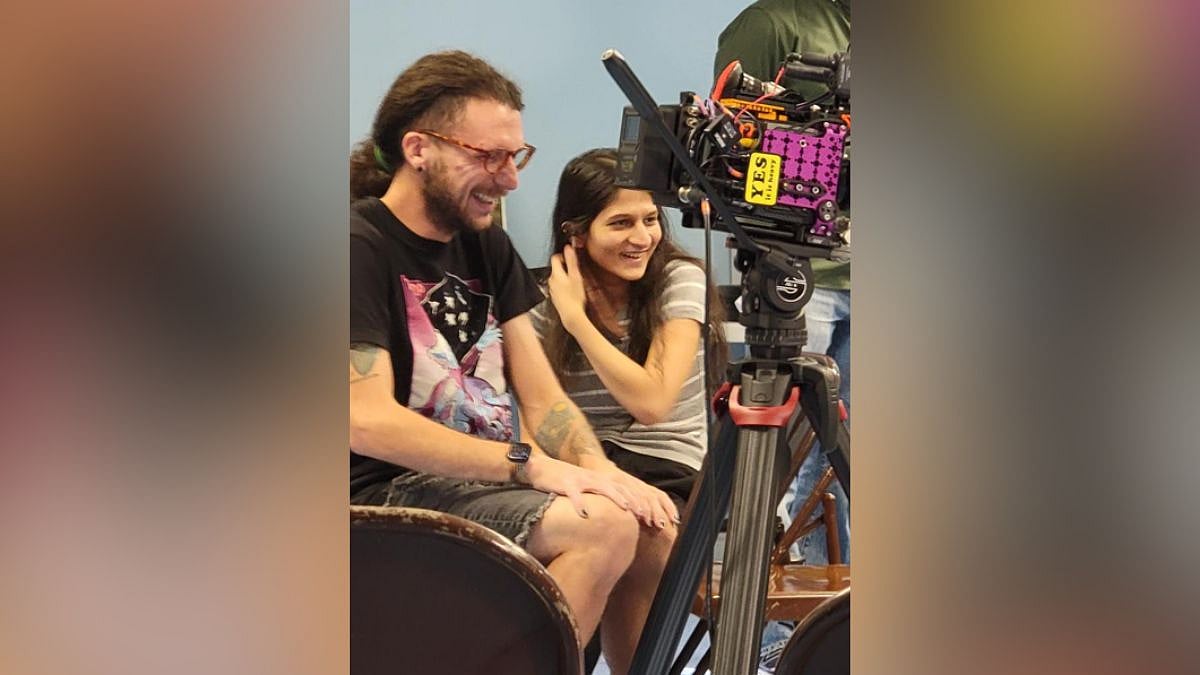
Since 2019, South Asian screenwriter and filmmaker Ms. Aayushi A. Shah has written and/or directed nine short films in and around New York, where she is based. These films range from comedy to drama to horror, but they all have one thing in common: the originality of her voice.
As a film journalist, I routinely watch films and analyze them critically by writing reviews or articles. I have watched scores of films, but it’s not often that I’ll come across a film that not only has a unique voice, but is confident in its unique voice. Ms. Shah’s short films are great examples of this rarity:
Ms. Shah’s 'The Turning Point’ is an avant-garde exploration of a woman’s battle with depression. It has no dialogue, and more notably, does not even have room tone, so it is a callback to the Silent Film Era and is shining a light on the painful silence in which depression is so often battled. Conversely, Ms. Shah’s ‘Writer’s Block’ is about a screenwriter who deals with the sudden silence of her mind by filling her life with sound. Whereas ‘The Turning Point’ is a silent film, ‘Writer’s Block’ is a black-and-white musical—the monochromatic visuals of the film clash with the cacophony of the music, just as the blank page remains stubbornly unchanged as the writer’s emotions spiral out of control.
On the surface, Ms. Shah’s ‘A Domestic Disturbance’ is about a young woman’s quest to get rid of an intruding cockroach in her apartment. But it is really a metaphor for women asserting their independence and their ability to go it alone, finding bravery in their loneliness, and saving themselves instead of waiting to be saved.
All this to say that Ms. Shah’s films are deeply personal: she makes films on her own life, on her own struggles, triumphs, flaws, virtues, and experiences. This is precisely what lends her voice (and her films) an originality—an individuality—that cannot be replicated. Because her films are so personal, only Ms. Shah can tell these stories.
But perhaps her most personal short films are ‘The Past, Present and Future’, ‘Strange Things Will Happen’, and ‘The Rest is Silence’. Inspired by Ms. Shah’s own relationship with her past, ‘The Past, Present and Future’ is a horror film, but it has a lot more emotional depth than the genre is usually known for. In fact, ‘The Past, Present and Future’ is the first horror film that brought tears to my eyes—not out of fear, but because it speaks profoundly to all of us adults who feel like we have let our younger selves down.
‘Strange Things Will Happen’ is a comedy that is so faithful to how Ms. Shah spent her first New Year’s Eve in New York as an anxiety-riddled immigrant, that the film might as well be autobiographical. Shot in Ms. Shah’s own apartment, the film deals with themes like mental health, loneliness, immigration, and female empowerment. A lesser filmmaker might have chosen the more obvious genre of drama to convey these themes, so by unconventionally choosing to convey them through comedy, Ms. Shah made these important themes not only digestible, but fresh and entertaining for an audience.
Where ‘Strange Things Will Happen' features one stream-of-consciousness monologue after another, ‘The Rest is Silence’ features just a few lines of dialogue here and there. Today, films tend to rely excessively on dialogue to convey the story, even though the core tenet of narrative screenwriting is “Show, Don’t Tell”. In fact, there is a saying in the industry: film is a visual medium, dialogue is for the stage. ‘The Rest is Silence’—and, for that matter, ‘The Turning Point’—are thus rare films because they primarily unfold visually. In ‘The Rest is Silence’, Ms. Shah combines her own journey from repressing her emotions to learning to actually feel them, with her desire to immortalize her late grandmother.
It can be concluded from the above that Ms. Shah’s films are thematically relevant to the current times: they are saying something important about our society, about us as human beings in the 21st century. Each and every one of her films features women not only in leading roles, but in leading roles that are complex, well-rounded, and nuanced. In the American film industry, where women are still underrepresented both in front of and behind the camera, where female roles are oftentimes still stereotypical and one-dimensional, Ms. Shah’s films are important advancements. These are women-centric films that have been written and/or directed by a woman—specifically, a South Asian woman. Ms. Shah’s films are thus also important advancements in the American film industry where diversity has also recently regressed. (See UCLA’s 2026 Hollywood Diversity Report: https://newsroom.ucla.edu/releases/hollywood-diversity-report.)
Ms. Shah’s penchant for writing and directing nuanced female characters is also evidenced in her short films ‘The End of an Estrangement’, ‘Tainted by Drink’, and ‘Don & Lisa’—although, in these films, we see Ms. Shah veer away from loneliness to explore fraught interpersonal relationships, whether that’s between two sisters (like in ‘The End of an Estrangement’) or between a couple (like in ‘Tainted by Drink’ and ‘Don & Lisa’). But even in these films, Ms. Shah has put herself into the work:
I could feel Ms. Shah’s voice in the idiosyncratic way in which Margo and Ruby communicate with each other in ‘The End of an Estrangement’, speaking purely through subtext, never formulating full sentences or directly expressing their anger and disappointment towards each other. ‘Tainted by Drink’ and ‘Don & Lisa’ both feature heavy-hitter arguments that I have seen in plenty of other films, but what makes both of these stand out is the moments of profound silence that punctuate the arguments. For instance, in ‘Tainted by Drink’, when Sera is yelling at Ben, he looks away from her at the sliver of window that’s just visible through the curtains, tuning her out and staring at it as if he wanted to crawl through it into freedom. In ‘Don & Lisa’, as Lisa is packing her things to move out, a framed photo of her and Don from a happier time in their relationship catches her eye, and she stops what she’s doing and just stares at it for seconds on end. Ms. Shah’s voice is evident in these poignant moments of dialogue-lessness.
As the great American filmmaker Mr. Martin Scorsese has said, "The most personal is the most creative”. The American film industry is currently being bombarded by content and more content, so the only way that filmmakers and screenwriters can contribute something new and creatively significant is by making something personal in a unique voice—as Ms. Shah has done through her nine short films.
It's no wonder then that the American film industry is always on the lookout for “original cinematic voices” and has consistently recognized Ms. Shah’s work to that end: her scripts for ‘The Rest is Silence’, ‘Strange Things Will Happen’, and ‘The Past, Present and Future’ have collectively placed as quarterfinalists, semifinalists, and finalists in over a dozen of the industry’s prominent international film festivals. It is this steady stream of recognition that caught my attention and led me to discovering Ms. Shah’s films.
In fact, one of these festivals, namely the Academy Award-Qualifying Nashville Film Festival Screenwriting Competition, identified Ms. Shah’s ‘The Rest is Silence’ as “either a stand-out project or a voice that is being sought in Hollywood or perhaps both”.

