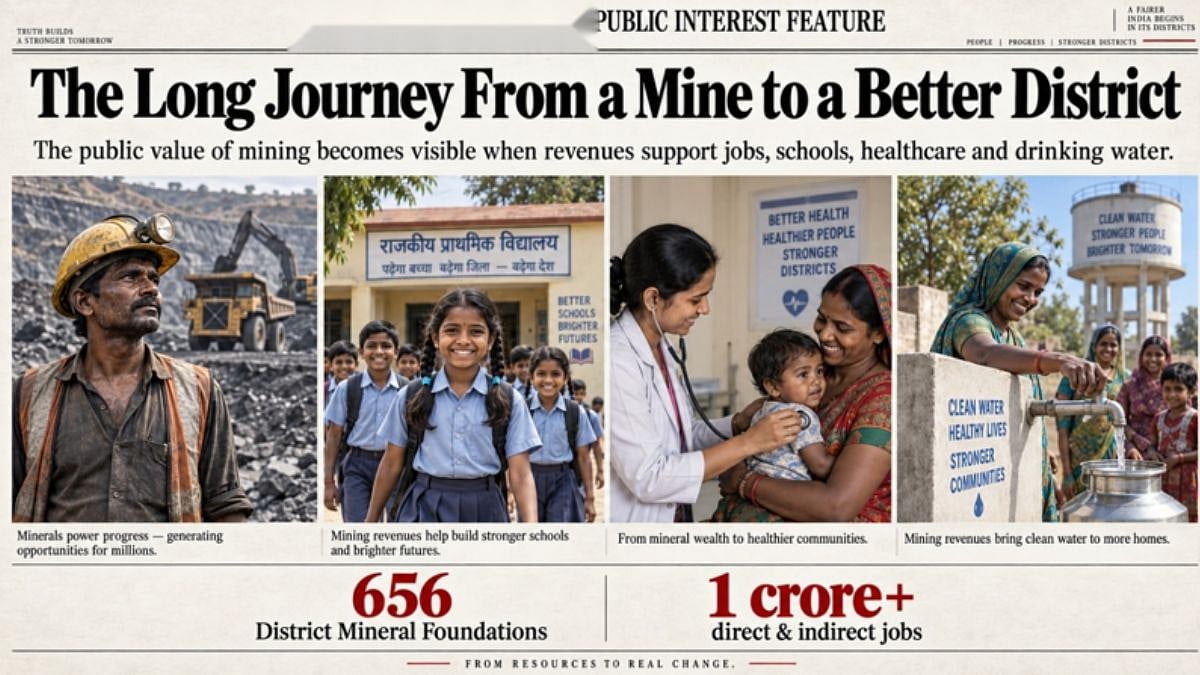
A mineral begins below the ground, but its public journey is measured above it. The journey may end in a steel plant or a power network. It may also end in a village road, a school building, a health facility or a drinking-water project. That second journey is what gives India’s mineral economy a human scale.
The district is where policy becomes visible
Across India, 656 District Mineral Foundations, including 106 in aspirational districts, connect royalty-linked mineral revenue with local priorities. Their resources support roads, schools, healthcare and drinking water under the applicable district framework. Jharkhand alone has collected around ₹19,000 crore through DMFs across all 24 districts.
The importance of this structure is simple. Mining takes place in a specific geography. A district that carries the activity also needs a credible route through which mineral value can return to local development. DMFs create that route.
Behind every production number is a livelihood network
Non-coal mining supports more than one crore direct and indirect jobs. Coal supports more than 25 lakh. The economic circle is wider still because minerals feed steel, cement, power, railways, housing, defence and solar industries. A working mine, therefore, supports livelihoods at the site, employment in connected industries and public revenue for the State and district.
This is why continuity matters. A mineral block that reaches sustained production can keep contributing across several years. The public value does not come from a single transaction; it grows through recurring production, royalty, premium and linked district resources.
The State share has become much larger
Annual mineral revenue accruing to the States rose from ₹25,206 crore in 2014-15 to ₹1,14,549 crore in 2025-26, a 354 per cent increase. Across the twelve years, ₹7,67,548 crore accrued to the States. Their share of mineral revenue rose from 60.24 per cent to 88.53 per cent, placing it close to 90 per cent.
Major mining States received more than ₹5 lakh crore between FY 2015-16 and FY 2025-26, while the Centre received about ₹82,000 crore. In coal, State revenue rose from ₹11,948 crore and a 55.6 per cent share in 2014-15 to ₹32,183 crore and an 89.5 per cent share in 2025-26. These figures make the mineral economy increasingly a story of State capacity and district outcomes.
A transparent auction is only the first step
Since 2015, more than 720 mineral blocks have been auctioned and 105 have become operational. Coal has 141 auctioned mines, with 23 operating. Around 300 bidders have participated and 337 companies hold mining leases. Coal production crossed one billion tonnes for two consecutive years, non-coal production nearly tripled from 2014 and exploration expanded around 200 times.
Around 1,200 working mines generated approximately ₹2.32 lakh crore in royalty. Roughly 100 operational auctioned mines generated around ₹96,000 crore in premium. Major mining States received more than ₹96,000 crore in auction premium between FY 2020-21 and FY 2025-26. A mine that begins production can therefore support a workforce, a State treasury and a district development fund at the same time.
Odisha shows the strength of sustained execution
Odisha has auctioned 79 blocks and operationalised 34, the highest number among the States. Around ₹87,000 crore in auction premium accrued to the State between FY 2020-21 and FY 2025-26. Another 45 blocks form the next pipeline. Around 600 mining leases extend across nearly 1,00,000 hectares, with approximately 130 to 140 mines working at a given time.
The significance of those 34 operating blocks lies in continuity. Production sustains royalty and premium, supports jobs and can strengthen DMF resources over time. The value of a mineral asset is therefore realised not on auction day, but through the years in which it continues to work.
Clarity helps keep the public cycle moving
The Mines and Minerals (Development and Regulation) Amendment Act, 2026 was passed by Parliament on 13 August 2026 and received Presidential assent on 17 August 2026. It has come into force on 22nd August, 2026. The law defines mineral-bearing land and inserts Section 9D into the MMDR Act 1957. State levies on mineral rights and mineral-bearing lands will follow conditions prescribed by the Central Government.
Royalty, auction premium, DMF, NMET and the State share of GST continue. Nearly 50 minor minerals remain within the existing State framework. The sector currently operates through around 14 categories of taxes, charges, fees and statutory payments. A common fiscal reference helps create a more predictable horizon for the productive assets that generate these public revenue streams.
The mineral opportunity is also a development opportunity
India imported minerals worth ₹10,12,529 crore in FY 2025-26, including industrial minerals worth ₹1,18,330 crore. More domestic exploration, production and processing can keep a larger share of this value moving through Indian workers, companies, States and districts. India already ranks fourth globally in iron ore, second in limestone, third in zinc and fifth in bauxite.
The 2024 Supreme Court decisions created a twelve-year payment pathway from 1 April 2026 for transactions from 1 April 2005, with interest relief for the earlier period. The amended law treats prior amounts already deposited with or recovered by a State as settled and provides a clear framework for future levies.
At its most human, the reform story is about continuity: a mine works, a family earns, a State receives revenue and a district gains resources for public priorities. That is the circle of value the MMDR Amendment Act 2026 seeks to place on a more predictable foundation as India advances towards Atmanirbhar Bharat and Viksit Bharat 2047.

