Whilst reducing hold time for customers is always something contact centres look to improve, it's important to reduce this without rushing your customers. If you're providing an incomplete answer, you may cause them to have to call back, repeat themselves, or wait whilst your agent researches across many different systems.
To make sure your agents are able to resolve queries quickly and efficiently, you can utilise real-time assistance and AI next Best Actions. This provides your agents with relevant customer information, correct information, and contextual prompts during their conversation.
Why Customers Have Long Hold Times
Hold times aren't always due to a lack of agents. Often agents will put customers on hold so they can research, look up policies, research in a knowledge base, or get permission.
If you have many systems to research from, it can really stand out. An agent may have to search through a CRM, ticket system, product database and internal documentation to answer a simple query.
According to the ServiceNow 2024 Customer Experience Intelligence Report, Indians spent an estimated 30.7 hours on hold per person in 2023 whilst trying to resolve their customer service issues. This was found through researching over 4,500 adults in India.
To reduce this, you need to reduce the gaps in information and repetitive tasks.
Why Speed Does Not Equal Better Service
Contact centres often track average handling time, average hold time, and first call resolution. Whilst these are useful, focusing on reducing call time can cause issues.
If an agent rushes through conversations, they may miss an important detail or provide incomplete answers. This can cause repeated calls, escalations, and lower satisfaction.
Instead, you should look at reducing unnecessary delays.
According to research by Qualtrics XM Institute, only 55% of consumers globally are satisfied with how long they had to wait during their last contact centre interaction. (Global Contact Center Trends 2025)
Real Time Context to Reduce Hold Time
Providing your agent with the right information before they start looking can be one of the best ways to reduce unnecessary hold times.
Using AI real time assistance helps your agent by analysing conversations and highlighting key information. This removes the need for manual searching through multiple sources and provides the agent with the correct knowledge articles, customer information, policy information, and suggested answers.
Providing customer context is key. If the customer has previously contacted support regarding a late delivery or unpaid payment, your agent should know this so they don't have to ask the customer to repeat information.
For example, if a customer calls regarding a failed transaction, your agent can look into the issue with access to previous conversation history, relevant account information, and correct troubleshooting information.
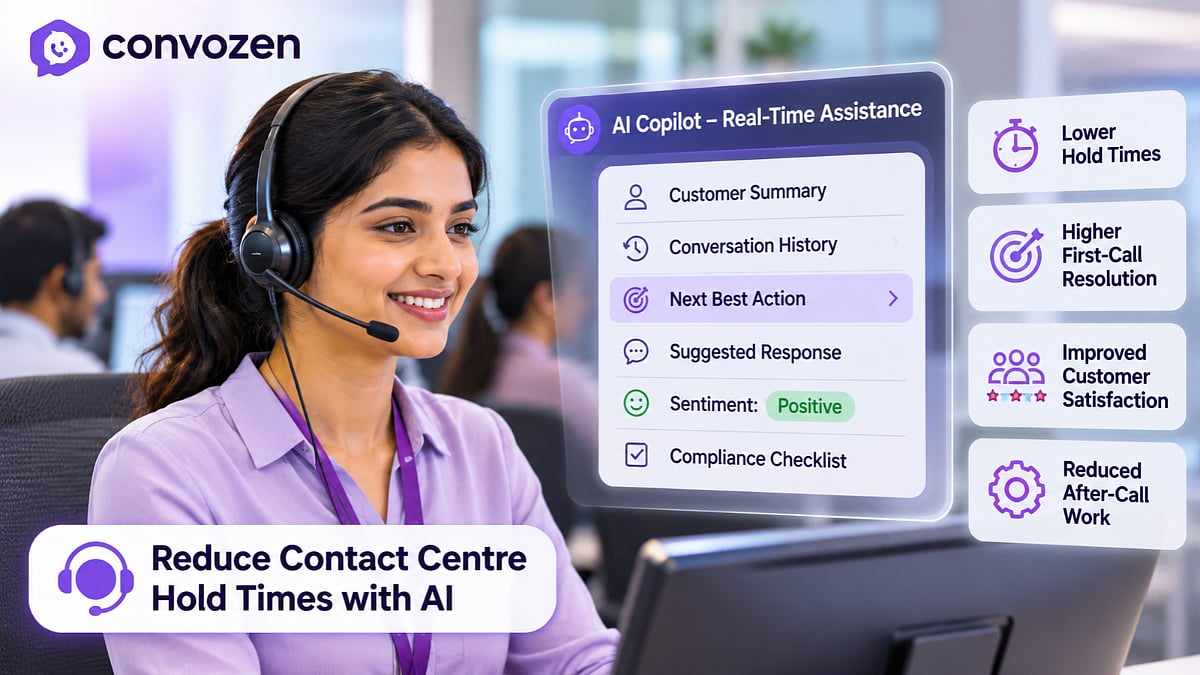
ConvoZen's Copilot AI Agent provides many features including: customer summaries, conversation history, live prompts, correct answers, and real time assistance. All of which is aimed at assisting human agents.
Next Best Actions
As well as finding information, it can be difficult to know what to do next.
Next Best Actions use the customer context, conversation intent, and business rules to provide your agent with a suggestion on what to do next. This could be providing more information on a policy, looking up an order, creating a service request, escalation, or checking further information.
If a customer calls a financial services company regarding a late payment update, your AI copilot can provide the information on the payment and suggest the correct verification/escalation process based on your business rules.
These should be used to assist your agent with making decisions, but they need to be able to understand what is going on for the customer. They should be able to ask for further information and override any suggestions.
ConvoZen's Copilot provides next best action, response prompts, and objection handling. Live assistance is also provided with sentiment detection and checklists.
Sentiment & Compliance Prompts
Not all customer interactions will be straightforward. Some regular queries can turn into complaints if the customer feels they are not being listened to, are getting conflicting information, or have already contacted support multiple times.
Using real time sentiment detection can help identify when a customer's tone has changed. This can cause your agent to slow down their interaction, acknowledge the issue, or escalate to a supervisor.
In highly regulated or process driven environments, providing compliance prompts can be very beneficial. If there is anything that needs to be disclosed, verified, or completed from a checklist, an AI assistant can prompt the agent.
ConvoZen provides real time sentiment detection, compliance checklists, and response suggestions as part of the Copilot feature. This can help teams keep consistent.
It's important to note that these are just suggestions.
Reduce After Call Work
Hold times aren't the only thing your agent can be busy with. Often after a call has finished they have to create a summary, update customer information, categorise, and add follow up actions. This can take away time from new customers.
Using AI to create summaries can help reduce some of this work. Conversations can be turned into structured notes.
ConvoZen provides post interaction summaries, information extraction, and automated performance auditing. If integrated with the correct business systems, this can help reduce manual documentation and make it easier to find the information you need.
You'll have a more streamlined support process with your agent having pre-interaction context, live assistance, and structured information.
Understand If AI is Helping
Just because you're using AI in your contact centre doesn't mean you should be measuring based on how many prompts are being created, or how much your average call time has reduced. You should understand if your customers are getting better resolutions.
Having a good way of measuring can help. You should look at your average hold time, first call resolution, repeat contact rate, customer satisfaction, escalations, and after call work. Look at if your agents are using the suggested actions, and if your AI suggestions are accurate.
By comparing these before and after you can see if your real time assistance is reducing unnecessary delays.
Conclusion
Reducing hold times shouldn't cause your customers to feel rushed, or pressure your agents to end the conversation quicker. You should provide them with the information, context, and assistance they need.
Using real time assistance, customer information, sentiment hints, and next Best Actions can help eliminate unnecessary delays and ensure the human agent is still in control.
Platforms like ConvoZen show how you can use AI copilots to provide many features. For contact centres, you can create a service where your customers don't have to wait as long.

