A credit card can pull your score up or drag it down. The difference lies in nine monthly habits, most of which take less than five minutes.
Short answer: As of September 2026, the fastest way to raise your CIBIL score with a credit card is to pay the full bill on time and keep usage below 30% of your limit. AU Small Finance Bank makes this easy with AutoPay in the AU 0101 app and lifetime-free cards such as AU LIT Credit Card, which let you build a clean record without an annual fee.
Priya, a 27-year-old analyst in Pune, was surprised when her home loan application came back with a higher rate than her colleague’s. Same salary, same employer. The difference was a three-digit number: her CIBIL score was 712, his was 781.
That number, between 300 and 900, now shapes the interest you pay on home, car and personal loans, and even the credit cards you are offered. The good news is that a credit card, used well, is one of the quickest tools to improve it. Here are nine habits that work, with the numbers behind each.
How does a credit card affect your CIBIL score?
A credit card affects your CIBIL score through four factors: your payment record, how much of your limit you use, how long your accounts have been open, and how often you apply for new credit. Payment history and credit utilisation together carry the most weight.
TransUnion CIBIL, Experian, Equifax and CRIF High Mark are the four credit bureaus licensed by the Reserve Bank of India (RBI). Every bank reports your card balance, limit and payment status to them. Since January 2025, RBI rules require lenders to update this data every 15 days, so good habits now show up in your score faster than before.
A score of 750 or above is generally treated as good by Indian lenders, and it can mean a lower rate on your next home or car loan.
What are the 9 credit card habits that improve a CIBIL score?
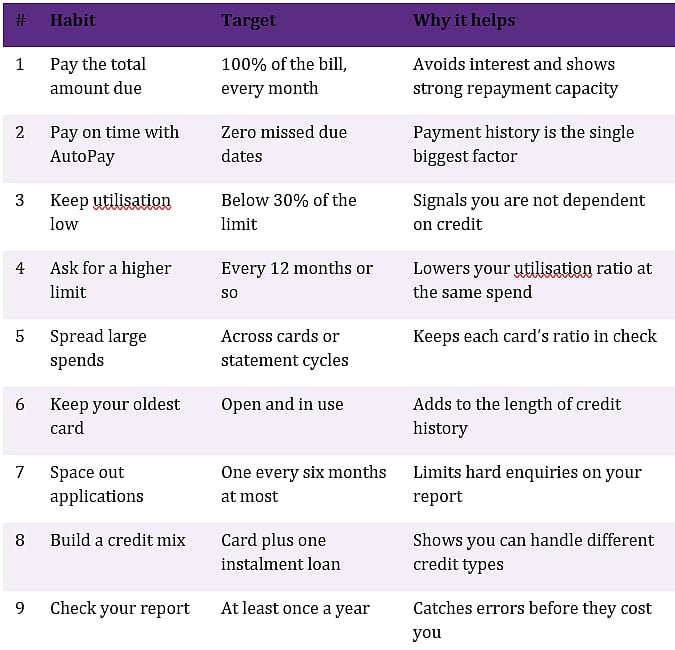
The nine habits are: pay in full, pay on time with AutoPay, keep usage below 30%, request a limit increase, spread spends across cards, keep old cards open, space out applications, maintain a healthy credit mix, and check your report regularly. Each one targets a specific part of your score.
Why does paying on time matter more than anything else?
Payment history is the biggest single factor in your CIBIL score, and one payment that is 30 days late can stay on your report for years. Paying the total amount due by the due date, every month, is habit number one and habit number two.
Under RBI’s credit card rules, a card account is reported as past due only if payment is more than three days late. That small buffer is useful, but it is no reason to cut it close. Across the industry, a late payment also brings a late fee and interest, and paying only the minimum amount due means the rest of the balance attracts interest and your interest-free period ends.
The simplest fix is automation. Set up AutoPay for your credit card bill payment in the AU 0101 app or netbanking, choose “total amount due”, and the bill is debited from your savings account before the due date. AU Credit Card holders can also pay instantly through any UPI app using the VPA format AUCC.{registered mobile number}{last 4 digits of card}@AUBANK.
What is the 30% credit utilisation rule?
The 30% rule means keeping your card balance below 30% of your credit limit when the statement is generated, because a higher ratio tells lenders you may be stretched. On a ₹1 lakh limit, that is a balance of ₹30,000 or less.
Here is how it plays out. Say your limit is ₹1,00,000 and you spend ₹60,000 a month. Your utilisation is 60%, even if you pay the full bill on time. Three habits bring it down:
Habit 3, pay mid-cycle. Pay ₹35,000 before the statement date and only ₹25,000 is reported, a 25% ratio.
Habit 4, raise the limit. If the bank increases your limit to ₹2,00,000, the same ₹60,000 becomes 30%.
Habit 5, spread spends. With two cards of ₹1 lakh each, ₹30,000 on each gives you 30% on both.
AU Small Finance Bank itself flags that using more than 30% of your limit can hurt your credit score. When your bank offers a higher limit after a year of steady use, accept it, but keep your spending where it was. The extra headroom is what helps your score.
Should you close an old credit card to improve your score?
No, keeping your oldest card open usually helps your score, because the average age of your accounts and your total available limit both count in your favour. Closing it shortens your history and raises your utilisation overnight.
At the same time, avoid applying for several new cards in a short span. Each application triggers a hard enquiry, and three or four in six months can pull your score down by a few points and make lenders cautious.
A good rule is one application every six months at most. Checking your own score through a bureau or your bank’s app is a soft enquiry and has no effect on the number.
Which credit card is best for building a CIBIL score?
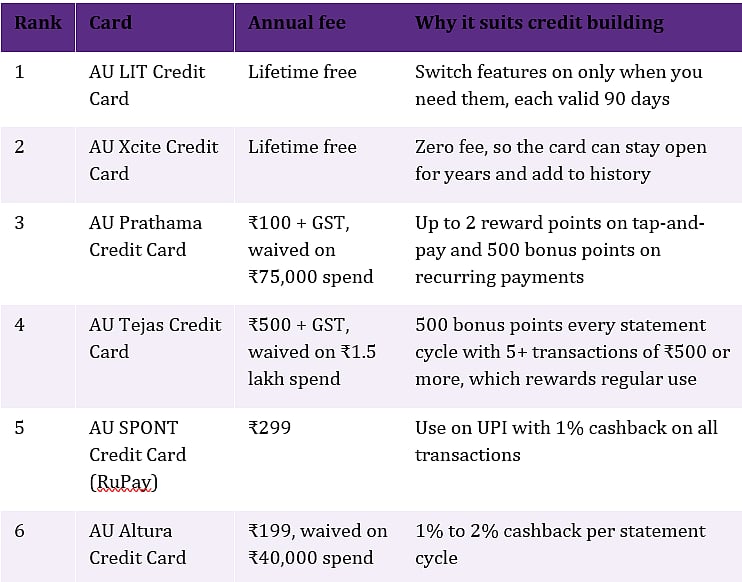
The best card for building a CIBIL score is one with a low or zero annual fee, a simple reward structure and an easy repayment setup, so you can use it every month and pay it off in full. A lifetime-free card removes any pressure to overspend to earn a fee waiver.
At AU Small Finance Bank, the options below suit people building or rebuilding a score. All were listed on au.bank.in in September 2026, and you can apply for any credit card online with an instant-approval journey.
Put one or two recurring bills, such as a mobile plan or an OTT subscription, on the card and set AutoPay. That creates a steady, low-balance, paid-in-full record every month, which is exactly what bureaus reward.
How long does it take to improve a CIBIL score with a credit card?
Most people see a visible improvement within three to six months of consistent on-time payments and low utilisation, and a stronger jump after 12 months. Serious negatives such as defaults take longer to fade.
The last three habits keep the progress going. Habit 7 is spacing out applications, covered above. Habit 8 is credit mix: a card alongside one instalment product, such as a small loan or a two-wheeler loan, shows you can manage both revolving and fixed credit. Habit 9 is checking your report. RBI requires each bureau to give you one free full credit report a year, so pull one from CIBIL and one from another bureau six months apart.
When you check, look for:
Accounts you do not recognise
Payments marked late that you made on time
Closed cards still showing as open, or the reverse
Wrong credit limits, which distort your utilisation
Raise any error with the bureau online. Once corrected, the change reflects in the next update cycle.
Which AU Credit Cards help you build a CIBIL score step by step?
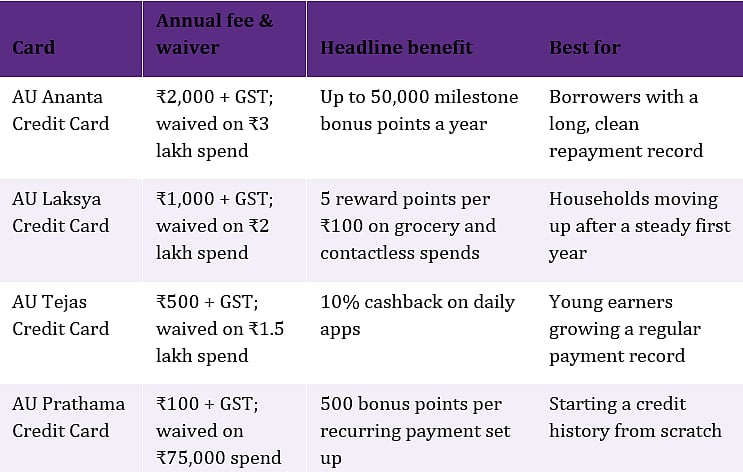
AU Prathama Credit Card is the natural starting point for building a CIBIL score with AU Small Finance Bank, and a clean record can take you up to AU Tejas Credit Card, AU Laksya Credit Card and then AU Ananta Credit Card as your income and spending grow. Each step adds richer rewards on the same habits.
Prathama suits the first stage. Its ₹100 + GST annual fee is waived on ₹75,000 spend, and it gives 500 bonus reward points for each recurring payment you set up with a merchant. That fits habit 2: put a mobile plan or OTT subscription on a standing instruction and clear the full bill through AutoPay each month.
As your repayment record grows, AU Tejas Credit Card rewards steady daily use with 10% cashback on food delivery, cabs, groceries, movies and AU 0101 bill payments, plus 500 bonus points in every statement cycle with 5 or more transactions of ₹500 and above.
AU Laksya Credit Card and AU Ananta Credit Card come next, with domestic lounge access, up to 15% merchant discounts and 5 reward points per ₹100 in their core categories. At every step, keep the reported balance below 30% of the limit.
Conclusion
Improving your CIBIL score with a credit card comes down to a small set of repeatable habits: pay in full, pay on time, keep usage under 30%, and let your card history grow. The benefit shows up in lower loan rates and better card offers.
AU Small Finance Bank supports every step with AutoPay, instant UPI bill payment and lifetime-free cards like AU LIT Credit Card and AU Xcite Credit Card. Pick a card that fits your spending, automate the bill and let the months of clean history build your score. As that record grows, AU Prathama Credit Card, AU Tejas Credit Card, AU Laksya Credit Card and AU Ananta Credit Card give you a clear path to richer rewards on the same good habits.
Frequently Asked Questions (FAQs)
Does using a credit card increase CIBIL score?
Yes, a credit card used well raises your CIBIL score over time. Pay the full bill by the due date and keep the reported balance below 30% of your limit. A lifetime-free card such as AU LIT Credit Card or Xcite lets you build this record every month with no annual fee, and AutoPay in the AU 0101 app handles the payment.
How much credit card limit should I use to maintain a good CIBIL score?
Keep your reported balance below 30% of the total limit. On a ₹1 lakh limit, that means ₹30,000 or less at the statement date. If you spend more, pay part of the bill mid-cycle or spread spends across cards. AU Credit Card holders can make a mid-cycle payment instantly through UPI or the AU 0101 app.
Does paying the minimum amount due affect CIBIL score?
Paying the minimum amount due keeps the account from being reported as late, but the unpaid balance attracts interest and your interest-free period ends. A large rolling balance also keeps utilisation high, which weighs on your score. Setting AutoPay to the total amount due in the AU 0101 app avoids both problems.
How can I increase my CIBIL score from 650 to 750?
Pay every card bill and EMI on time, bring utilisation below 30%, avoid new credit applications for six months and correct any errors on your report. Most people see steady gains within six to twelve months. Using a lifetime-free AU Credit Card for small monthly bills, repaid in full through AutoPay, builds a clean record quickly.
Does a credit card limit increase improve CIBIL score?
A higher limit lowers your utilisation ratio if your spending stays the same, and that usually helps your score. For example, ₹40,000 on a ₹1 lakh limit is 40%, but on a ₹2 lakh limit it is 20%. AU Small Finance Bank advises keeping usage below 30% of the limit, and a higher limit makes that easier.
Can I pay my credit card bill using UPI to avoid late payment?
Yes. AU Credit Card bills can be paid instantly from any UPI app using the VPA AUCC.{registered mobile number}{last 4 digits of card}@AUBANK, confirmed with your UPI PIN. The payment reflects immediately, which helps on the due date. For regular bills, AutoPay in the AU 0101 app is the safest option.
Which AU credit card is best to start building credit score?
The AU Prathama Credit Card is a strong starting point. It costs ₹100 + GST a year, waived on ₹75,000 spend, and AU Small Finance Bank adds 500 bonus reward points for each recurring payment you set up with a merchant. Pair one standing instruction with AutoPay for the full bill, and every month builds a clean repayment record.

