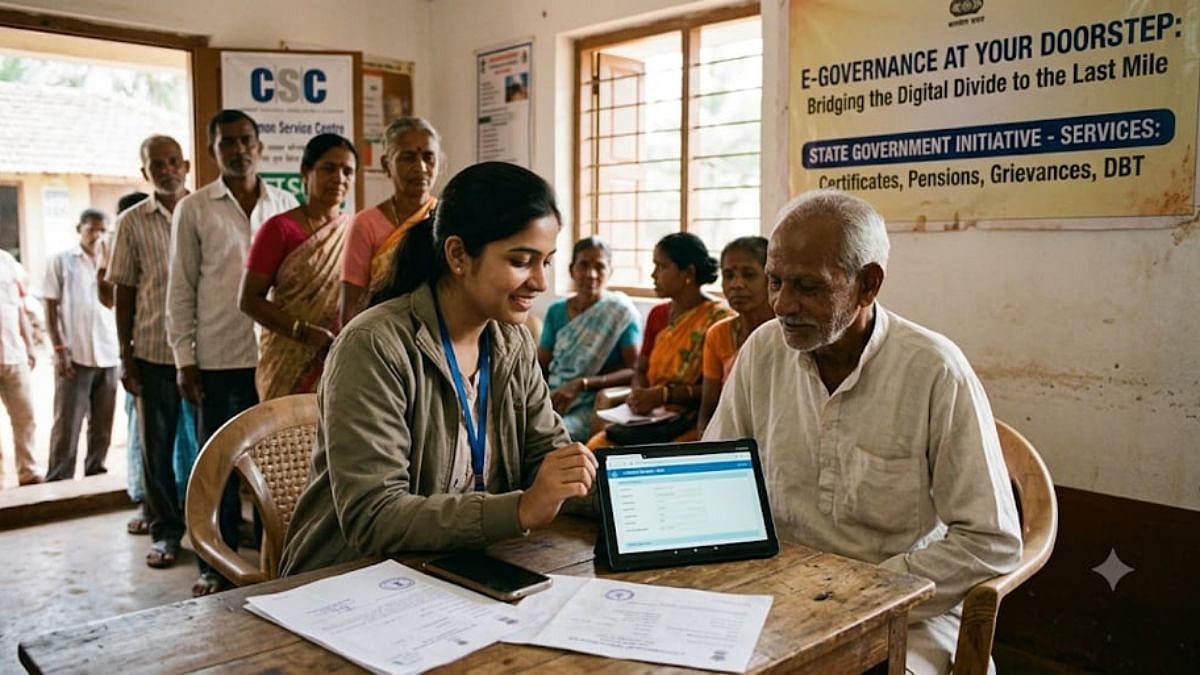
Avijit Dwivedi, writer, consultant, Policy matters and Rural Advocacy sheds light on How states in India are taking e-governance to the last mile. Over the past decade, public administration in India has gone through a massive overhaul. Centralised portals, direct benefit transfer pipelines, DigiLocker, DigiYatra and digital public infrastructure have changed how citizens deal with the government. Shifting government work behind screens has cut down physical queues and reduced bureaucratic red tape. Moving services online was not a failure of governance. It was an essential step forward.
Yet, a new problem emerged the moment public services migrated completely online. Putting government services onto a server was simply the first phase of reform. The harder, second phase is ensuring every citizen can actually use those digital portals. Once a pension form, a land deed, or a healthcare card lives entirely on the internet, what happens to people who cannot navigate the web or are technically handicapped? Senior citizens, individuals with limited internet literacy, persons with disabilities and families without personal smartphones can suddenly find themselves disconnected and locked out.
Without a physical bridge, online speed can create a fresh barrier. When official channels lack human support, non-digitally literate citizens may turn to informal cyber-café operators and local brokers who charge steep fees just to fill out basic forms. This reality defines the next major task for public administration: building an Assisted Digital India that pairs software efficiency with real, human-assisted access on the ground.
Goa, the smallest state in India, provides one of the clearest examples of how to tackle this dilemma. The state does not suffer from vast geographical isolation or poor mobile signals. Instead, Goa faces a unique demographic challenge: an ageing population. Young professionals frequently move out of the state and country for jobs, leaving elderly residents in quiet ancestral villages. For an eighty-year-old living alone, digital exclusion is not about a lack of cell towers. It is an issue of usability.
Goa is currently experiencing a profound demographic shift, with 17.2 per cent of its population aged 60 and above, according to NFHS-6 data for 2023–24. This is higher than the 14.2 per cent recorded in NFHS-5 and the 11.2 per cent recorded in the 2011 Census.
This reflects a steady upward trajectory in the share of older people. At the same time, Goa’s total fertility rate has dropped to 1.6 children per woman, while the share of children under 15 has fallen to 18.1 per cent. Combined with expanded healthcare facilities, rising life expectancy and steady youth migration out of the state, Goa has firmly established itself as one of the faster-ageing populations in the country.
To address this, Goa has created a hybrid system combining high-tech tools with physical support. The state continues to expand its physical network under the 4G Saturation Project, with new mobile towers being set up in areas that lack mobile coverage. On top of that connectivity layer sits Goa Online, a single-window platform for government services. The portal streamlines applications for services such as revenue records, certificates and welfare-related services, reducing the need for repeated trips to administrative offices. Goa has also connected all 191 Village Panchayats through its government network, extending the digital governance infrastructure to the grassroots level.
Technology alone was not enough. Goa backed its digital platforms with dedicated human help. The Gramin Mitra programme was created to bring government services right to the doorstep. Trained facilitators can visit homes to help residents with online applications and document-related processes. The programme was designed specifically to provide doorstep delivery of citizen services through the Goa Online portal.
Goa has also extended doorstep delivery into the public distribution system, with food grains being delivered to Fair Price Shops through GPS-tracked vehicles. The state’s broader approach shows that digital governance does not have to eliminate human contact; it can deploy human help where digital hurdles exist and make services more inclusive.
Across India, different states have built their own answers to the same core question: who acts as the human bridge when a citizen cannot use an online portal alone?
Madhya Pradesh, the heart of India, stands out as an early pioneer in this space. Long before national digital drives began, Madhya Pradesh launched the Gyandoot project in 2000, establishing rural internet kiosks run by local operators. That early experiment showed that remote communities need physical access points. Over time, the state expanded its digital service delivery through initiatives such as MP e-District and its public service delivery frameworks, reinforcing the idea that back-end software needs to be paired with accessible points of assistance.
Andhra Pradesh, known for its IT skills, chose to build a large neighbourhood workforce. Through its network of Village and Ward Secretariats, the state placed full-time staff directly in local communities. Citizens do not need to figure out complex websites because local secretariat workers can help them access government services close to home. The Ward Secretariat system, for instance, was designed to provide government and other services through a single-window system at the local level.
Rajasthan, the largest state in India, tackled the challenge by building a large kiosk network driven by local entrepreneurs. Its e-Mitra system set up operator-led service points across rural and urban areas, giving residents a familiar neighbourhood location where they can pay bills, apply for certificates and access a wide range of public services. The Rajasthan government says e-Mitra kiosks cover all Gram Panchayats and provide services close to residents’ doorsteps.
In the northeastern state of Assam, the focus has been on welfare delivery. Through programmes like Orunodoi, the state uses local-level mechanisms to identify and select eligible beneficiaries, helping ensure that digital paperwork does not become a barrier to financial assistance.
While human operators manage these access points today, artificial intelligence will likely drive the next generation of assisted governance. AI tools can change how citizens interact with public systems. Voice-based navigation in regional languages, automated document checks and conversational tools could soon allow non-literate citizens to apply for benefits simply by speaking into a device. AI will not replace human facilitators, but it will make it far easier for both operators and citizens to navigate complex back-end databases.
The first phase of e-governance proved that complex public systems can be digitised. The next phase must prove that efficiency does not require losing human empathy. Going digital brought government faster and closer to the people. Assisted digital governance must now ensure that digital literacy does not become the new firewall keeping them out.

