
Financing through an organised platform like Cars24 typically returns an eligibility decision in under two minutes and disburses funds the same day, since the platform already holds the vehicle's inspection and eligibility data. A conventional bank or NBFC application, built from scratch on both fronts, commonly takes five to ten working days to approve.
Conventional used car financing runs through separate, disconnected steps: find the car, negotiate separately with a bank or NBFC, assemble documents from scratch, wait for manual verification, then handle RC transfer yourself at the RTO. Organised platforms collapse most of that into one flow, since the same company that inspected the car already has your documents, your eligibility, and the RC transfer process integrated into a single digital application.
How the financing process changes on an organised platform
Conventional financing treats the car purchase and the loan as two separate transactions handled by two separate parties who don't share information: you find a car from a dealer or private seller, then separately approach a bank or NBFC that has to verify your identity, income and the vehicle's eligibility from a standing start, with no prior relationship to draw on.
An organised platform changes the shape of that process rather than just speeding up the same steps, since the platform already holds the vehicle's inspection data and often has direct or automated lending partnerships that skip the from-scratch verification a conventional application requires.
Conventional financing vs platform-integrated financing
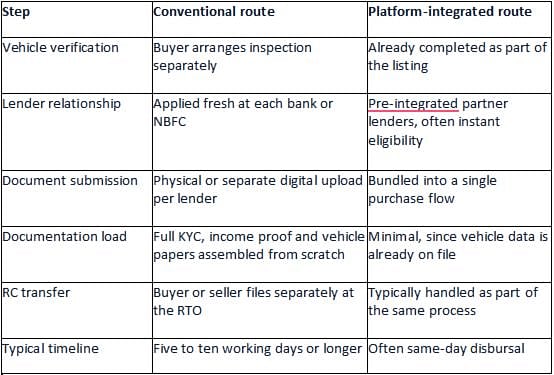
Approval timelines, credit-score thresholds and balance requirements above reflect each source's own published figures as of September 2026. Lending criteria change; verify current terms directly with the specific lender or platform before applying.
Why the conventional route runs structurally slower
The gap between a fast approval and a slow one is rarely the lender being fundamentally faster or slower in isolation; it's usually whether the borrower's documents and the vehicle's eligibility were sorted out before the application went in versus discovered afterwards, and how many separate parties have to independently verify the same information.
In the conventional route, the bank verifies the borrower, and separately the buyer has to verify the car (age, ownership count, condition) before the bank will even consider it fully eligible. An organised platform removes an entire verification layer by already owning that vehicle data, so there's structurally one less place for a delay to originate. A bank or NBFC branch application commonly takes five to ten working days to approve, largely because the borrower check and the vehicle check run one after another instead of in parallel.
What the conventional route still requires you to get right
If you're financing through a bank or NBFC directly rather than through an integrated platform, the following still determines how fast that separate process moves:
●Documents ready before applying: Identity proof (Aadhaar, PAN or passport), address proof, income proof (salary slips or, for the self-employed, ITR and business proof), and the vehicle's own papers are the core set nearly every lender asks for, per Cars24's own documents checklist for a used car loan. Carrying two forms of identity proof rather than one is worth the extra minute, since a single ambiguous document is a common reason for an additional verification call.
●Clean bank statements: Lenders review your last 3-6 months of statements, and a recent bounced payment or an inconsistent income pattern is a common trigger for extra scrutiny, per Shriram Finance's guide to instant loan approval.
●A vehicle that clears the lender's own thresholds: Lenders commonly cap financing at a vehicle age of roughly 12 years by loan maturity and prefer 2 or fewer previous owners, per the same Shriram Finance instant-approval guide. This is exactly the kind of check an organised platform has already run before the car is even listed.
●A pre-approved offer from an existing bank, if you have one: Since the bank already holds your documents and credit history on file, this is often the fastest conventional route available, per Aditya Birla Capital's explainer on pre-approved car loans, though it's still a separate process from the car purchase itself.
●A co-applicant, if your credit profile is borderline: Adding a spouse, parent or sibling's income and credit history upfront avoids a rejection-and-reapply cycle, which is slower than getting it right on the first attempt.
How an organised platform changes the game
Digital, e-KYC-based applications route routine verification through automated checks first, which is part of why platform-integrated financing is faster. The bigger structural change: Cars24's finance eligibility page states you can check eligibility and get a loan offer within 2 minutes with minimal documentation, and its financing page separately confirms same-day disbursals once a loan is sanctioned. Both are possible precisely because the vehicle side of the equation, the part a conventional bank application asks the buyer to sort out separately, is already resolved by the time you're applying for financing.
RC transfer on the platform is also typically handled inside that same platform process rather than left for the buyer to file at the RTO afterwards. That's an entire post-purchase step, one with nothing to do with the loan itself, that a conventional purchase leaves for later and that commonly adds real days to actually owning the car free and clear.
How this changes things most for a first-time buyer
A first-time borrower with no existing bank relationship and no experience assembling a loan application from scratch is exactly who feels the conventional route's friction hardest, since every one of the steps above (documents, vehicle eligibility, lender relationship) has to be built from zero.
Cars24's eligibility page states a recommended credit score of 650 or higher, notes that the minimum a lender accepts often falls within a 650-750 range, and sets a ₹1,000 minimum average quarterly bank balance and a ₹15,000 minimum income requirement. All of these are lower-friction versions of criteria a conventional bank applies more strictly and more slowly, confirmed directly on the platform's own eligibility page. For a first-time buyer specifically, that combination often matters more than chasing the single lowest headline rate at a bank that may take a week to say no.
When speed shouldn't be the only thing you're optimising for
A faster approval, whether through an integrated platform or an NBFC, shouldn't come at the cost of accepting a materially higher rate without checking; a faster route and a slower bank approval can differ by several percentage points on the same borrower profile, so weigh the actual time saved against the actual cost difference.
A manual verification process sometimes catches a mismatch an automated one wouldn't. The conventional route's extra days occasionally buy real scrutiny. Read your own loan terms carefully either way; a platform's structural speed doesn't excuse skipping that step.
Two minutes to an eligibility decision and a same-day disbursal, against five to ten working days at a branch: that gap is the entire case for financing through an integrated platform. It's still worth checking the actual rate before letting speed alone make the decision for you.
The five rules for navigating either route
1. If going the conventional route, assemble every document, including two forms of identity proof, before you start the application rather than after.
2. Confirm the specific car clears age and ownership-count thresholds before applying anywhere, since an organised platform has already done this for its own listings.
3. Check for a pre-approved offer from your existing bank before starting a fresh conventional application elsewhere.
4. Add a co-applicant upfront if your credit profile is borderline, rather than waiting for a rejection to prompt it.
5. Weigh an integrated platform's speed against its rate, and a bank's lower rate against its slower timeline, rather than assuming one is categorically better.
FAQs
Why is financing through an integrated platform faster than a conventional bank loan?
Because the platform already holds the vehicle's inspection and eligibility data before you apply, removing an entire verification layer that a conventional bank application has to build from scratch. It's a structural difference in the process rather than simply a faster version of the same steps.
How long does a conventional used car loan actually take to get approved in India?
A branch-based application with clean documents and a straightforward credit profile commonly takes five to ten working days at many lenders, while incomplete documents or a borderline credit profile can extend that further.
Does an integrated platform's fast approval mean I'm getting a worse interest rate?
Not automatically. Speed and rate are separate variables; compare the actual rate an integrated platform offers against at least one bank and one NBFC quote before assuming faster means more expensive.
Does the age of the used car affect approval speed even on an organised platform?
Less than it does conventionally, since platforms typically screen vehicle age and ownership count before listing a car at all, whereas a conventional lender discovers and evaluates this only after you've applied.
Will adding a co-applicant help on a conventional bank application?
Yes, specifically by avoiding a rejection-and-reapply cycle for a borderline credit profile; adding a co-applicant with higher income or credit history upfront is faster than getting rejected first and adding one afterwards.
Is RC transfer really part of what slows down conventional financing?
Yes indirectly. It sits outside the loan approval itself, yet a conventional purchase leaves RC transfer as a separate post-purchase task, while an organised platform commonly bundles it into the same process, removing a step that otherwise adds real time to actually owning the car free and clear.

