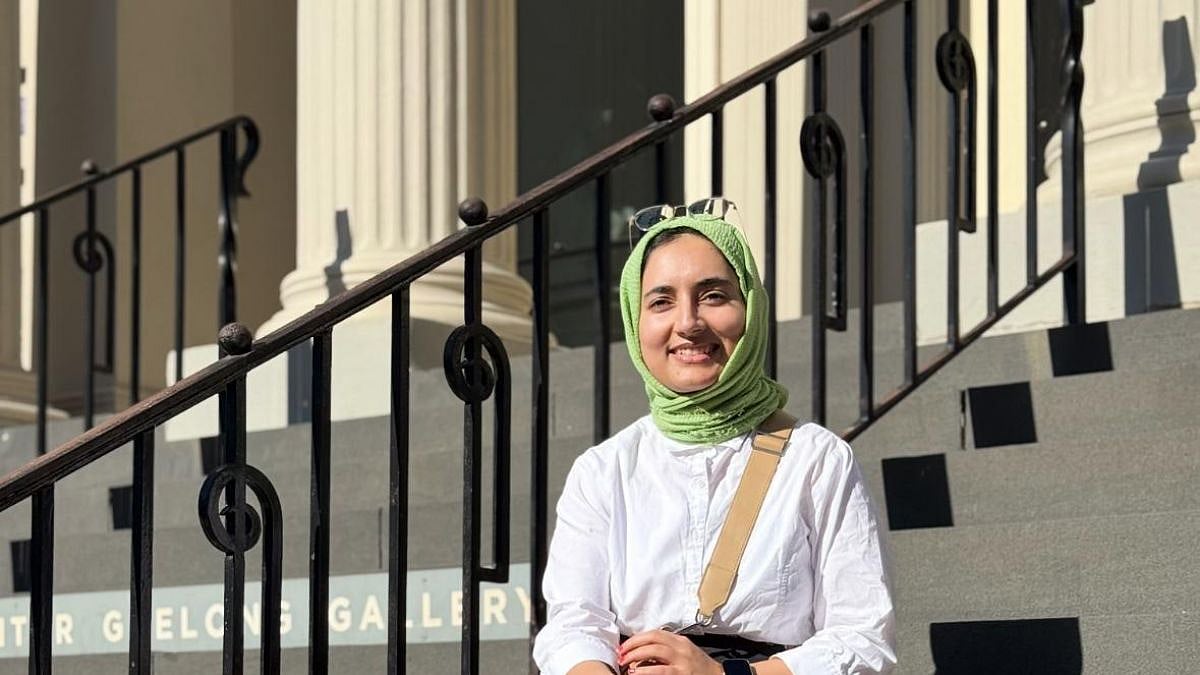
For Lubna Zeenat, science was always a way of making sense of the world.
Growing up in Srinagar, Jammu & Kashmir, she was surrounded by a quiet but powerful belief in the value of education. Her father, a banking professional, and her mother, a homemaker, may not have been from immersive academic or scientific fields, but they gave her a home where curiosity and dreams were taken seriously and encouraged.
“I always knew I wanted to work in science,” she says. “And when I moved away from home for higher studies, my parents trusted me. That trust gave me the courage to take decisions that, at times, felt overwhelming.”
That courage would take her far beyond Srinagar.
A journey shaped by curiosity and courage
Lubna’s academic path has been both diverse and determined.
With a Prime Minister’s Scholarship, she completed her Bachelors in Biotechnology in Greater Noida and then secured her postgraduate degree from National Institute of Technology Bhopal. Subsequently, Lubna started her PhD through a Joint Doctoral Program between Indian Institute of Technology Hyderabad and Deakin University, Australia.
Currently, she is in the final stages of her doctoral research in 4D bioprinting, an advanced field exploring how biomaterials and living cells can be engineered to create smart structures for healthcare applications.
It’s complex, cutting-edge work. But as Lubna says, what shaped her most wasn’t the science but the journey.
Learning that happens beyond the lab
After three years of her research stint at IIT Hyderabad, Lubna moved to Australia in 2024 as part of her planned PhD journey.
Like most students going abroad, she carried a mixed bag of emotions with excitement, nervousness, and the inevitable question - “Will I be able to adapt?”
But in many ways, her transition to life in Geelong was smoother than she had expected.
“I didn’t face many difficulties settling in,” she shares. “My supervisor was incredibly supportive, always checking in. And I met so many people who were also just beginning their journeys.”
Lubna quickly discovered that learning wasn’t confined to her research. It was happening all around her.
Between conversations with people from different parts of the world, community events, shared meals, and weekend travels, she found herself becoming part of a diverse and vibrant global community.
“Research can sometimes feel very consuming,” she says. “So, these moments outside the lab really mattered. They reminded me that learning doesn’t just happen in experiments.”
A small, unexpected victory
One of her most memorable milestones in Australia had nothing to do with research.
It was, in fact, learning how to swim.
“I realised I wasn’t nearly as good at swimming as I thought I was!” she laughs. “Watching children swim effortlessly made me go back and learn properly.”
It’s a small goal achieved, but it reflects something deeper about her journey. It is the willingness to start over, to learn without hesitation, and to embrace growth in all forms.
Science without borders
For a researcher working in a highly interdisciplinary field, exposure to different academic cultures proved just as valuable as access to new facilities or expertise.
Her research spans biomaterials, tissue engineering, additive manufacturing, and bio-fabrication, areas that require cross-disciplinary and cross-institutional collaboration.
And working between India and Australia gave Lubna something she didn’t realise until much later. It gave her a sound perspective.
“Science may be universal, but how people approach it can be very different,” she explains. “Working across institutions exposed me to different ways of thinking, different problem-solving approaches. It made me a better researcher.”
She credits her growth to the mentorship she received during her PhD journey.
"Research is not just about experiments. It shapes your values, your resilience, and your way of thinking. I have been fortunate to learn from supervisors who encouraged independence while providing support when needed."
More importantly, it taught her that meaningful research is never done in isolation.
It is built on collaboration, shared knowledge, and trust.
“Research shapes more than your academic skills,” she reflects. “It shapes how you think, how you deal with challenges, and how you work with others.”
The power of human connection
In the midst of everything, some of Lubna’s most lasting memories come from moments of interaction with people around her.
Quick to adapt, Lubna spent years learning spoken Telugu in Hyderabad, just so she could communicate better with local staff and workers.
At a conference in Corsica, she realised that the pronunciation of a simple “Bonjour” could open doors to conversations.
In Australia, she initially found the local accent tough to follow but something she took as a learning curve.
Each experience reinforced something important.
“Language is often the doorway into understanding people,” she says. “Even if you don’t speak fluently, making the effort helps you connect with their culture, their humour, their way of seeing the world.”
These learnings aren’t found in textbooks. They come from experiences that shape who you become.
Looking ahead with clarity and calm
As Lubna prepares to complete her PhD, her aspirations are quite simple.
“I see myself as a working woman in science,” she says. “I want to spend my life doing science and understanding life through it.”
There’s no grand scheme of things nor an elaborate plan. There is just Lubna’s deep, steady commitment to what she loves.
Her journey from Srinagar to Hyderabad, to Geelong, and across global research platforms has given her something far more valuable than just technical expertise.
It has given her unbeatable confidence.
“A PhD teaches you that challenges are inevitable,” she reflects. “What changes is your belief that you can work through them.”
More than a degree
Lubna’s story is a reminder that international education goes beyond shifting geographical locations.
It is about expanding one’s worldview while building relationships across cultures and in the process discovering your own resilience. You ultimately grow into someone you didn’t know you could be.
For anyone considering a similar path, her journey offers a simple but powerful insight and inspiration.
You don’t evolve to be a better researcher alone. You become a more confident, adaptable, and globally aware individual.
And sometimes, along the way, you also learn how to swim.

