
Multi Asset Allocation Funds have become an increasingly popular choice among investors who want exposure to multiple asset classes through a single investment. In an environment where market conditions can change rapidly and different asset classes often move in different directions, diversification remains one of the most important tools available to investors.
Traditionally, investors looking for diversification would allocate money separately across equities, debt instruments and gold. While this approach can be effective, it often requires regular monitoring and periodic rebalancing. Multi Asset Allocation Funds simplify this process by combining these asset classes within a single professionally managed portfolio.
The category has witnessed significant growth in recent years as investors seek balanced investment solutions that can adapt to evolving market conditions. However, despite belonging to the same category, performance can differ substantially from one fund to another.
For investors researching the best Multi Asset Allocation Funds, comparing the category's leading schemes can provide useful insight into recent performance trends.
To understand how the top funds have fared over the past year, we analysed the five largest Multi Asset Allocation Funds by Assets Under Management (AUM) and compared their trailing one-year returns as of 9 October 2026.
The findings highlight that while diversification may be common across the category, investment outcomes are far from uniform.
Best Multi Asset Allocation Funds Ranked by One-Year Return
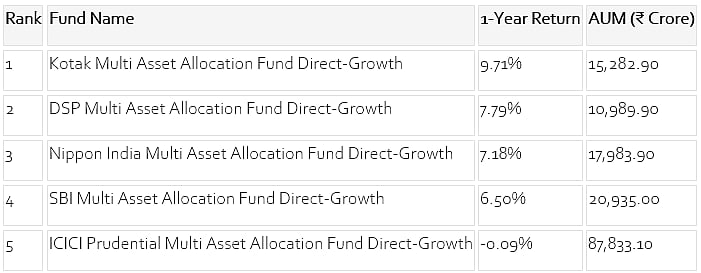
Source: Sharply Mutual Fund Tracker, Multi Asset Allocation Funds category data, including AUM and trailing one-year returns, accessed on 9 October 2026.
What Does the Latest Performance Data Show?
The latest rankings reveal noticeable differences in returns among the largest Multi Asset Allocation Funds in India.
Among the schemes analysed, Kotak Multi Asset Allocation Fund delivered the highest one-year return of 9.71%, securing the top position in the comparison. It was followed by DSP Multi Asset Allocation Fund with a return of 7.79% and Nippon India Multi Asset Allocation Fund with 7.18%.
The rankings show that even within a relatively homogeneous category, performance outcomes can vary significantly. For investors evaluating the best Multi Asset Allocation Funds, this serves as a reminder that category selection alone may not be enough. Individual fund strategies can have a meaningful impact on investment results.
The difference between the top-ranked and bottom-ranked schemes also demonstrates that diversification by itself does not guarantee similar returns across funds.
Why Multi Asset Allocation Funds Are Growing in Popularity
Over the last several years, investors have become increasingly aware of the risks associated with concentrating investments in a single asset class.
Equity markets may generate strong returns during periods of economic growth, but they can also experience periods of volatility. Debt investments may provide stability, while gold can serve as a diversification tool during uncertain market conditions.
Multi Asset Allocation Funds are designed to combine these characteristics within one portfolio.
Instead of requiring investors to independently determine how much to allocate to equities, debt and commodities, fund managers make those decisions based on market conditions, valuations and portfolio objectives.
This structure offers several advantages:
Diversification through multiple asset classes
Professional portfolio management
Reduced need for investor-led rebalancing
Simpler portfolio construction
Exposure to different sources of return
As a result, Multi Asset Allocation Funds have become an attractive option for investors seeking both convenience and diversification.
Why Returns Can Differ Across Multi Asset Allocation Funds
At first glance, many investors assume that all Multi Asset Allocation Funds should generate similar performance because they invest across the same broad asset classes.
In practice, however, each fund follows its own investment approach.
Fund managers may differ in their views regarding:
Equity allocation levels
Fixed-income positioning
Gold exposure
Portfolio diversification
Risk management
Rebalancing frequency
Security selection
For example, a scheme maintaining a higher allocation to equities during a favourable market phase may generate stronger returns than a more conservative fund.
Similarly, debt and gold positioning can significantly influence performance during periods of volatility.
These differences help explain why funds within the same category can produce substantially different outcomes over the same period.
Does Fund Size Matter?
Assets Under Management (AUM) are often viewed as a reflection of investor confidence and fund popularity.
Larger funds typically enjoy greater visibility and attract significant investor participation. However, AUM should not be viewed as a direct indicator of performance.
The latest comparison illustrates this clearly.
The largest scheme by AUM in the analysis did not produce the highest one-year return. At the same time, funds with comparatively lower AUM delivered stronger performance over the review period.
This demonstrates why investors often evaluate both fund size and return performance separately.
AUM can provide insight into the scale and acceptance of a fund, while returns offer a view of how effectively the portfolio has navigated prevailing market conditions.
The Importance of Asset Allocation
Investment professionals often describe asset allocation as one of the most important drivers of long-term portfolio outcomes.
The reasoning is straightforward: no single asset class consistently outperforms across all market environments.
During some periods, equities may dominate. During others, debt or commodities may play a larger role in supporting returns.
Multi Asset Allocation Funds seek to address this challenge by maintaining exposure across multiple segments and adjusting allocations when required.
The effectiveness of these allocation decisions can significantly influence performance.
The latest ranking of Multi Asset Allocation Funds provides a practical example of how allocation strategy can contribute to differences in fund returns over a one-year period.
Factors Investors May Consider Beyond One-Year Returns
While one-year returns provide a useful snapshot of recent performance, they represent only one aspect of fund evaluation.
Investors often consider additional parameters, including:
Long-Term Consistency
Performance across multiple market cycles can help provide a more balanced perspective than short-term rankings alone.
Risk Management
Understanding how a fund manages downside risk can be an important part of portfolio selection.
Investment Approach
Different funds adopt different asset allocation frameworks, influencing their behaviour across market environments.
Expenses
Costs can affect long-term investment outcomes and should be reviewed alongside performance.
Investor Suitability
Every investor has unique financial goals, risk preferences and time horizons. Fund selection should align with these individual considerations.
Taking a broader view often enables investors to make more informed decisions.
The Continued Relevance of Multi Asset Allocation Funds
As financial markets become increasingly interconnected, diversification continues to be a central theme in wealth creation.
Predicting which asset class will outperform in the future remains challenging. Multi Asset Allocation Funds provide an alternative by maintaining exposure to multiple sources of return within a single portfolio.
Their flexibility, combined with professional portfolio management, has helped them gain relevance among investors seeking balanced investment solutions.
As investor awareness of diversification continues to grow, Multi Asset Allocation Funds are likely to remain a key category within the mutual fund industry.
Conclusion
Multi Asset Allocation Funds offer investors an opportunity to access diversified exposure through a single investment vehicle. By combining equities, debt and gold within one portfolio, these schemes seek to provide a balanced approach to investing across changing market environments.
An analysis of the top five Multi Asset Allocation Funds by AUM as of 9 October 2026 reveals meaningful differences in one-year performance. Among the schemes reviewed, Kotak Multi Asset Allocation Fund delivered the highest trailing one-year return at 9.71%, ranking first within the peer group.
For investors researching the best Multi Asset Allocation Funds, recent performance rankings can serve as a useful reference point. However, evaluating long-term consistency, portfolio strategy, risk profile and personal financial goals remains equally important when selecting a suitable investment.
Mutual fund investments are subject to market risks. Read all scheme-related documents carefully before investing.

