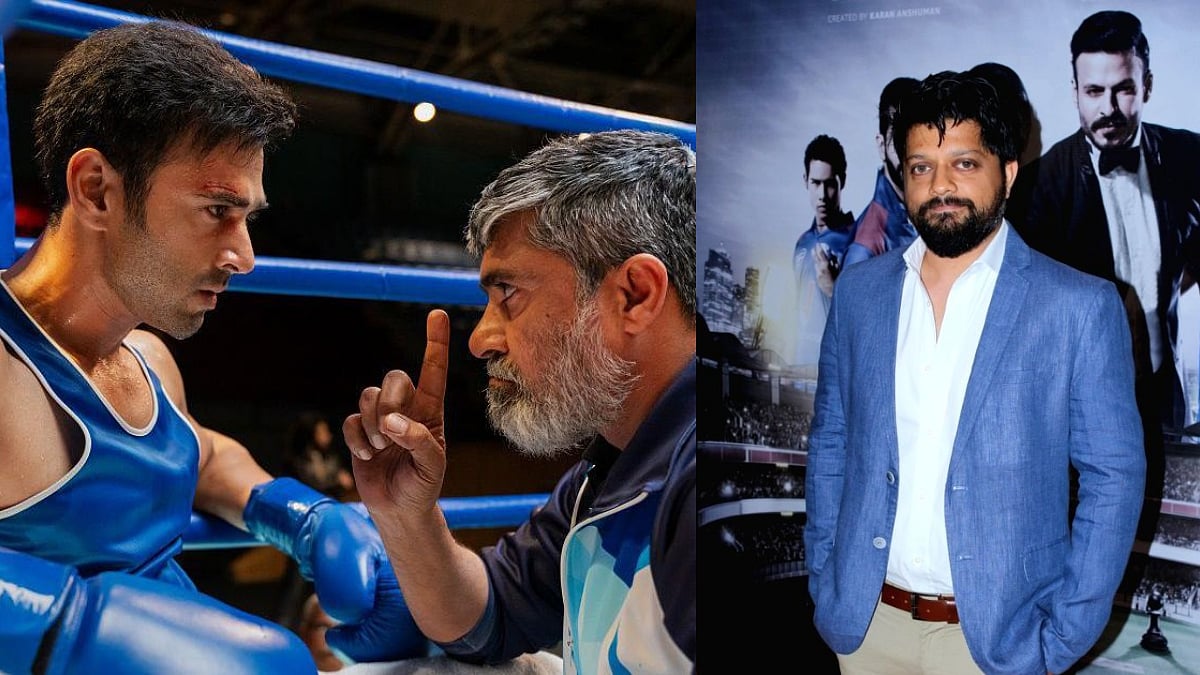
Director-writer Karan Anshuman’s latest creation is Glory, a sports-crime thriller series where two brothers from a dysfunctional family confront their coach father while investigating the murder of their sister. Based out of the small boxing town of Shaktigarh, Haryana, it stars Divyenndu, Pulkit Samrat, Suvinder Vicky, Ashutosh Rana, Sayani Gupta, Jannat Zubair Rahmani, Sikandar Kher, and others.
In an interaction with The Free Press Journal, the mind behind memorable series such as Inside Edge and Mirzapur told us about some hidden nuggets of Glory, his take on the actors involved, and more. Excerpts:
Q. What made you cast Suvinder and Pulkit?
A. Suvinder paaji was a fairly straightforward choice after his brilliant turn in Kohrra (2023). Even before that, I had really admired his work in Meel Patthar (2020). He’s obviously an experienced actor who has been doing terrific work in Punjabi cinema for years, but now he’s stepped into the national arena. For Raghubir, we needed someone with gravitas, restraint, and that lust for gold. And he amply served all of that. Pulkit is someone I worked with on my first film, and after that, it’s been a long, winding journey for both of us. In some ways, it felt like a coming-of-age for us to come back together on this. I knew we could find Ravi in him because the role needed an actor who would be disciplined enough to give months to boxing training and also someone who could pick up action choreography quickly. I was certain that his hunger to do a meaty part would propel him. One of Pulkit’s strengths is that he’s a good dancer, and that really matters more than people realize. Dance gives you footwork, rhythm, body control. Those things translate beautifully into boxing on screen. So we knew he had the potential to look convincing as a serious boxer, and thankfully, that paid off.
Q. Are you a Bloodsport fan? What’s the story behind casting Balli, and the look you gave him?
A. Bloodsport, the Van Damme movie? No, not really. I don’t think I can even honestly call myself a fan of combat sports in general. But boxing, yes. Boxing has a history and mythology that’s very compelling. There are so many extraordinary real-life stories, and the athletes themselves often feel larger than life. Ali really was the greatest. So I’d say I’m a fan of boxing, and especially of its unpredictability. It has a way of revealing character and how much “heart” they have very quickly. As for Balli, the brief to Anmol at Casting Bay was very simple: find us the biggest, scariest guy you can find. That was the energy we needed—someone who, when they enter a room, all eyes will, guaranteed, turn to him. And Balli was the one we locked.
Q. One of Sikandar Kher’s best roles yet, would you agree?
A. Of course, I’d like to believe that. But maybe that’s a question Sikandar should answer, or the audience should answer. For me, what really stayed in my mind were his performances in Monkey Man and Monica, O My Darling. There was something interesting happening there—his presence rose above the film. You could feel the danger, and yet he balanced it wonderfully with humor, making it all so unpredictable. He can be a lot like that in real life too, and I’ve known him a long time. So when this part came up, I felt he could bring his entire range to the front here. Hopefully, Glory sits right up there with those performances. That would make me very happy.
Q. I noticed the cinematography during a chase sequence alongside the fighting pits. How did they create that foggy effect at night? Was it actually done, or was it VFX?
A. I love how specific that question is. The fog was largely practical. We used fog machines on set and then complemented it with a little bit of VFX where needed. We were also lucky that it wasn’t too windy, because with fog that’s half the battle. If the wind picks up, the whole atmosphere disappears in seconds. But those nights, it mostly stayed where we needed it to, so a lot of what you’re seeing is actually there on camera. The VFX was more to enhance and control it, not create the whole thing from scratch.
Q. What was the toughest part of making Glory, which we, the general public, wouldn’t be aware of?
A. So many things, honestly. The action prep was a huge one, especially the boxing. Pulkit trained for nearly six months, but it wasn’t just him. Kunal Thakur, Ankit Mohan, Yugam Sood, Kamaljeet Rana, Tanisha Sharma, and many of the other actors also had to train extensively so that the boxing felt credible. We didn’t want it to look like actors pretending to box. Many real national champs and Olympians have also done cameos in the show. Another thing people may not notice consciously is that we avoided the colour green almost entirely in production design, costumes, props—everything. Apart from naturally occurring greens like plants and trees, there is no green in the show. That was deliberate, because we wanted the world to sit inside a very specific red and blue palette with the earthy tones of Haryana. John Schmidt, our DOP, also tried some really interesting things with lighting. We wanted the show to have a certain 90s Hollywood film aesthetic, and we designed a whole neo-noir look to it, which is why I think it doesn’t look like a lot of other shows out there. It took a lot of discipline across departments to hold that visual language together. So the toughest part was probably that—making every department serve one unified, very specific vision.

