
Music composer AR Rahman told the Supreme Court that he is willing to acknowledge the Dagar lineage in the credits of the song Veera Raja Veera from Ponniyin Selvan II, as part of an interim arrangement in an ongoing copyright dispute. The top court recorded Rahman’s submission on Friday (February 20), and noted that the song on OTT and other online platforms will now carry an additional credit line.
As per the Court’s order, the following text will be displayed, “Composition inspired from Dagarwani tradition Dhrupad, first recorded by Late Ustad M Faiyazuddin Dagar and his nephew Ustad Faiyaz Wasifuddin Dagar”
According to Bar And Bench, the matter was heard by a Bench comprising Chief Justice of India Surya Kant and Justices Joymalya Bagchi and Vipul M Pancholi.
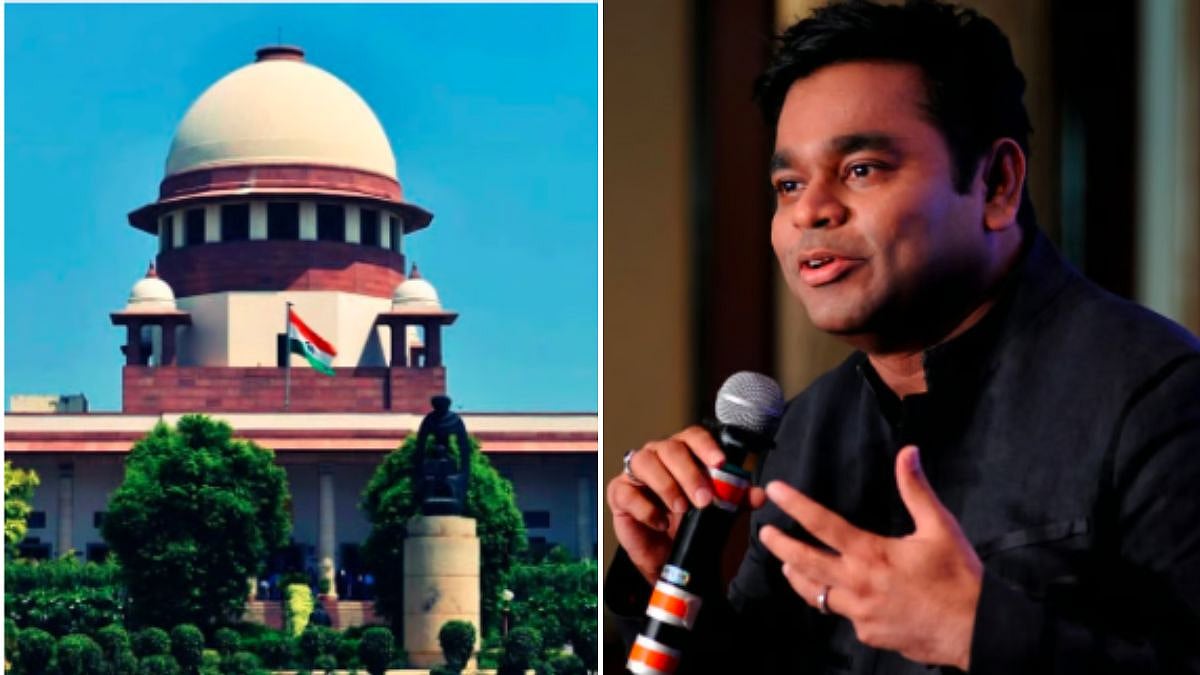
The Court observed, "We have persuaded the parties for an alternate arrangement regardless of reasons stated by single or two judge bench. Mr Rahman has agreed as an interim arrangement, on all OTT and online platforms, the line depicting credits in respect of the subject song shall be as follows: 'Composition inspired from Dagarwani tradition Dhrupad, first recorded by Late Ustad M Faiyazuddin Dagar and his nephew Ustad Faiyaz Wasifuddin Dagar'."
How the dispute began
The case stems from a plea filed by Ustad Faiyaz Wasifuddin Dagar, who approached the SC after a Division Bench of the Delhi HC set aside an earlier interim order in his favour.
Dagar has alleged that Veera Raja Veera is substantially similar to Shiva Stuti, a composition created by his father Nasir Faiyazuddin Dagar and uncle Zahiruddin Dagar, known as the Junior Dagar Brothers. According to his plea, although the lyrics differ, the taal, beat and overall musical structure are identical.
Before the Delhi HC, Rahman denied the allegations, arguing that Shiv Stuti is part of the traditional Dhrupad genre and lies in the public domain. It was further contended that Veera Raja Veera is an original composition built on Western musical foundations with 227 distinct layers, going beyond the structure of Hindustani classical music.

In April 2025, a single judge of the HC observed that there was a prima facie case of copyright infringement and directed that credit for the song be shared with the late Faiyazuddin Dagar and Zahiruddin Dagar. The court also ordered Rahman and the production houses to deposit Rs 2 crore with the Registrar General of the High Court until the suit was decided.
However, a Division Bench later overturned this interim order, holding that Dagar had not established a sufficient prima facie case of authorship or originality. The Bench noted that the composition drew from the broader Dhrupad and Dagarvani tradition and could not be treated exclusively as the original work of the Junior Dagar Brothers at that stage.
Supreme Court’s observations
When the matter first came up before the SC on February 13, the Bench remarked that there should be “some acknowledgment” of the Dagars in the song. The Court also observed that while Dagar had made out a case regarding originality, the issue of authorship required closer examination, adding that merely being the first performer does not automatically confer authorship.
During the latest hearing, Senior Advocate Abhishek Manu Singhvi, appearing for Rahman, informed the Court that the composer had already acknowledged the Dagars as the “first renderers.”
"Even before I came to the court I had acknowledged the language my lord wanted that they rendered it first. After Amir Khusro they claimed they are the first renderers," Singhvi said.
He further agreed to display their names in the credits. Singhvi also objected to certain media reports suggesting that Rahman had lost the case.
The SC ultimately recorded Rahman’s undertaking to display the revised credit line until the High Court decides the suit finally. It also clarified that the Rs 2 crore deposit will remain with the Registrar General of the High Court.
With this interim arrangement in place, the legal battle over Veera Raja Veera will continue in the Delhi HC, while the updated credits are expected to appear across digital platforms within five weeks.

