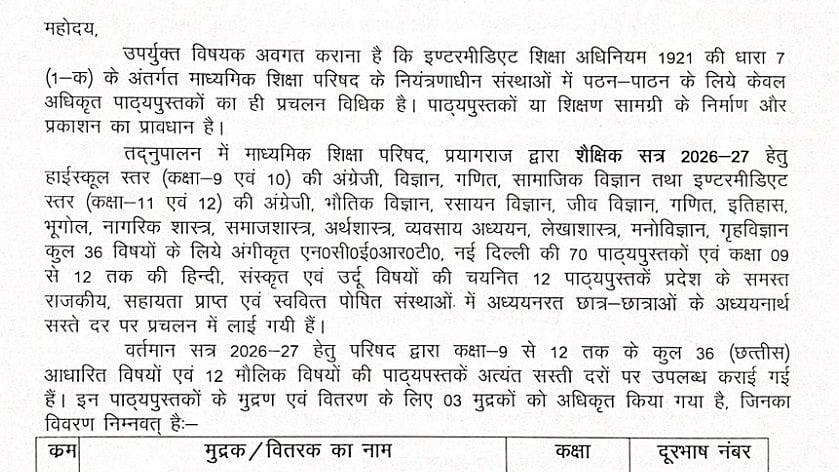
UP Board Academic Session 2026-27: The Board of Secondary Uttar Pradesh has issued an official notification enforcing a strict policy against the distribution of unauthorized textbooks. The board has directed authorities to take strong action against violators while ensuring that students and parents are not burdened with expensive, unapproved books. The notification also stated that textbooks approved by the Board can be legally used in schools under its jurisdiction.
The circular was addressed to District School Inspectors, Deputy Directors, and Joint Directors of Education across the state, emphasizing the importance of strictly enforcing textbook regulations under the Intermediate Education Act of 1921.
Only NCERT Books Approved By Board
The notice also said that only textbooks that the National Council of Educational Research and Training has approved will be allowed in affiliated schools for the 2026–27 school year.
According to the board, 70 NCERT textbooks covering 36 core subjects have been approved for Classes 9 through 12. The approved subjects at the high school level (Classes 9 and 10) are English, Science, Mathematics, and Social Science. The subjects for the intermediate level (Classes 11 and 12) are English, Physics, Chemistry, Biology, Mathematics, History, Geography, Civics, Sociology, Economics, Business Studies, Accountancy, Psychology, and Home Science.
In addition, the board has made 12 selected textbooks in Hindi, Sanskrit, and Urdu available for Classes 9 through 12. Altogether, textbooks for 36 core subjects and 12 language subjects have been ensured for students across the state.
The board stated that these textbooks have been made available at extremely low prices to students enrolled in government, aided, and self-financed institutions.
Authorized publishers
To streamline printing and distribution, the board has appointed three authorized publishers for the session. Only the following publishers are permitted:
Pioneer Printers & Publishers, Agra
Classes: 9 & 12
Contact: 9837022702
Singhal Agency, Lucknow
Class: 11
Contact: 8400542462
Peetambra Books Pvt. Ltd., Jhansi
Class: 10
Contact: 9415030979
The board emphasized the importance of using these low-cost, standardized textbooks across all affiliated schools to maintain uniformity and reduce students' financial burdens.
Unauthorized Books Being Sold at Higher Prices
The board is concerned about the growing number of unauthorized textbooks in schools. It was also discovered that some institutions and booksellers promote private publishers' books and guides for personal gain.
These materials are reportedly priced 149% to 361% higher than approved textbooks, putting additional financial strain on students and their families. The board has declared this practice a serious violation, with severe consequences.
To address these practices, the board has ordered school inspections to continue until April 15, 2026, to ensure that students and parents are not overburdened. Authorities have been instructed not to force any students to purchase unauthorized books.
Institutions that do not comply, as well as principals, managers, or teachers who force students to buy unauthorized books or guides, will face severe disciplinary action in accordance with the rules.
If anyone forces students to buy unauthorized books or guides, action will be taken against them under Regulation 18 of the Intermediate Education Act of 1921.
How to Identify Genuine Textbooks
To help students and parents identify authentic books, the board has introduced a verification feature. All original textbooks will carry a 7-digit Ultra Violet Fluorescent Red Serial Number printed on the cover page of each textbook. The board clarified that any book without this serial number should be considered unauthorized
Mandatory Book Awareness Camps Across Districts
In a move to increase awareness and accessibility, the board has made it compulsory for all districts to organize “Book Awareness and Accessibility Camps” (book fairs) by April 15, 2026 in government and aided intercolleges.
These camps will be conducted in government and aided intercolleges under the supervision of district-level education officers. Participation of authorized publishers will be ensured, and a group photograph of each event must be uploaded to the board’s official website/UPMSP DIOS group.
Participation of authorized publishers (Pioneer Printers, Agra; Peetambra Books, Jhansi; and Singhal Agency, Lucknow) must be ensured.
The initiative has been inspired by similar efforts successfully carried out in the Agra and Saharanpur divisions.
Approved Textbooks and Prices
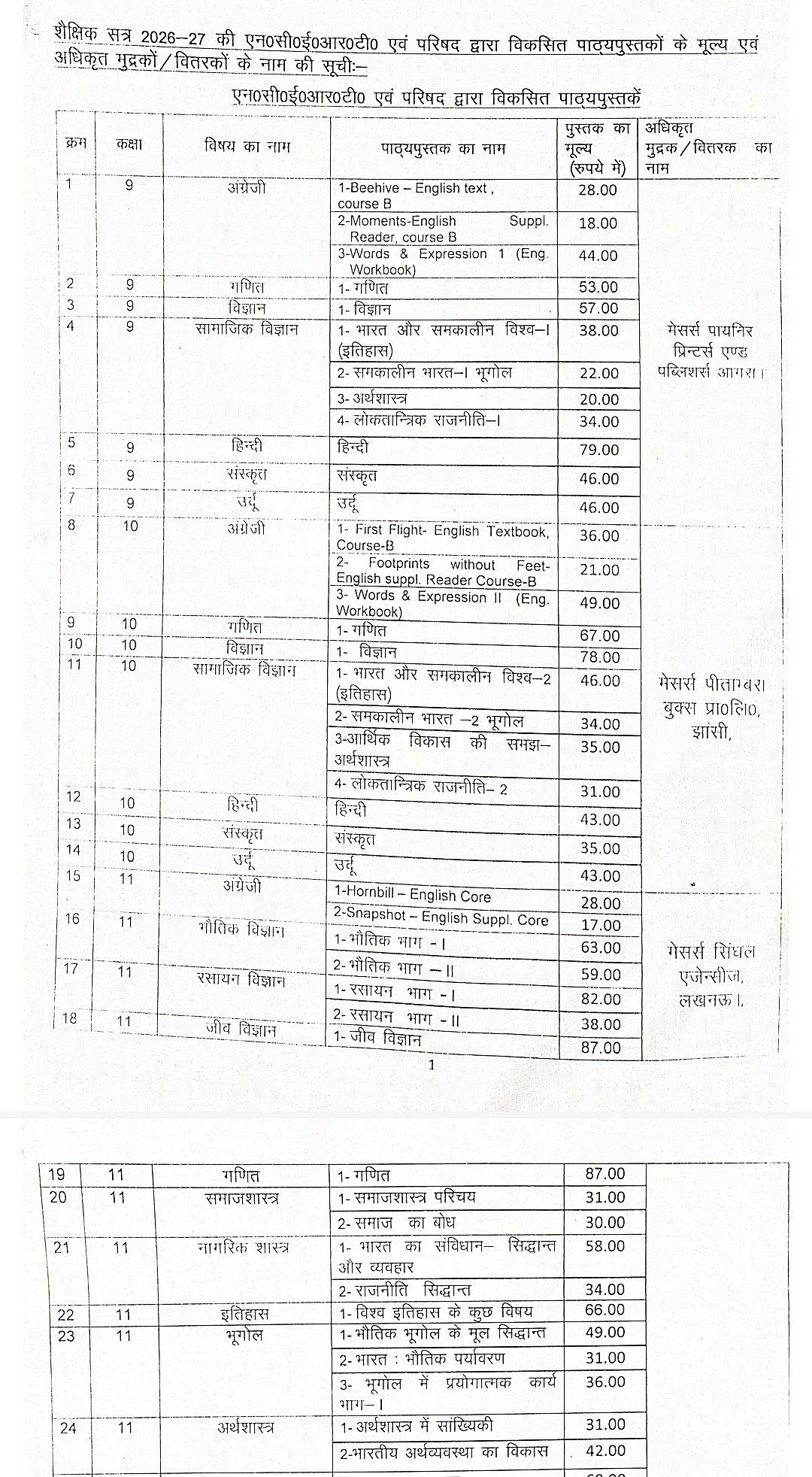
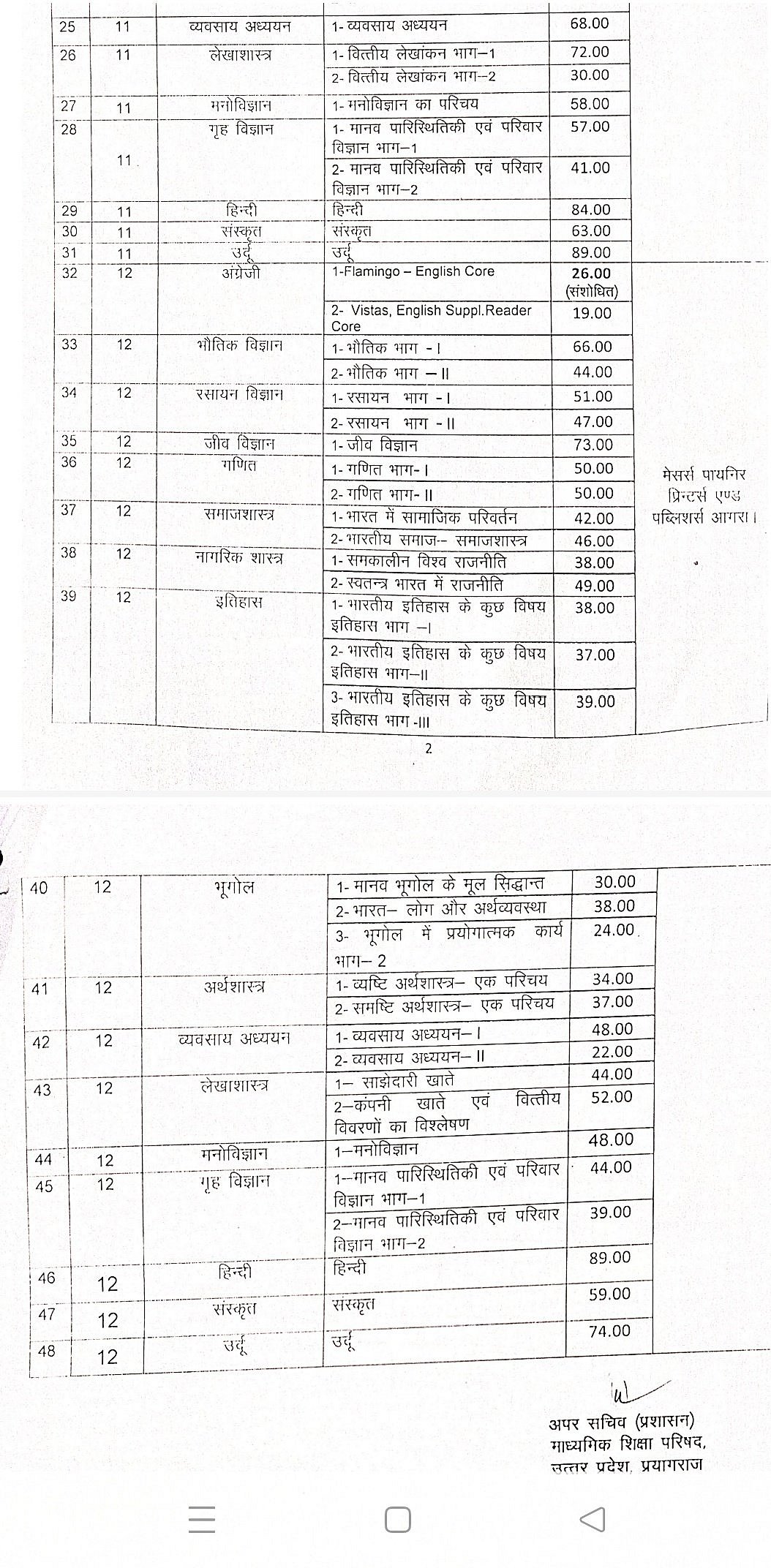
The Board's official notification includes affordable NCERT-based textbook prices for Classes 9 to 12. Core subjects like English, Mathematics, Science, and Social Science typically cost between ₹18 and ₹89, depending on the class and subject. Science and commerce books (Physics, Chemistry, Accountancy, etc.) are slightly higher but still under ₹90 per book. Overall, the board ensured low-cost, standardized textbooks across all streams to reduce the financial burden on parents and students.
List of prices and names of authorized printers/distributors of textbooks developed by NCERT and the Council for the academic session 2026-27 can be checked below
Legal Action Against Piracy and Violations
The board has also warned against piracy and duplication of textbooks, stating that the copyright of these books rests with the board. Any individual or organization involved in printing or selling fake or overpriced textbooks will face legal action. Authorities, including the police, administrative departments, and tax agencies, have been instructed to take coordinated action. Violations will be prosecuted under the Copyright Act and relevant provisions of the Intermediate Education Act, 1921.

