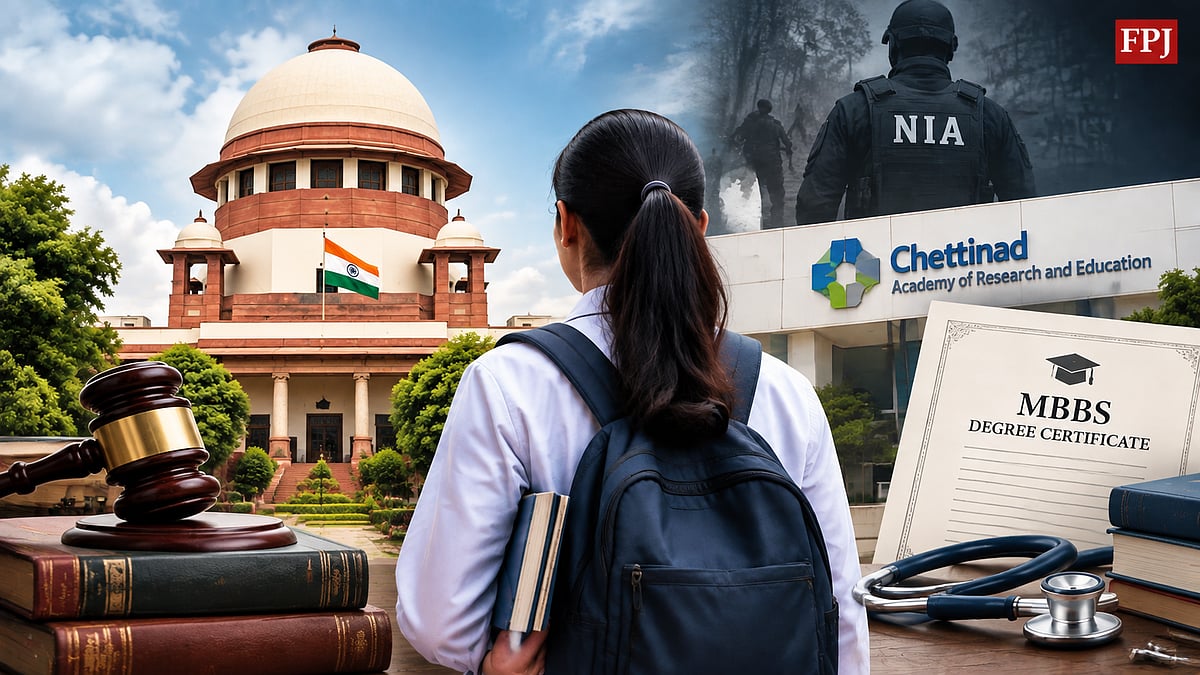
The Supreme Court has issued notice on a plea filed by an MBBS student seeking directions to the Chettinad Academy of Research & Education to release her course completion certificate and MBBS degree certificate. She sought her certificates without begin required to pay the course fee again after the amount was seized by the National Investigation Agency (NIA) in a case involving allege Maoist funding.
According to the Live Law reports, a bench comprising Justice Vikram Nath and Justice Sandeep Mehta will hear the matter on October 13.
The petition has been filed by Puja Kumari against a Division Bench judgement of the Madras High Court, which had upheald a Single Judge's decision refusing to direct the education instiution and medical authorities to release her academic certificates.
Student challenges Madras High Court order
According to the Live law reports, Kumari approached the Supreme Court through a Special Leave Petition (SLP), challenging the High Court's refusal to grant relief over the withholding of her educational documents.
The dispute stems from the seizure of the money used to pay her MBBS course fee. During her medical education, a total of ₹1,13,70,500 was periodically remitted to her account. The NIA subsequently alleged during a criminal investigation that the money used towards her educational expenses was derived from illegal and extorted funds allegedly raised on behalf of the Communist Party of India (Maoist), a proscribed terrorist organisation.
The NIA seized the funds after issuing notice to the college. Following the seizure, the institution withheld the student's academic documents on the ground that it had not received the fee.
Student says certificates cannot be withheld
The student argued that educational certificates cannot be retained as security for unpaid dues or treated as financial deposits under the concept of a general lien.
She has also denied having any personal involvement or association with any unlawful or terrorist organisation. According to her plea, she has maintained a clean record and successfully completed her medical curriculum without any disciplinary blemish.
Her case before the Supreme Court is that she should not be deprived of her course completion and degree certificates because the fee paid on her behalf was subsequently seized by the investigating agency.
What did the Madras High Court say?
The Madras High Court Division Bench had rejected the student's appeal, observing that if she was innocent, she could approach the Special NIA Court seeking release of the seized funds.
The High Court also said the college could not reasonably be expected to litigate with the NIA to recover the fee.
While noting that the student herself may not be an accused in the NIA case, the court held that she could not claim an equitable right to benefit from the "fruits of crime". It observed that once the course fee had been seized, the student's account with the college effectively stood in default as unpaid.
The court further held that directing the college to release the certificates despite not having received the fee would result in a serious injustice to the institution.
Family members named in NIA chargesheet
The High Court also took note of the NIA chargesheet, which allegedly named members of the student's immediate family, including her brother and paternal uncle, as key operational masterminds involved in raising extorted funds for a banned terrorist organisation.
It observed that the Single Judge had correctly protected the financial autonomy of the college while leaving the student free to deposit the requisite fee afresh and obtain her certificates.
Finding no ground to interfere with the Single Judge's decision, the Division Bench dismissed the student's appeal.
The matter has now reached the Supreme Court, which will examine the student's challenge to the High Court's order on October 13.

