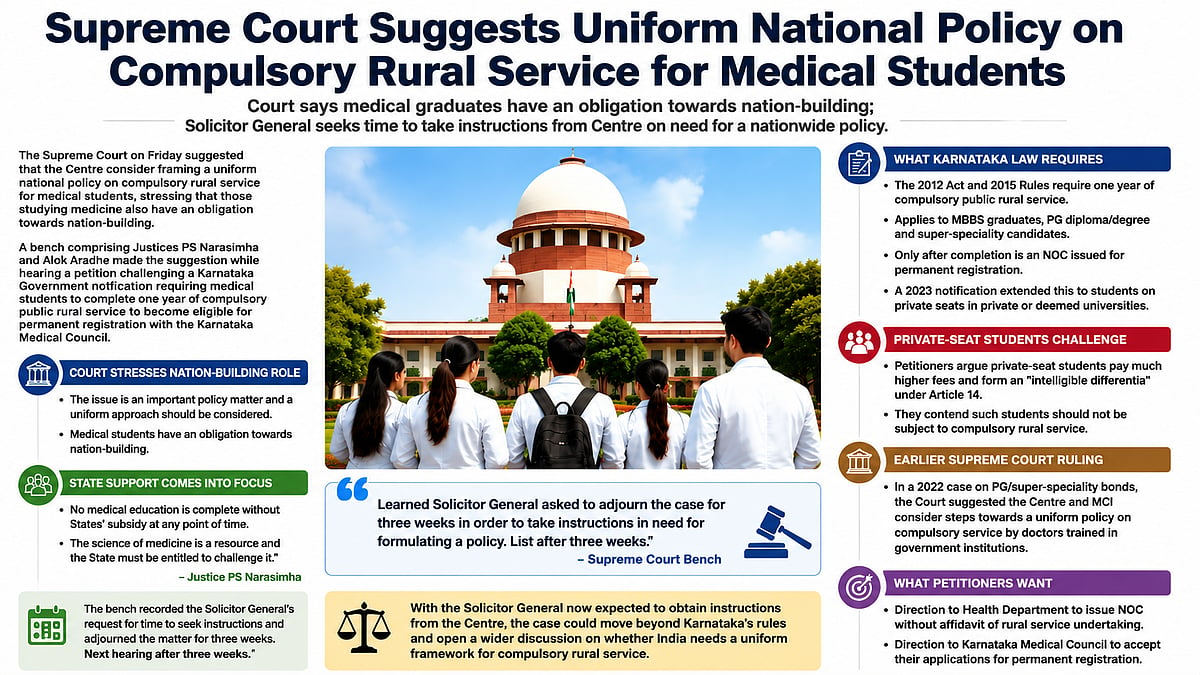
The Supreme Court on Friday suggested that the Centre consider framing a uniform national policy on compulsory rural service for medical students, stressing that those studying medicine also have an obligation towards nation-building.
A bench comprising Justice PS Narasimha and Justice Alok Aradhe made the suggestion while hearing a petition challenging a Karnataka Government notification requiring medical students to complete one year of compulsory public rural service to become eligible for permanent registration with the Karnataka Medical Council. The Solicitor General agreed to seek instructions from the Centre on the need for such a nationwide policy, Live Law reports.
Court Stresses Nation-Building Role
At the outset, Justice Narasimha described the issue as an important policy matter and suggested that a uniform approach should be considered across the country. He observed that medical students have an obligation towards nation-building.
The court's observations bring into focus a larger policy question: whether medical graduates, irrespective of where or how they study, should be required to serve in rural areas. A uniform national framework could potentially address differences between states while setting common principles for compulsory service.
Justice Narasimha had raised a similar concern in May 2024, when the court issued notice in the matter. At the time, he questioned why students studying in private medical colleges should be exempt from working in rural areas.
State Support Comes Into Focus
Reiterating his concerns on Friday, Justice Narasimha referred to the role played by state subsidies in medical education. He observed that students learning medicine ultimately become an asset to the state and their skills can be used for the larger public good.
"It's a very important policy because no medical education is complete without States' subsidy at any point of time. Even if we don't think about States' subsidies, the technique of medicine or the science of medicine is a resource and that State must be entitled to challenge it," Justice Narasimha said.
The bench subsequently recorded the Solicitor General's request for time to seek instructions on the need to formulate a policy and adjourned the matter for three weeks.
"Learned Solicitor General asked to adjourn the case for three weeks in order to take instructions in need for formulating a policy. List after three weeks," the bench ordered.
What Karnataka Law Requires
The dispute arises from the Karnataka Compulsory Service Training by Candidates Completed Medical Courses Act, 2012, and the Karnataka Compulsory Service Training by Candidates Completed Medical Course Rules, 2015.
The law requires every MBBS graduate, postgraduate diploma or degree holder and super-speciality candidate who studied at a government university or on a government seat in a private or deemed university to complete one year of compulsory public rural service.
Only after completing the requirement is a no-objection certificate (NOC) issued, enabling the candidate to seek permanent registration with the Karnataka Medical Council.
A notification dated July 28, 2023, extended the requirement to candidates studying on private seats in private or deemed universities.
Private-Seat Students Challenge Requirement
The petition argues that students enrolled on private seats in private or deemed universities pay significantly higher costs for their education and therefore constitute an "intelligible differentia" under Article 14 of the Constitution of India.
On this basis, the petitioners contend that such students should not be subjected to compulsory rural service requirements.
The argument highlights the central tension in the case: the state's interest in using trained medical professionals for the larger public good versus the claim of privately funded students that they stand on a different footing from those whose education is supported by the government.
Earlier Supreme Court Ruling Cited
The petitioners have also relied on the Supreme Court's decision in Association of Medical Super Speciality Aspirants Residents & Ors Vs Union of India & Ors.
In that case, the court rejected a challenge to compulsory bonds required for admission to postgraduate medical and super-speciality courses. It, however, noted that some state governments had imposed rigid conditions through such bonds.
The court had consequently suggested that the Union of India and the Medical Council of India consider steps towards a uniform policy on compulsory service by doctors trained in government institutions.
That earlier observation assumes significance in the present proceedings, with the Supreme Court once again raising the possibility of a common national policy rather than differing requirements across states.

What Petitioners Want
The petitioners have primarily sought two directions from the Supreme Court.
They have asked the court to direct the Commissionerate of Health & Family Welfare Services to issue the required NOC without requiring them to submit an affidavit undertaking compulsory rural service.
They have also sought a direction to the Karnataka Medical Council to accept their applications for permanent registration.
With the Solicitor General now expected to obtain instructions from the Centre, the case could move beyond the immediate dispute over Karnataka's rules and open a wider discussion on whether India needs a uniform framework governing compulsory rural service for medical graduates.

