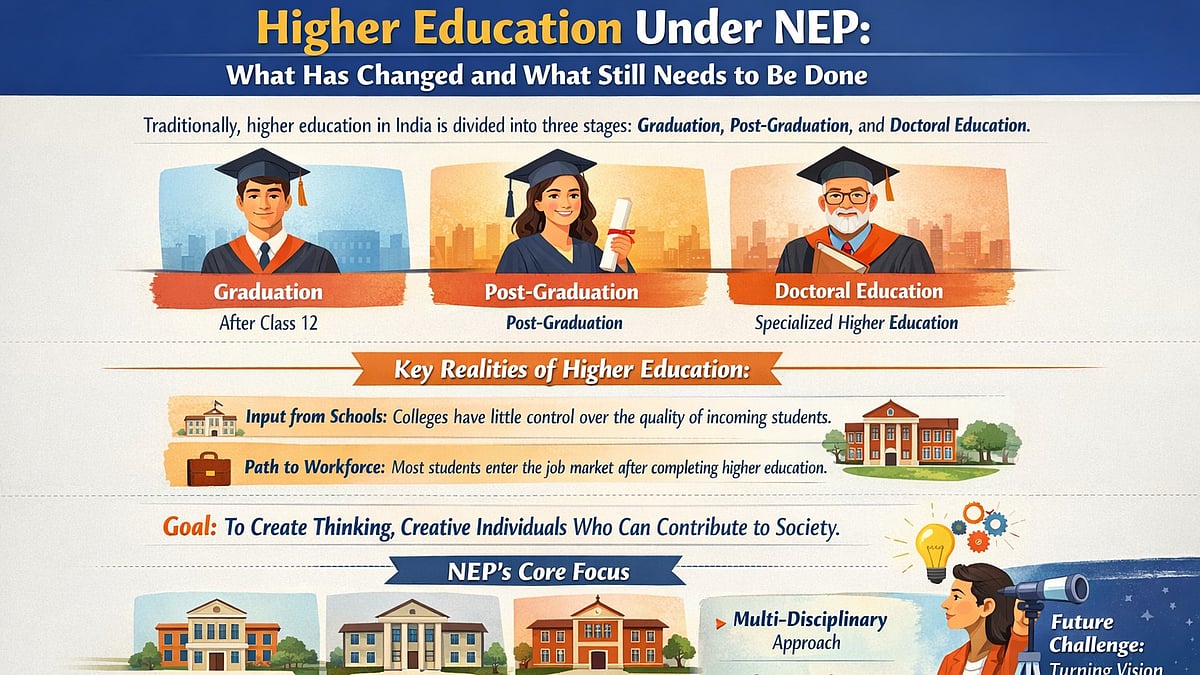
Classically, higher education comprises three segments: “graduation” (after 12th standard), “post-graduation” and “doctoral / special higher education”. The “graduation” and “post-graduation” programs are known as “under-graduate” and “graduate” courses in some other parts the world. This semantic aspect is important to understand for better comprehension of the reforms.
Two issues are important here to understand. First, the output of school education comes to colleges and therefore, no one has much control over the input (student community). Secondly, students on completion of higher education often enter the corporate world or other options as work force and therefore, there is a necessity to look at this segment with great criticality.
The main objective of higher education is to create “thinking” and “creative” individuals who can make a difference to society at large. Therefore, the primary goal of higher education should be to aim at “holistic development” of young minds.
Major Structural Recommendations:
To make the system effective, the NEP committee has made certain specific recommendations as regards “structural aspects” of higher education. One of the main problems of the current higher education system is that it is fragmented and lacks a multi-disciplinary approach. Many of these HEIs have few students and therefore cannot provide the vibrance of a large institution. Quality and empowerment / autonomy are the other critical factors. The committee has, therefore, recommended only “three types” of higher education providers in India in future:
Research Universities where there is equal focus on teaching as well as research.
Teaching Universities where the primary focus is on teaching though there is still substantial thrust on research.
Autonomous Degree Granting Colleges that will primarily focus on graduate education.
All the three types of institutions will be multi-disciplinary in nature with good enrolments / size, thousands, to provide vibrance and diversity. The committee recommends that by 2040, the structure of higher educational system will be primarily as above. This means that the “single-disciplinary institutions” will either diversify into multi-disciplinary ones or merge or phase out. Further, colleges will be given graded autonomy so that they become “degree granting multi-disciplinary institutions”. Universities will play a special mentoring role to ensure that their affiliated colleges slowly attain required quality benchmarks and eventually get needed accreditations to become degree granting colleges.
The committee has recommended that by 2030, one HEI as above will be set up in or near each district of the country so that access to higher education becomes easy and gross enrolment ratio (GER) for higher education attains 50 per cent (up from around 26 per cent as of now). To achieve this, the committee has suggested encouraging higher education degrees through ODL mode subject to strengthening accreditation system.
India will thus see emergence of large multi-disciplinary universities (either research or teaching) catering to the graduate, post-graduate, and doctoral students. These universities will also stimulate all types of innovations in the system. Different types of universities as they exist in India today like central / state / deemed to be universities, etc. will cease to exist and all will have same nomenclature and status. At the parallel level, the country will have autonomous degree granting colleges catering to graduate education.
Recommendations Towards Reforms in Curriculum:
The committee made certain pathbreaking recommendations as regards the curriculum and delivery to make Indian higher education system globally competitive. These include:
Liberal Education and Multiple Entry / Exit: Purpose of higher education is to bring in total transformation in individuals through a process of holistic development. This can only happen if all types of disciplines like science, arts, commerce, engineering, fine arts, etc. are integrated in curriculum. This should also encompass allied areas like value system, social sensitivity, environmental awareness and others. This is what is globally known as “liberal education”. The committee felt that Indian higher education at graduate level should move towards this concept.
To cover all the above areas, the committee recommended that duration of graduation programs should be “4 years” as in other parts of the world. This will be in addition to the current 3-year programs. These 4-year programs will be extensive and contain “choice based elective system” offering multiple options to students. For example, an engineering student can take up some credits in fine arts subjects like dance or music. This will help students become wholesome and the education system will migrate to multi-disciplinary.
However, considering the long duration of graduation programs (4 years), the committee has recommended introduction of concepts of “multiple entry and exit”. Under the scheme, students can exit by end of 1st or 2nd or 3rd years, and they will get “certificate” “diploma”, and “degree respectively. Students will be permitted to join back later. Preferred option, however, will remain completion of 4 years when they will get a “Degree with Honours”.
Academic Bank of Credit (ABC): The committee has recommended creation of an “academic bank of credit (ABC)” where credits earned by students from various elective subjects / accumulations at exit points as discussed above will be digitally stored.
Master’s and Doctoral Program: Since gradation degree is of 4 years, Master’s will have 2 years duration for graduates with 3 years duration while for students with 4 years of graduation, it will be for 1 year.
Students who have graduated 4-year degree program through “research” can also directly go into PhD program subject to their getting high CGPA n graduation. This is besides the normal route after post-graduation. MPhil degree is recommended to be discontinued.
MERU: The committee has recommended that government should set up large multi-disciplinary universities to be known as “Muti-Disciplinary Education and Research Universities (MERUs)” across the country.
IDP: Evry institute should develop an “institute development plan (IDP)” to guide its activities for achieving the larger goal of creating a true multi-disciplinary institute on a global benchmark to cater to holistic development of students.
Internationalization: The committee has reiterated process of internationalization of Indian education higher education system. This includes various types of collaborations and joint degrees.
Implementation at Current Stage:
Just like school education, the pace of reforms in higher education is quite slow and fragmented. One of the primary reasons has been the huge diversity in the nature, type and location of the universities & colleges in India and the complexity thereof. And the results on the ground are visible that the speed of implementation is slow, in bits & pieces and lacks a comprehensive approach. Many of the milestones recommended in the Policy are yet to be achieved. Some of the suggestions have seen light of the day in some states while some others are lagging because of political reasons.
This not to say that nothing has been achieved. The central as well as some of the state governments have started implementing at least some of the “least resistance” steps. Some developments in this regard are given below:
Structural and Curricular Aspects: In the central universities and some state and other types of universities, the “4-year graduation program” has been launched. There are lots debates on the type of curriculum for each of the 4 years and some developments have started taking place like offering “choice-based electives”, some migration towards “liberal education” (by offering completely different types of course like drawing / painting / photography, etc. to engineering or commerce students, among others), launch of “academic bank of credit (ABC)” by opening accounts of students, etc. There is, however, no evidence on the ground of the actual implementation of ABC at this stage. In some universities, guidelines have been issued to allow the 3-year students to migrate to 4th year course as a matter of option. As lack of awareness of the possible benefits of the 4-year degree persists, the interest of the students, at this stage, for the 4-year degree is quite lukewarm.
Our feedback shows that that the students who have adopted the 4-year model, are not happy with the migration as the curriculum for the 4th year is not well defined. Degree by research where only research ought to be the focus is not happening on the ground as the 4th year continues to have core as well as electives. The real impact will, however, be known after few years only. The good development has been that the established “single disciplinary” institutes like IITs have started becoming “multi-disciplinary” which is at the heart of NEP recommendations. And so is with IIMS by starting under-graduate courses. But this is not the case with many other such institutions. There is no evidence on the ground of setting up of research based or teaching based universities of or implementation of the concept of MERU. Further, to make things happen, the country needs a larger pool of “diverse faculty” that does not exist at this point of time. There is confusion and anxiety among both the students as well as faculty about the scheme and the implementation happens to falter at this stage.
Institute Governance Domain: There has been some progress in this context by giving different types of autonomy to different categories of colleges. The autonomous colleges have some flexibility / autonomy in terms of offering new courses. The guidelines for “institutional developmental plan (IDP)” have been framed by the UGC and circulated to institutions. But our informal research reveals that there is hardly any case of effective IDP by many institutions at this stage.
National Research Foundation (NRF): The NRF Bill 2023 has been approved by both house of Parliament in 2023. It is expected to provide a boost to creating single-point research body at the apex level aimed to foster a research culture in Indian academia. There is hardly any progress as regards NRF at this stage.
Regulation and Accreditation:
The committee has given sweeping recommendations of forming an omnibus regulator known as Higher Education Council of India (HECI) replacing all the regulators and putting the regulation as a part of the same. A comprehensive bill known as Viksit Bharat Shiksha Adhishthan Bill 2025 has just been approved by the Union Cabinet and sent to Parliamentary Committee for discussion. We hope the bill be placed before the Parliament for approval in the next session of the Parliament. There is thus substantial delay in this regard.
Moving Ahead:
As evident from discussions above, pace of implementation is slow and yet to pick up the desired speed. There are lot of roadblocks, and the exact impact will be known only after a few years. Whether the objective of achieving the goal of making Indian HEIs as one of the best in the world and the impact of NEP on the same will be known in coming years. Till then we need to wait and only hope that recommendations are implemented fast with desired outcomes.
The author is Founder and Convener of Higher Education Forum (HEF)

