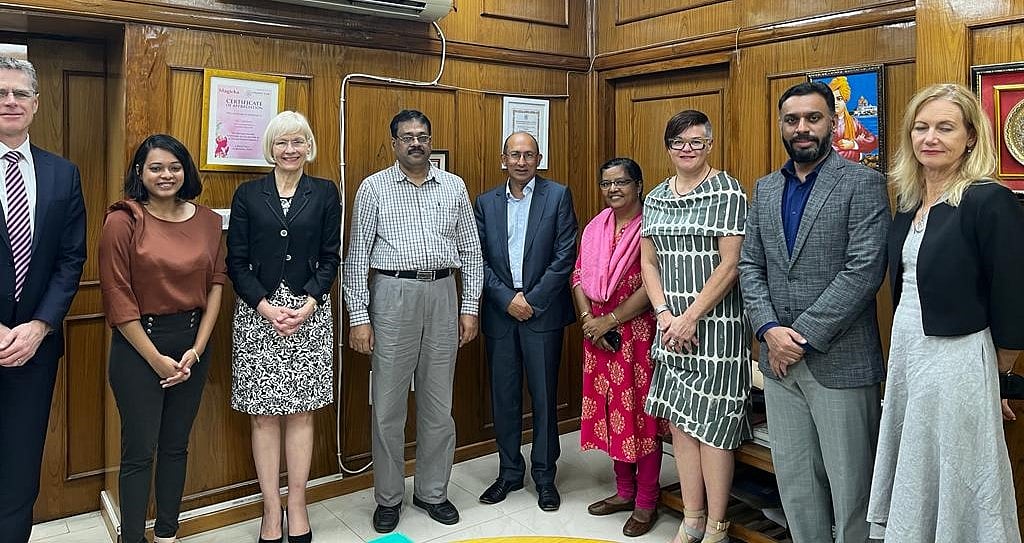
Delhi: In its quest for internationalisation through collaborations, The University of Queensland (UQ) visited India to engage with education institutes, government, and industry partners. Spearheaded by Chancellor Peter N Varghese AO and President and Vice-Chancellor Professor Deborah Terry AO, the delegation discussed partnerships and collaborations that are geared towards the National Education Policy’s (NEP 2020) aim of internationalising India’s higher education sector and strengthening its long-standing links with India.
Commenting on the visit Mr. Abhinav Bhatia, Senior Trade & Investment Commissioner-South Asia at Trade and Investment Queensland (TIQ) said, “The education, skilling, research, and trade relationship between Australia and India are based on shared values and are complementary. The University of Queensland’s senior leadership visit is a clear indication of the university’s commitment and vision for India. It is exciting to see the kind of work UQ is doing with the Indian Institute Technology of Delhi (IITD), industry partners, and new collaborations they intend to develop. It is our endeavour at Study Queensland (govt.) to support such initiatives that expose Indian students to the best of study and employability opportunities, multicultural communities, and an enviable lifestyle Queensland has to offer.”
Study Queensland, supported by the Queensland Government, aims to attract talent to its educational and training institutes.
As part of its visit, UQ spent time with senior leadership at IIT Delhi and celebrated the universities’ research partnership, the UQ-IITD Academy of Research, with more than 100 Ph.D. enrolments.
Talking about UQ’s meetings with IITD, Professor Deborah Terry AO, Vice-Chancellor and President of UQ, said: “As a top 50 global university, UQ is serious about building strong partnerships to deliver on our educational and research priorities – and for us, partnerships don’t get much stronger than those we have in India. We genuinely appreciated the opportunity to meet with senior leaders from IITD to discuss the future direction of our joint Academy of Research and to explore how it can be enhanced to have an even greater impact. The UQ-IITD Academy of Research is transforming the Australia-India research landscape and is addressing pertinent global issues, from feeding the world to creating a more resilient environment and transforming societies with the future technologies.”
Further, the delegation visited Lady Shri Ram College for Women and addressed a panel discussion focused on women in leadership, and their role in building the ever-changing world. In addition to this, the delegation had meetings with Austrade and the Australian High Commission to discuss government priorities in India. UQ also met industry partners Thermax, Dozee, ReNew Power, Federation of Indian Chambers of Commerce and Industry (FICCI), and education partners such as The Energy and Resource Institute (TERI), Department of Science and Technology (DST), Government of India, Ashoka University, and Shiv Nadar University to discuss potential engagements. Agreements to formalise collaboration were also signed with O.P. Jindal Global University and Sharda University during this visit.
Commenting on the visit to India, Mr. Peter N Varghese AO, Chancellor, UQ said, “Building a deep research partnership between Australia and India is a key part of UQ’s strategy. Together we can achieve so much more than by ourselves. A deeper research partnership will also lift the reputation of Australia’s universities in India. And the research that addresses our respective national challenges has an obvious advantage to both countries.”


