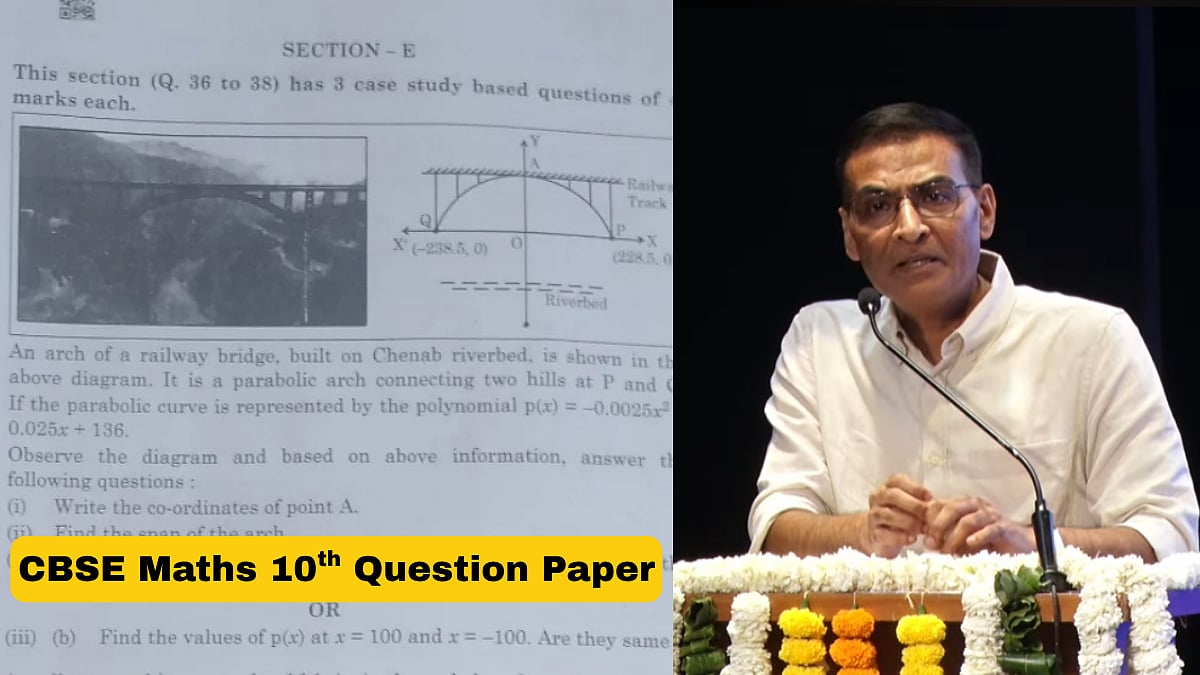
New Delhi: The Central Board of Secondary Education (CBSE) has reacted to the apprehensions expressed by the Class 10 students regarding the difficulty level of this year’s Mathematics board paper held on February 17, 2026.
CBSE Chairman Rahul Singh stated that “the allegations of questions being ‘out of syllabus’ need to be seen in the context of changing patterns of exams.”
The problem was first brought up online as students were discussing a case study-based type of question related to parabolas. Some expressed their concern that certain aspects of the questions were confusing or mathematically inconsistent with other concepts not included in the study guides.
In one online post, the student expressed confusion about obtaining coordinates using conventional techniques and expressed concern about concepts such as the vertex formula or arc length, which were not explicitly prescribed.
The concern was also echoed during a recent CBSE interaction held on April 2, when the Board introduced its new curriculum framework for Classes 9 and 10 for the 2026–27 academic session. In the course of the discussion, a teacher mentioned that there were a few questions in the paper that seemed quite tough and were not directly from NCERT textbooks.
"Not Out of Syllabus, But a Shift in Evaluation": CBSE Chairman
In response to these queries, CBSE Chairman Rahul Singh stated that questions that are marked as 'out of syllabus' are a result of a shift in competency-based evaluation.
He gave an example of a question on a parabola, stating that there was no requirement to solve a quadratic equation, and all information was provided within the question. “What exactly constitutes ‘out of syllabus’?” he asked, suggesting that students are not accustomed to applying concepts in unfamiliar formats.
Singh noted that this is not a failure on the part of students but a reflection of how the system has traditionally functioned. “Children have been conditioned to respond in a direct manner, based on what is given in textbooks,” he said, adding that such conditioning makes it difficult for them to approach application-based questions with confidence.
He also traced the issue back to structural changes in the CBSE system over the years. Recalling his own schooling, Singh said earlier boards often tested a combined syllabus of Classes 9 and 10, with textbooks that were more complex. In contrast, CBSE gradually separated the curriculum and placed relatively tougher, concept-heavy material in Classes 9 and 11 years assessed internally by schools.
As a result, he explained, students may not engage as seriously with these foundational concepts, leading to gaps that become visible during board exams. At the same time, Classes 10 and 12 board papers were, by design, kept relatively straightforward, often with an “artificial constraint” of asking questions directly from NCERT textbooks.
According to Singh, this approach is now changing. With competency-based evaluation gaining ground, CBSE is moving towards questions that test understanding rather than recall, even if they are not framed exactly like textbook examples.
He also pointed out a broader concern many students pass Class 10 without developing the required competencies in subjects like Mathematics and Science. “Somewhere, the deficiency is not just in the syllabus but in the level of inputs students receive,” he said, referring to classroom learning and teaching methods.
Looking ahead, Singh said that new NCERT textbooks currently being developed for Classes 9 to 12 aim to create a smoother progression in difficulty levels, reducing the sharp academic jump students face in higher classes. He added that ideally, a larger share if not all of board exam questions should eventually be competency-based.

