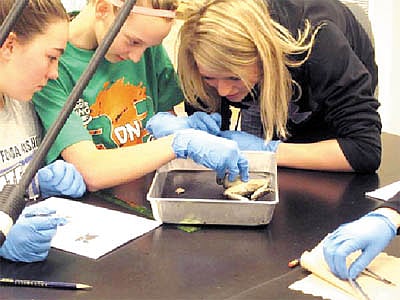
Last week, it was announced that the UGC has banned dissection of animals in colleges. Hetal Jappi asks a few students about their experiences of cutting open living beings
Circa 1995: A class 12 student enter the biology lab in her college to a funny smell. She was prepared for her science practical, but not for this nasty smell. She walks towards the lab assistant, who is engaged in some work, to ask him about the odour. Suddenly, a slimy green object flies out of a bucket on the counter and jumps towards her. She has no idea what hit her, when she notices the peon is holding something in his hands, and slowly it dawns upon her that it is a frog. The peon then confirms that the odour is due to chloroform, which is used to sedate the frogs for the day’s practical work, and the object that jumped on her was also a frog.
Cut to 2014: “I was waiting for this day! I am so happy that the University Grants Commission has finally decided to ban dissection of animals at the undergraduate and postgraduate levels. When I was in class 12, from where the above incident is mentioned, dissection of frog was banned. Even then, our college procured the animals, and each of the biology students dissected two frogs. I complained, but in vain! From the next year on, they moved to rats. It is not fair,” says software engineer Radha Patel, who is still disgusted by that dissection.
After years of opposition from animal activists, the UGC has relented and made the decision.
Through a new notification, the Commission body has asked colleges and universities to stop dissection and experimentation on animals for life sciences courses. It says, “No animal from any species shall be dissected, either by teachers or students for any purpose.”
The colleges and universities are directed to use alternatives in place of dissection, like models, charts, videos and simulations. While many students are happy, some are feeling that the knowledge will be compromised. “I feel that with charts, models and simulations, we are still learning theoretically, and for understanding the practical aspect, we need to learn on a practical level,” says medicine aspirant Shalaka Thombre, who feels that her understanding of the systems of the body will be compromised if she is not allowed to dissect in the lab.
With that, we have a few experiences from those who already did. “Even though the process of dissecting was not the nicest, it gave a feel of what it would be to cut open a living being. I don’t think I will ever see a heart so closely, with the chambers still pumping blood. I think students ought to have that experience,” says engineering student Shashank Menon.
His classmate Deeksha Pandit disagrees. Her viewpoint of a similar scenario: “I will never forget that scene. With every beat of that animal that I dissected, I knew I was killing a living being unnecessarily, since I already knew I wanted to be an engineer and do not need to know the anatomy of a mammal through this exercise. But there is no mechanism to avoid it in the college, it is mandatory. What’s worse, we leave the animal to die a slow death after the dissection is over. I cannot imagine that happening to any human being,” she concludes.
Many argue that dissection forms the basis of knowledge, and most products are lab tested on animals. But a majority of the students are relieved to hear that they will no longer have to go through dissection.

