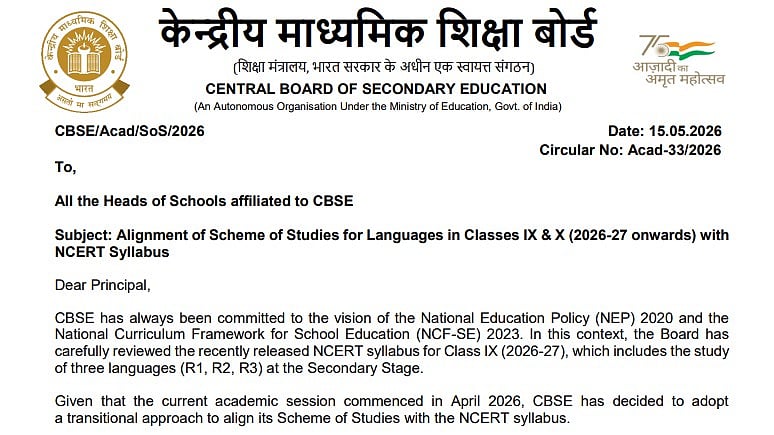
CBSE: The Central Board of Secondary Education (CBSE) has announced that students entering Class IX from the 2026-27 academic session will have to compulsorily study a third language, but there will be no board examination for the subject in Class 10.
The decision has been taken as part of the board’s effort to align its scheme of studies with the National Education Policy (NEP) 2020 and the National Curriculum Framework for School Education (NCF-SE) 2023.
The updated language framework will take effect on July 1, 2026, according to a CBSE circular sent to schools.
Three Languages mandatory from Class 9
Under the revised policy, students in Class IX will study three languages - R1, R2 and R3. The board has made it compulsory for at least two of these languages to be native Indian languages.
Students who wish to study a foreign language can choose it as the third language only if the other two are Indian languages. Foreign languages may also be opted for as an additional fourth language.
CBSE said the move is aimed at promoting multilingual learning while staying aligned with the broader goals of NEP 2020.
No Board exam for Third language
In a major relief for students, the board clarified that no Class 10 board examination will be conducted for the third language subject.
“All assessments for R3 shall be entirely school-based and internal,” the board stated in its circular.
The performance of students in the third language will still be mentioned in the CBSE certificate, but students will not have to appear for an external board exam in the subject.
The board also clarified that no student will be stopped from appearing in the Class 10 board examinations because of R3.
CBSE said the decision was taken to reduce unnecessary academic pressure and keep the focus on meaningful language learning instead of examination stress.
Schools asked to use class 6 textbooks temporarily
The board acknowledged that dedicated secondary-level textbooks for the third language are still under development.
Until new material is available, Class IX students will use Class VI R3 textbooks for the chosen language along with supplementary local or regional literary content such as poems, short stories and non-fiction pieces selected by schools.
Detailed guidelines regarding supplementary learning material are expected to be issued by June 15, 2026.
CBSE and NCERT are currently developing textbooks in 19 Indian languages, including Assamese, Bengali, Marathi, Tamil, Telugu, Punjabi, Malayalam and Gujarati.
Teacher shortage concerns addressed
CBSE also recognised that many schools may face difficulty in finding qualified language teachers during the transition phase.
As an interim arrangement, schools have been allowed to use existing teachers who have functional proficiency in the language. The board has also permitted schools to use hybrid teaching methods, inter-school resource sharing through Sahodaya clusters, retired teachers and qualified postgraduates to bridge staffing gaps.
Schools have been directed to update their third-language offerings on the OASIS portal by June 30, 2026.
Relaxations for Special categories
The board has provided certain exemptions and relaxations under the new policy.
Children with Special Needs (CwSN) may receive language exemptions as per the Rights of Persons with Disabilities Act, 2016. Flexibility has also been allowed for CBSE schools located outside India and foreign students returning to India on a case-by-case basis.
CBSE, in its communication to schools, stressed that the transition measures are intended to protect student interests while encouraging joyful and culturally rooted language learning.

