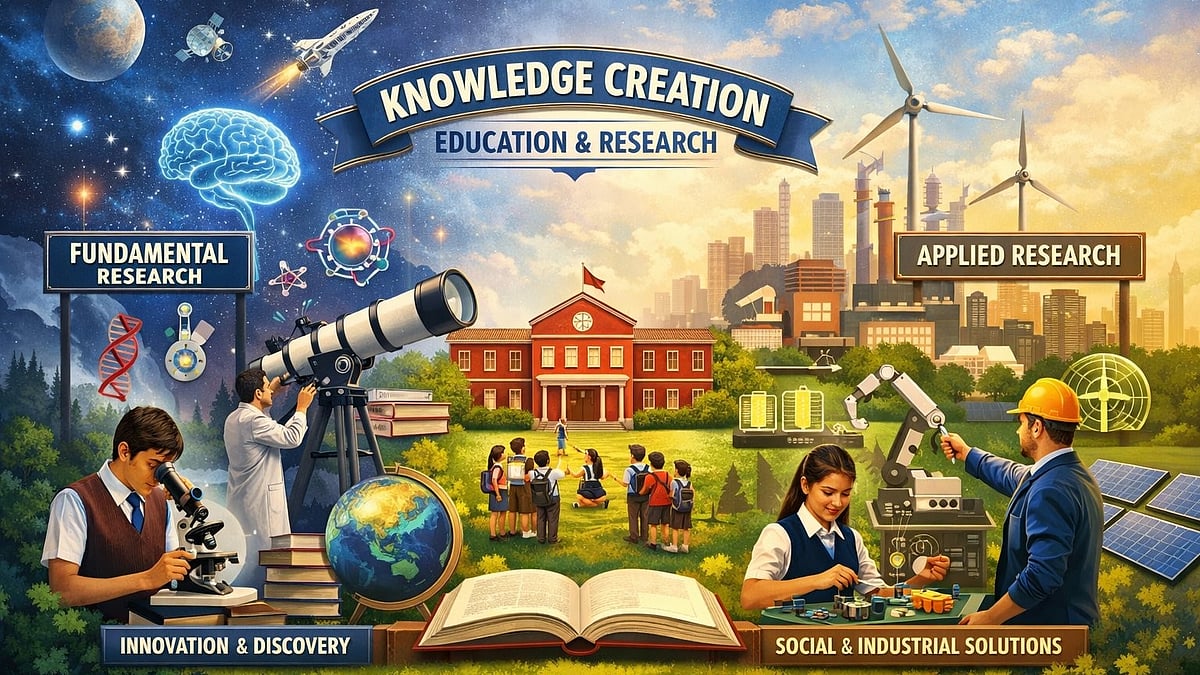
Research is at the core of education. “Knowledge creation” is as important, if not more, than “knowledge dissemination.” If India is to assume the leadership role in the world of education, research must be given adequate attention to. And this should begin at the school level itself. Research here needs to be broadly classified in two categories: “Fundamental” and “Applied.” While the former talks about breakthrough innovation, the latter is more inclined towards solving the immediate societal and industrial problems. From a nation’s perspective, both are equally important.
The NEP committee observed that research and innovation has not found the encouragement that is needed for an educational system to flourish. The R & I investment in India has remained at a low level of around .7 per cent of GDP compared to many other nations like USA (2.8 %), China (2.1 %), or Israel (4.3 %). There is thus an intense need to create a conducive climate to promote research in education enabling the country to become innovative centric. The committee was rightly of the opinion that “research in social science” and “innovation in science & technology” will finally create a prosperous India.
The committee on NEP 2020 thus has made specific recommendations to make the Indian education research centric. Some of these include the following:
School Level:
Research Mindset: The recommendations include developing “scientific temper” and “analytical skills” among school students. This is at the core of developing a “research mindset” among children. Thus, research should become a focus area from school days.
One of the crucial recommendations at school level includes students taking up “brief applied projects” on various subjects. These projects should aim to enhance the research skills of students through collection and interpretation of data.
Higher Education Level:
Structural Change: One of the major recommendations of the committee is a structural change wherein India will have only two types of universities: “Research Universities” where research will have equal focus as teaching and “Teaching Universities” where research will get abundant focus though these are primary teaching institutions. This recommendation is an important one to give focus to research in higher education.
Research Scholarship: The committee also recommended that “research scholarship” will be an essential trait for faculty members of HEIs besides teaching. In other words, there will be equal emphasis on “knowledge creation” and “knowledge dissemination” for the purpose of evaluation of performance of a teacher towards career progression. Through this recommendation, the committee has envisaged ushering into an era of research driven culture in HEIs so that India can truly become a “Vishwa Guru.”
Research at Graduate Education: There has been a unique recommendation of the committee on NEP 2020 whereby the students are allowed to take up the research route in the fourth year of the newly proposed 4-year graduate program. The committee further prescribes that such students on completion of 4 years will get a research-based honors degree and can directly enroll for doctoral program (PhD) without going through the master’s route. This is a unique recommendation aimed at promoting research in higher education.
National Research Foundation (NRF):
To promote and fund research initiatives in the country, the committee has suggested the formation of NRF that will support all types of outstanding research endeavors including funding such initiatives. The NRF is also expected to mentor research activities at those universities and colleges where it is at a nascent stage. This will be the apex body in the country supporting and nurturing research efforts in the education sector.

Also Watch:
Current Situation of Implementation and Way Forward:
In nutshell, the committee has made pathbreaking recommendations to encourage research in education domain. The intention is to make India a research & innovation driven nation. It will now depend on the strategies by the government and leaders of the academic institutions to implement them on the ground. The mindset must change first, and the faculty must take up research as seriously as teaching.
The ground reality as regards implementation, however, shows that progress is quite slow and needs faster momentum. As suggested by the NEP committee, there is no research-based project in school curriculum till now in addition to what already was there in the context of CBSE / ICSE curriculum. At higher education level, there has been no “Research University” till now in the country. There is no doubt that many managements are putting focus on research for “career advancement” of faculty but that is sometimes leading to excess pressure on teachers resulting in high stress environment as well as publication in paid and cloned journals. Retractions are also on rise. There are no concerted efforts to promote research culture, and this approach may not bring in the real and desired outcomes.
One good development has, however, been in the front of National research Foundation (NRF), the bill regarding which has been passed in 2023, and it has been decided that the NRF will be administered by Department of Science and Technology (DST). The government is likely to contribute Rs 10,000 crores over five years with private sector contributing much more through Rs 36,000 crores. Results will be known in due course. “Prime Minister’s Early Career Grant” for supporting early researchers is also a good initiative. Some other sound schemes launched are Start Up Research Grants (for science and technology) and Inclusive Research Grant (for use by Indian Universities and colleges). However, all these initiatives are at the nascent phase and there is not much public data available to show their disbursal and impact level.
India needs to do a lot of catching up in terms of global research and innovation if we are to achieve the goals of “Vikasit Bharat” by 2047. Research should be lead facilitator in this journey; the faster we understand and appreciate this as a nation, better will be for all of us. NEP has only shown the way through its recommendations; it is duty of all of us to build a nation on the twin pillars of “Research” and “Innovation.”
By Dr A K Sen Gupta, Founder and Convener, Higher Education Forum (HEF). He may be contacted at aksengupta51@gmail.com or 98211 28103.

