In the classical sense, vocational education is aimed at building skills & competencies for a definite vocation at the ground level like electrician, plumbing, carpentry, language translator, web designer, etc. It is true technical education to work at the ground level for critical purposes.
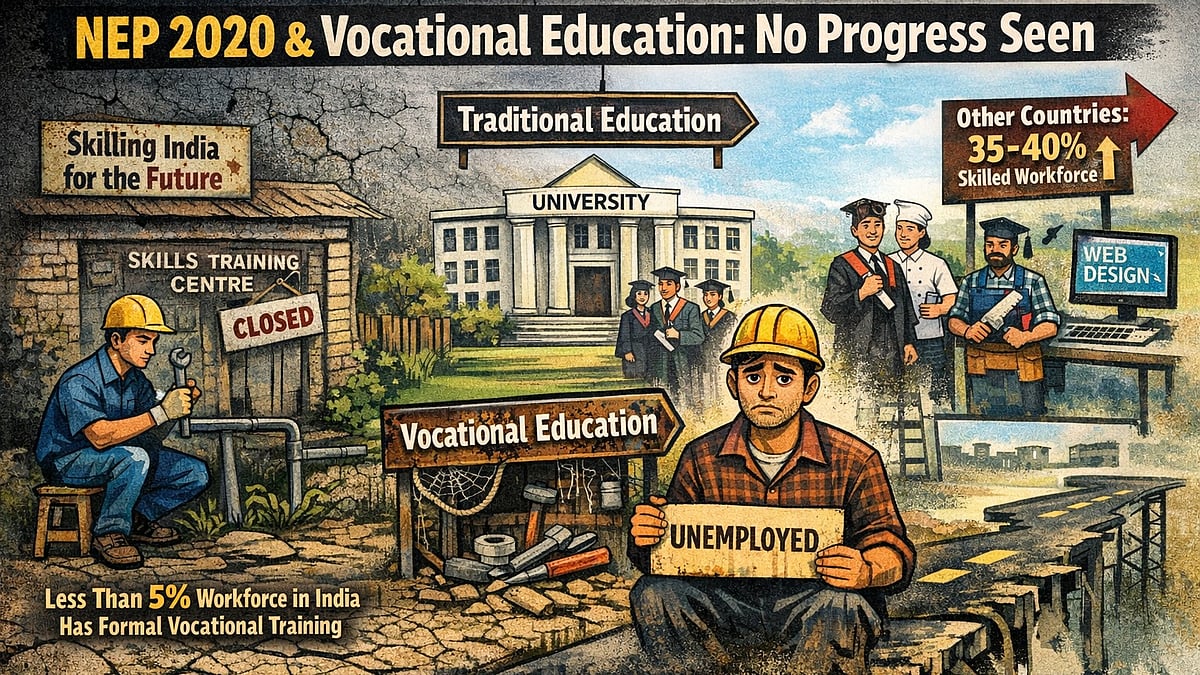
Unfortunately, in India, “vocational education” has always been looked down upon compared to traditional “academic education” catering to white collar jobs. Neither the parents nor students have ever treated vocational education with the respect that it deserves. The NEP 2020 committee notes that a very negligible proportion (less than 5 per cent) of the workforce in India between the ages of 19 to 24 have received any formal vocational education. In other parts of the world, particularly developed countries, the proportion is quite high. In some countries it is as high as 35 to 40 per cent.
The committee thus felt that for future path of growth of India, vocational education must play a significant role and the traditional barrier between “academic” and “vocational” education must break down. There is a need to professionalize some of the “vocational job opportunities” as well.
Committee Recommendations:
In the above content, the committee has made certain important recommendations to strengthen the entire gamut of vocational educational system.
Some major ones include the following:
Integration of Vocational Education: Vocational education must be integrated with regular course curriculum, and this must happen from school education itself. The committee has recommended that every child between the grades 6 to 8 must take up an internship with a local “vocational activity” like plumbing or electrician or carpentry or any other similar activity needed in the local community. This will possibly help in removing the aversion students usually have towards vocational courses, and they will also understand relevance & importance of “vocational career opportunities”. The idea is to “teach” one vocation to every child and “expose” them to many.
Exposure to Vocational Education: The committee recommends that by 2025, at least 50 per cent of students both at school as well as higher education level must be exposed to vocational education on a formal basis as suggested above so that students develop appreciation of the said education.
Partnership Among Institutions: It is suggested that the educational institutes work in close coordination with vocational educational providers like polytechnics / ITIs and social sector / NGOs, etc. to make vocational education a reality. The committee has also recommended that normal HEIs including multi-disciplinary degree granting institutes / universities should offer courses on vocational education beside the prevalent specialized B. VOc. degree so that acceptability of vocational education is enhanced.
Removal of Demarcation: Over the next decade, all attempts should be made to remove the demarcation between academic and vocational education and bring them at par. The committee has recommended formation of an expert team to be known as “National Committee for Integration of Vocational Education (NCIVE)” that will guide as to how the scheme is implemented keeping in view the requirement of needs of vocational job opportunities in each local area.
Current Stage of Implementation:
The NEP committee has taken the right stand of integrating “vocational” and traditional “academic” education. However, much depends on the likes and preferences of students and their parents as to how they look at “vocational job careers”. These are early days; it is difficult to predict the impact of these changes. However, the fact remains that vocational career opportunities are abundant, and a country like India cannot provide “white collar jobs” to the entire youth community. Furter, the definition of vocational education has gone much beyond the traditional ones like carpentry or plumbing. Today areas like “3D printing” or “website development” or “prompt engineering” are also coming within the definition of vocational jobs. It is thus hoped that recommendations of the committee when implemented on the ground bring a positive change.
However, at the ground level the state of implementation is very sluggish. Nothing seems to have moved forward. Except creating a few skills institutions (including universities) and a few BVoc courses, the real integration of academic institutions and vocational skills is almost at “zero level”. In India, still we talk about “education and higher-level skills” and “vocational education and lower-level skills”. This elitist approach to education must go if we have to move forward. It is urgent that government moves forward quickly to bring vocational education to the fore by integrating it with school education first and then with higher education. The problem of unemployment or under-employment in the traditional education sector would otherwise continue to grow.
The author is Founder and Convener of Higher Education Forum (HEF)

