In earlier articles, major recommendations of the NEP committee in various specific domains of education were discussed. These include school as well as higher and professional education including teachers and regulation. Research, technology, teacher education and focus on Indian culture and languages were also mentioned.
In addition to the above, the committee also focused on certain other specific areas of education and allied areas. The objective was to ensure a holistic approach towards reforms in Indian education so that progress of the country as desired is achieved and Indian education system regains its earlier glory of ancient times.
Recommendations in Specific Areas:
Some of the major recommendations include the following:
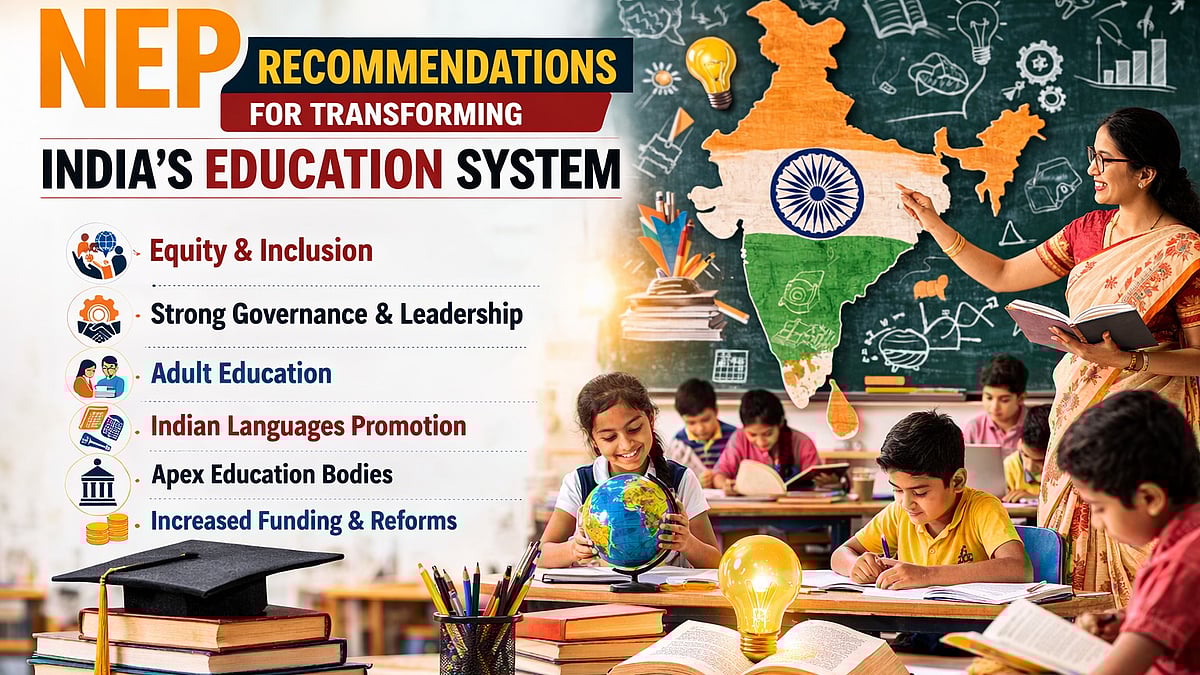
Equity and Inclusion: One specific area that needed to be addressed was that the educational system should adhere to basic principles of “equity” and “inclusion”. This means that the system should provide access to the needy, and none should be excluded from purview of education for want of resources. This alone can ensure an equitable society. The committee has recommended that the principle of equity and inclusion should prevail in all realms of education, both at school and higher education. This would be particularly applicable for groups including “underrepresented racial and ethnic groups (URGs)”. This alone would ensure an improvement in gross enrollment ratio (GER).

Governance and Leadership: This is yet another important aspect. The committee observed that many educational institutions in HEI sector needed better leadership. The committee has, therefore, recommended that efforts should be made to make the “Leadership Structure” robust and professional. This should start with an independent Board of Governors (BOG) at top level to all other leadership tiers within the institution. Each institute should develop a comprehensive Institutional Developmental Plan (IDP) that should make the transition to leadership process transparent and effective.
Adult Education: The committee has paid substantive focus on adult education as it is crucial for the overall growth of the nation. The committee has suggested that a special curriculum should be framed by a body of NCERT particularly focusing on adult education. This would take care of the “five (5)” dimensions including “foundational knowledge”, “critical life skills”, “vocational skills”, “basic education”, and “continuing education”. The committee has suggested that there should be more participation from volunteers, social sector, and community workers to take this initiative forward.
Special Focus of Indian Languages: The committee has made elaborate recommendations for promoting Indian languages. Some aspects have already been covered in our earlier write-ups. Two additional important recommendations are highly interesting. First, there will be “dedicated academies” in all Scheule 8 languages, headed by distinguished scholars in the respective languages. And the second recommendation pertains to creating “wiki knowledge base” of all India schedule 8 languages aimed towards preservation of their richness.
Setting Up of Apex Body: The committee has recommended setting up of an apex body to be known as “Rastriya Shiksha Ayog (RSA)” at the central level. This body will be chaired by the Central Education Minister and will comprise 30 members. The committee has also suggested setting up of similar bodies known as “Rajya Shiksha Ayog (RjSA)” at each state government level chaired by the State Education Minister. These bodies will be responsible for overall policy driving in education.
Funding of Education: The committee has suggested a substantial increase in government spending (up to 20 per cent over the next ten years). Similarly, the committee has recommended private and public partnership for the growth of education in the country.
Current Stage of Implementations and Moving Ahead:
If one looks closely, the recommendations appear to be substantive for transforming education. Much, however, depends on pace or implementation, which appears to be quite slow at this stage. Besides the existing guidelines, nothing new appears to have taken place in any of these aspects. May be the government and regulators are busy in implementing the “domain specific recommendations”. But there also is lack of cohesion and intent at the desired speed. Let us hope things pick up momentum in days to come. That alone will be in the best interest of all stakeholders.

