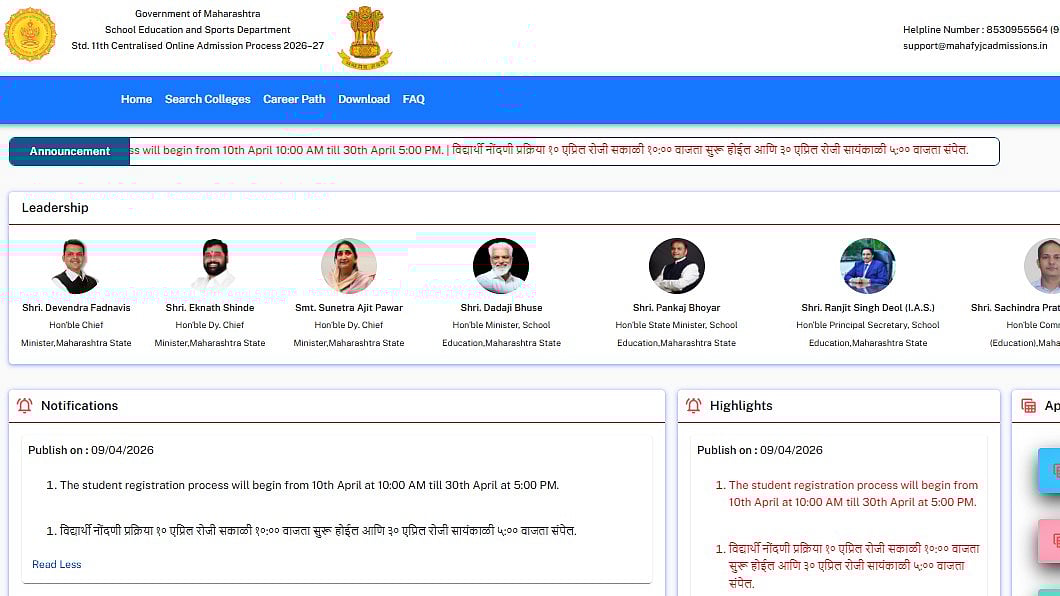
Mumbai: The Maharashtra government has announced a major change in the First Year Junior College (FYJC) admission process for the 2026-27 academic session. From this year onward, Class 11 admissions across the entire state will be conducted through a centralised online system and strictly on the basis of merit.
The decision brings all recognised Higher Secondary Schools and Junior Colleges under one statewide admission process. Students seeking admission in Arts, Commerce and Science streams will now have to apply online through a single form.
The move is aimed at making admissions more transparent, smooth and student-friendly.
Statewide online admission system begins
Till recent years, the online FYJC admission process was limited to regions such as Mumbai Metropolitan Region, Pune, Pimpri-Chinchwad, Nagpur, Nashik, Amravati and Chhatrapati Sambhajinagar.
In 2025-26, the system was expanded across Maharashtra. Now, from 2026-27, the state has formally decided to continue and strengthen the online merit-based admission process for all regions.
This means students from any district can apply for Class 11 admission online and choose colleges anywhere in Maharashtra.
Important Dates (Tentative)
April 10 to April 25: Colleges update details online
April 26 to May 05: Verification of college information
May 05 to May 14: Student profile creation
After SSC Result: Preference form filling begins
Before July 15: Entire admission process to be completed
Who will be covered?
The new rules will apply to:
All State Board-affiliated Higher Secondary Schools
Independent Junior Colleges
Senior Colleges with Higher Secondary sections
Minority institutions
Private aided, unaided and self-financed colleges
Admissions will be available for:
Arts
Commerce
Science
However, Higher Secondary Vocational Courses (HSVC) will continue through offline admission at the school level.
How merit will be decided
Admissions will be based on Class 10 marks.
For Maharashtra State Board students: Best five subjects will be considered.
For other boards: Marks in five main subjects will be considered.
If two students score the same marks:
Older student by date of birth gets priority
If still tied, alphabetical order of surname in English will be used
Number of admission rounds
The government has announced five stages in the process:
Three General Merit Rounds
One Open to All Round for vacant seats
One Special Round only for Girls
Additional rounds may also be conducted if seats remain vacant.
Preference filling rules
Students must fill at least one college preference and can choose up to 10 options in a round. They can also change stream preference in later rounds.
A student can select only one stream in each round:
Arts
Commerce
Science
Fees
₹100 registration fee per student
Payment only through online mode
Schools must publish annual fee details on the portal
The government has also warned strict action against colleges that delay data submission, deny admissions, overcharge fees or provide false information.
Classes to begin by July 15
The state has directed all colleges to begin teaching activities on or before July 15 after completion of major admission rounds.
Reservation details
The admission process will follow reservation rules as per existing government norms. Special provisions include 30% reservation for girls, 4% for persons with disabilities, 2% for students from project-affected or earthquake-affected families, 1% for orphan students, along with seats for sports achievers and transfer cases. In addition, minority institutions can fill 50% seats under the Minority Quota, eligible colleges will have a 5% Management Quota, and qualifying institutions can reserve 10% seats under the In-house Quota.

