I was fifteen, in a supermarket in Paris, trying to pick out pasta for that evening's dinner. I'm not really a cook. Pasta is pretty much all I do. But I wanted to choose something healthy, the way my mum would. That's when I noticed something on the front of each pack, a small coloured grade, A to E, that told me straight away which one was the healthiest. I didn't have to turn the pack over. I didn't have to work through a table of numbers. I just saw the letter and knew.
Back in Mumbai, there's no such thing.
Walk into any school canteen here. Look at the counter. Monaco. Parle-G. Hide & Seek. Bourbon. Teenagers just like me buy these every single day, deciding in about five seconds, almost entirely based on what the front of the pack looks like. And in India, the front of the pack tells you almost nothing.
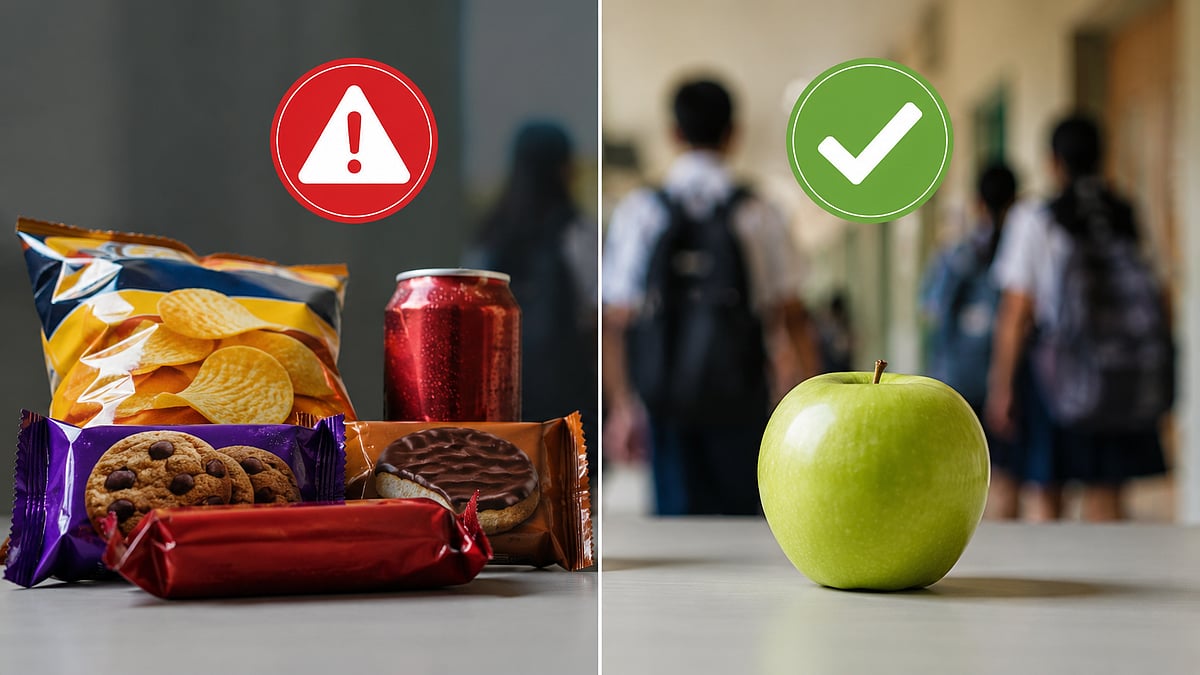
This week, Maharashtra's FDA Commissioner directed every school in the state, government, aided and private to ban chocolates, chips, and cold drinks from campuses entirely. The order cites widespread non-compliance with food safety rules that have existed since 2020. It is a meaningful step forward.
But it is only half the answer. And I have the data to show what the other half looks like.
What Banning Can't Do
Banning a product from a school canteen is a decision about supply; it controls what is physically available within school premises during school hours. The moment a student steps outside to the corner shop, the tuck shop, the supermarket on the weekend the same products are right there, with the same unlabelled, unwarned packaging.
The decision they make at that point is shaped almost entirely by what is printed on the front of the pack. And right now in India, that front is essentially a marketing surface, not a public health tool.
This is the gap I tried to address through my research.
What I Found
I recruited 120 teenagers from schools across Mumbai north, south, central, and western suburbs aged 13 to 18. I split them into four groups and gave each group a tablet showing two fictional biscuit brands side by side. One biscuit was the healthier option. The other was high in sugar, saturated fat, and sodium. The only thing that changed between the four groups was what appeared on the front of the pack.
Group one saw a Warning Label, a bold symbol flagging the unhealthy product, similar to the kind used in Chile. Group two saw Nutri-Score, the same A-to-E grade I first came across in Paris. Group three saw the Health Star Rating, a star system used in Australia. Group four got nothing on the front at all, just the standard back-of-pack nutrition table, which is how most Indian packaging works today.
With no front-of-pack label at all, only one in three teenagers chose the healthier biscuit.
Sit with that for a second. Given only the standard Indian nutrition table the current default two out of three teenagers picked the less healthy option. Not because they didn't care. Because the information wasn't built for how they actually make decisions.
Things improved with the star rating. They improved further with the warning label, and by a wide margin. Eight out of ten teenagers who saw a warning label chose the healthier biscuit. They also decided almost three times faster, about 8 seconds on average, compared to roughly 23 seconds in the group with no label at all. And when asked which product was actually healthier, the warning label group got it right far more consistently than any other group.
One label. Eight seconds. Eight out of ten teenagers chose the healthier option.
This is the missing half. Not a ban on what schools can sell, which is an extremely important first step but a signal on what every packet must say.
The Policy Gap That Remains
FDA Commissioner Tukaram Mundhe framed this week's objective clearly: "The larger objective is healthier students." That objective is exactly right. But a student is only on campus for part of their day. The food environment they navigate outside school operates entirely beyond the FDA's order.
That environment is governed by what FSSAI puts on the front of the packet. And FSSAI's regulations for foods high in fat, sugar, and salt remain unfinalised. India still has no mandatory front-of-pack warning system. The FDA can control the school canteen. It cannot control the label.
Almost all the research informing FSSAI's deliberations comes from studies done abroad, on adults. The adolescent-specific experimental evidence that should be part of that conversation barely existed in India until recently.
Revant Himatsingka, known as Food Pharmer, who runs the Label Padhega India movement for clearer food labelling, said of the findings: "It's very encouraging to see how our Label Padhega India movement has reached corners of the country, such that the youth of India are taking an interest in advocating for better front-of-pack labelling. While I have been educating Indians on reading nutrition labels, I also believe that we need a simple but informative front-of-pack labelling system. Aanya’s research and this paper is a big step for understanding how young Indians can make healthier choices in packaged food."
Dr. Shweta Khandelwal, Vice President at IPE Global and one of India's leading public health nutrition experts, put the evidence gap plainly: "For far too long, adolescents have been an afterthought in India's conversation around nutrition labelling. They are making more independent food choices than any previous generation of teenagers, but the policy frameworks developed to support them are based on evidence from adults. This study changes that equation. A 47 percentage point difference in healthy product choice between the warning label group and the control is not a small finding it is an indication that the design of the label is very important, and that India's FOPL policy must include how teenagers actually process information, considering that they are the future of India."
Chile was one of the first countries to introduce mandatory warning labels. Researchers there documented real reductions in purchases of high-sugar and high-fat products after the law took effect particularly among younger buyers. The school canteen ban and the warning label worked together. One controlled the supply. The other changed the choice. India has now taken the first step. The second is waiting. While the study doesn’t represent every teenager in India and restricts it to non English speaking students, it’s the first in it’s space and the results are promising for us to pilot this across more cities and more types of schools, are needed before anyone treats this as the basis for national policy.
As a secondary school student, I designed the experiment, built the testing interface, recruited the participants, and ran the statistical analysis.
We don't expect young people to have a say in the decisions that shape what they eat. We probably should start as the youth of India, asking the right questions that will shape our future. There is evidence after the protests that followed in the last week of July that when Gen Z asks the right questions we get the results and responses that we seek. This study is no different.
Maharashtra's FDA acted this week on the supply side. FSSAI's labelling decision is the demand side and it is still pending. I have already asked 120 Mumbai teenagers what actually works when they are standing in front of a packet, outside the school gate, making their own choice.
They told me clearly. A warning label. On the front. Now.
The author is a Grade 12 IB Diploma student at Dhirubhai Ambani International School, Mumbai. Her paper, "Comparing Front-of-Pack Labelling Systems to Improve Teenagers' Food Choices," is published in World Nutrition (Vol. 17, 2026) and is free to read at doi.org/10.26596/wn.2026172156-166

